English

English Medium Class 9 - CBSE Question Bank Solutions for Science

Advertisements
[object Object]
[object Object]
Subjects
Popular subjects
Topics
Advertisements
Advertisements
Science
< prev  2421 to 2440 of 3143  next > 

What are ultrasonic waves ? Name two animals which can produce ultrasonic waves.

[11] Sound
Chapter: [11] Sound
Concept: undefined >> undefined

The audible range of frequencies of an average human ear is from 20 Hz to 20 kHz. Calculate the corresponding wavelengths. (Speed of sound in air is 344 ms–1)

[11] Sound
Chapter: [11] Sound
Concept: undefined >> undefined

Advertisements

Three different vibrating objects produce three-types of sounds X, Y and Z. Sounds X and Y cannot be heard by a man having normal range of hearing but sound Z can be heard easily. The sound X is used in hospitals to break kidney stones of a patient into fine grains which then get flushed out with urine. The sound Y is similar to that which is produced during an earthquake before the main shock wave is generated.

(a) What type of sounds are (i) X (ii) Y, and (iii) Z ?
(b) Name one device which can produce sound like X.
(c) Name one device in a science laboratory which can produce sound like Y.
(d) Name one device in our homes which can produce sound like Z.
(e) What is the frequency range of sounds like Z ?

[11] Sound
Chapter: [11] Sound
Concept: undefined >> undefined

If 1.4 g of calcium oxide is formed by the complete decomposition of calcium carbonate, then the amount of calcium carbonate taken and the amount of carbon dioxide formed will be respectively :

[3] Atoms and Molecules
Chapter: [3] Atoms and Molecules
Concept: undefined >> undefined

One of the following can hear infrasound. This one is :

[11] Sound
Chapter: [11] Sound
Concept: undefined >> undefined

What is the physical state of water at 100°C.

[1] Matter in Our Surroundings
Chapter: [1] Matter in Our Surroundings
Concept: undefined >> undefined

During summer, water kept in an earthen pot becomes cool because of the phenomenon of

[1] Matter in Our Surroundings
Chapter: [1] Matter in Our Surroundings
Concept: undefined >> undefined

Choose the correct statement of the following

[1] Matter in Our Surroundings
Chapter: [1] Matter in Our Surroundings
Concept: undefined >> undefined

The boiling points of diethyl ether, acetone and n-butyl alcohol are 35°C, 56°C and 118°C respectively. Which one of the following correctly represents their boiling points in kelvin scale?

[1] Matter in Our Surroundings
Chapter: [1] Matter in Our Surroundings
Concept: undefined >> undefined

Which condition out of the following will increase the evaporation of water?

[1] Matter in Our Surroundings
Chapter: [1] Matter in Our Surroundings
Concept: undefined >> undefined

A sample of water under study was found to boil at 102°C at normal temperature and pressure. Is the water pure? Will this water freeze at 0°C? Comment.

[1] Matter in Our Surroundings
Chapter: [1] Matter in Our Surroundings
Concept: undefined >> undefined

Evaporation of a liquid at room temperature leads to a ____________ effect.

[1] Matter in Our Surroundings
Chapter: [1] Matter in Our Surroundings
Concept: undefined >> undefined

____________ is the change of solid state directly to vapour state without going through the ____________ state.

[1] Matter in Our Surroundings
Chapter: [1] Matter in Our Surroundings
Concept: undefined >> undefined

The phenomenon of change of a liquid into the gaseous state at any temperature below its boiling point is called ____________.

[1] Matter in Our Surroundings
Chapter: [1] Matter in Our Surroundings
Concept: undefined >> undefined

‘Osmosis is a special kind of diffusion’. Comment.

[2] Is Matter Around Us Pure
Chapter: [2] Is Matter Around Us Pure
Concept: undefined >> undefined

Alka was making tea in a kettle. Suddenly she felt intense heat from the puff of steam gushing out of the spout of the kettle. She wondered whether the temperature of the steam was higher than that of the water boiling in the kettle. Comment.

[1] Matter in Our Surroundings
Chapter: [1] Matter in Our Surroundings
Concept: undefined >> undefined

Conversion of solid to vapour is called sublimation. Name the term used to denote the conversion of vapour to solid.

[1] Matter in Our Surroundings
Chapter: [1] Matter in Our Surroundings
Concept: undefined >> undefined

Why does the temperature of a substance remain constant during its melting point or boiling point?

[1] Matter in Our Surroundings
Chapter: [1] Matter in Our Surroundings
Concept: undefined >> undefined

An atom with 3 protons and 4 neutrons will have a valency of

[4] Structure of the Atom
Chapter: [4] Structure of the Atom
Concept: undefined >> undefined

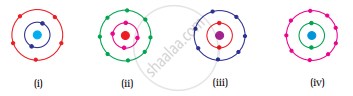
Which of the following in Fig. 4.2 do not represent Bohr’s model of an atom correctly?
[4] Structure of the Atom
Chapter: [4] Structure of the Atom
Concept: undefined >> undefined
< prev  2421 to 2440 of 3143  next > 
Advertisements
Share
Notifications

Englishहिंदीमराठी


      Forgot password?
Use app×