Advertisements
Advertisements
Factorise the following.
y2 + 4y – 21
Concept: undefined >> undefined
Factorise the following.
y2 – 2y – 15
Concept: undefined >> undefined
Advertisements
Factorise the following.
x2 – 10x + 21
Concept: undefined >> undefined
Factorise the following.
x2 – 17x + 60
Concept: undefined >> undefined
Factorise the following.
x2 + 4x – 77
Concept: undefined >> undefined
Factorise the following.
p2 – 13p – 30
Concept: undefined >> undefined
Factorise the following.
a2 – 16p – 80
Concept: undefined >> undefined
The curved surface area of a cylinder is 2π(y2 – 7y + 12) and its radius is (y – 3). Find the height of the cylinder (C.S.A. of cylinder = 2πrh).
Concept: undefined >> undefined
If x – y = 13 and xy = 28, then find x2 + y2.
Concept: undefined >> undefined
If m – n = 16 and m2 + n2 = 400, then find mn.
Concept: undefined >> undefined
Verify the following:
(a – b)(a – b)(a – b) = a3 – 3a2b + 3ab2 – b3
Concept: undefined >> undefined
Subtract b(b2 + b – 7) + 5 from 3b2 – 8 and find the value of expression obtained for b = – 3.
Concept: undefined >> undefined
If `x - 1/x = 7` then find the value of `x^2 + 1/x^2`.
Concept: undefined >> undefined
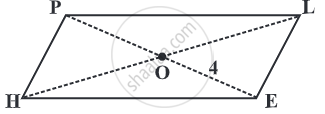
Concept: undefined >> undefined
If the diagonals of a quadrilateral bisect each other, it is a ______.
Concept: undefined >> undefined
If diagonals of a quadrilateral bisect each other, it must be a parallelogram.
Concept: undefined >> undefined
The point of intersection of diagonals of a quadrilateral divides one diagonal in the ratio 1:2. Can it be a parallelogram? Why or why not?
Concept: undefined >> undefined
Two sticks each of length 5 cm are crossing each other such that they bisect each other. What shape is formed by joining their endpoints? Give reason.
Concept: undefined >> undefined
Two sticks each of length 7 cm are crossing each other such that they bisect each other at right angles. What shape is formed by joining their end points? Give reason.
Concept: undefined >> undefined
a2 – b2 = (a + b) ______.
Concept: undefined >> undefined
