Advertisements
Advertisements
Which of the following phenomenon is applicable to the process shown in the figure?
Concept: undefined >> undefined
Common impurities present in bauxite are:
(i) \[\ce{CuO}\]
(ii) \[\ce{ZnO}\]
(iii) \[\ce{Fe2O3}\]
(iv) \[\ce{SiO2}\]
Concept: undefined >> undefined
Advertisements
Which of the following elements does not show allotropy?
Concept: undefined >> undefined
Which of the following is correct for P4 molecule of white phosphorus?
(i) It has 6 lone pairs of electrons.
(ii) It has six P–P single bonds.
(iii) It has three P–P single bonds.
(iv) It has four lone pairs of electrons.
Concept: undefined >> undefined
Which of the following statements are correct?
(i) All the three N – O bond lengths in \[\ce{HNO3}\] are equal.
(ii) All P – Cl bond lengths in \[\ce{PCl5}\] molecule in gaseous state are equal.
(iii) \[\ce{P4}\] molecule in white phosphorus have angular strain therefore white phosphorus is very reactive.
(iv) \[\ce{PCl}\] is ionic in solid state in which cation is tetrahedral and anion is octahedral.
Concept: undefined >> undefined
Phosphorus has three allotropic forms — (i) white phosphorus (ii) red phosphorus and (iii) black phosphorus. Write the difference between white and red phosphorus on the basis of their structure and reactivity.
Concept: undefined >> undefined
Identify the optically active compounds from the following:
(i) \[\ce{[Co(en)3]^{3+}}\]
(ii) \[\ce{[trans - [Co(en)2Cl2]^+}\]
(iii) \[\ce{cis - [Co(en)2Cl2]^+}\]
(iv) \[\ce{[Cr(NH3)5Cl]}\]
Concept: undefined >> undefined
Which of the following reactions will yield phenol?
| (i) |  |
| (ii) | 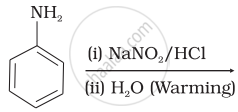 |
| (iii) | 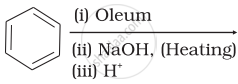 |
| (iv) |  |
Concept: undefined >> undefined
Name the starting material used in the industrial preparation of phenol.
Concept: undefined >> undefined
Which of the following is the correct representation for intermediate of nucleophilic addition reaction to the given carbonyl compound (A):
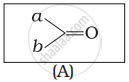
(i) 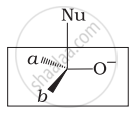
(ii) 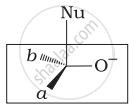
(iii) 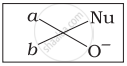
(iv) 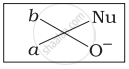
Concept: undefined >> undefined
Write a test to differentiate between pentan-2-one and pentan-3-one.
Concept: undefined >> undefined
Benzaldehyde can be obtained from benzal chloride. Write reactions for obtaining benzalchloride and then benzaldehyde from it.
Concept: undefined >> undefined
Alkenes  and carbonyl compounds
  , both contain a π bond but alkenes show electrophilic addition reactions whereas carbonyl compounds show nucleophilic addition reactions. Explain.
Concept: undefined >> undefined
Carboxylic acids contain carbonyl group but do not show the nucleophilic addition reaction like aldehydes or ketones. Why?
Concept: undefined >> undefined
Identify the compounds A, B and C in the following reaction.
\[\ce{CH3 - Br ->[Mg/ether] (A) ->[(i) CO][(ii) Water] (B) ->[CH3OH/H+][Δ] (C)}\]
Concept: undefined >> undefined
Which of the following should be most volatile?
Concept: undefined >> undefined
A compound Z with molecular formula \[\ce{C3H9N}\] reacts with \[\ce{C6H5SO2Cl}\] to give a solid, insoluble in alkali. Identify Z.
Concept: undefined >> undefined
Assertion: N-Ethylbenzene sulphonamide is soluble in alkali.
Reason: Hydrogen attached to nitrogen in sulphonamide is strongly acidic.
Concept: undefined >> undefined
Which of the following pairs represents anomers?
Concept: undefined >> undefined
Three structures are given below in which two glucose units are linked. Which of these linkages between glucose units are between C1 and C4 and which linkages are between C1 and C6?
| (I) |  |
| (II) |  |
| (III) |  |
Concept: undefined >> undefined
