English

Science (English Medium) Class 12 - CBSE Question Bank Solutions for Physics

Advertisements
Subjects
Topics
Subjects
Popular subjects
Topics
Advertisements
Advertisements
Physics
< prev  1121 to 1140 of 2719  next > 
An equipotential surface is that surface ______.
[2] Electrostatic Potential and Capacitance
Chapter: [2] Electrostatic Potential and Capacitance
Concept: undefined >> undefined
If a unit positive charge is taken from one point to another over an equipotential surface, then ______.
[2] Electrostatic Potential and Capacitance
Chapter: [2] Electrostatic Potential and Capacitance
Concept: undefined >> undefined

Advertisements
Which of the following statements is/are correct for equipotential surface?
  1. The potential at all the points on an equipotential surface is same.
  2. Equipotential surfaces never intersect each other.
  3. Work done in moving a charge from one point to other on an equipotential surface is zero.
[2] Electrostatic Potential and Capacitance
Chapter: [2] Electrostatic Potential and Capacitance
Concept: undefined >> undefined
Ampere’s circuital law states that ______.
[4] Moving Charges and Magnetism
Chapter: [4] Moving Charges and Magnetism
Concept: undefined >> undefined
Ampere’s circuital law is equivalent to ______.
[4] Moving Charges and Magnetism
Chapter: [4] Moving Charges and Magnetism
Concept: undefined >> undefined
The magnetic field around a long straight current carrying wire is ______.
[4] Moving Charges and Magnetism
Chapter: [4] Moving Charges and Magnetism
Concept: undefined >> undefined
A long solenoid has a radius a and number of turns per unit length n. If it carries a current i, then the magnetic field on its axis is directly proportional to ______.
[4] Moving Charges and Magnetism
Chapter: [4] Moving Charges and Magnetism
Concept: undefined >> undefined
Which of the following is the correct definition of ampere?
[4] Moving Charges and Magnetism
Chapter: [4] Moving Charges and Magnetism
Concept: undefined >> undefined

A wire of length 50 cm moves with a velocity of 300 m/min, perpendicular to a magnetic field. If the e.m.f. induced in the wire is 2 V, the magnitude of the field in tesla is ______.

[6] Electromagnetic Induction
Chapter: [6] Electromagnetic Induction
Concept: undefined >> undefined
A circular coil expands radially in a region of magnetic field and no electromotive force is produced in the coil This is because ______.
[6] Electromagnetic Induction
Chapter: [6] Electromagnetic Induction
Concept: undefined >> undefined

Equipotential surfaces ______.

[2] Electrostatic Potential and Capacitance
Chapter: [2] Electrostatic Potential and Capacitance
Concept: undefined >> undefined

Ampere’s circuital law is given by _______.

[4] Moving Charges and Magnetism
Chapter: [4] Moving Charges and Magnetism
Concept: undefined >> undefined

Two identical current carrying coaxial loops, carry current I in opposite sense. A simple amperian loop passes through both of them once. Calling the loop as C, then which statement is correct?

[4] Moving Charges and Magnetism
Chapter: [4] Moving Charges and Magnetism
Concept: undefined >> undefined

Which of the following is NOT the property of equipotential surface?

[2] Electrostatic Potential and Capacitance
Chapter: [2] Electrostatic Potential and Capacitance
Concept: undefined >> undefined

The emf induced across the ends of a conductor due to its motion in a magnetic field is called motional emf. It is produced due to magnetic Lorentz force acting on the free electrons of the conductor. For a circuit shown in the figure, if a conductor of length l moves with velocity v in a magnetic field B perpendicular to both its length and the direction of the magnetic field, then all the induced parameters are possible in the circuit.
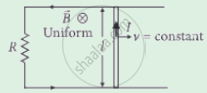
Direction of current induced in a wire moving in a magnetic field is found using ______.

[6] Electromagnetic Induction
Chapter: [6] Electromagnetic Induction
Concept: undefined >> undefined

The emf induced across the ends of a conductor due to its motion in a magnetic field is called motional emf. It is produced due to magnetic Lorentz force acting on the free electrons of the conductor. For a circuit shown in the figure, if a conductor of length l moves with velocity v in a magnetic field B perpendicular to both its length and the direction of the magnetic field, then all the induced parameters are possible in the circuit.
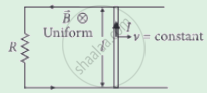
A conducting rod of length l is moving in a transverse magnetic field of strength B with velocity v. The resistance of the rod is R. The current in the rod is ______.

[6] Electromagnetic Induction
Chapter: [6] Electromagnetic Induction
Concept: undefined >> undefined

The emf induced across the ends of a conductor due to its motion in a magnetic field is called motional emf. It is produced due to magnetic Lorentz force acting on the free electrons of the conductor. For a circuit shown in the figure, if a conductor of length l moves with velocity v in a magnetic field B perpendicular to both its length and the direction of the magnetic field, then all the induced parameters are possible in the circuit.
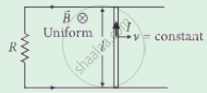
A 0.1 m long conductor carrying a current of 50 A is held perpendicular to a magnetic field of 1.25 mT. The mechanical power required to move the conductor with a speed of 1 ms-1 is ______.

[6] Electromagnetic Induction
Chapter: [6] Electromagnetic Induction
Concept: undefined >> undefined

The emf induced across the ends of a conductor due to its motion in a magnetic field is called motional emf. It is produced due to magnetic Lorentz force acting on the free electrons of the conductor. For a circuit shown in the figure, if a conductor of length l moves with velocity v in a magnetic field B perpendicular to both its length and the direction of the magnetic field, then all the induced parameters are possible in the circuit.
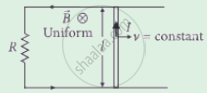
A bicycle generator creates 1.5 V at 15 km/hr. The EMF generated at 10 km/hr is ______.

[6] Electromagnetic Induction
Chapter: [6] Electromagnetic Induction
Concept: undefined >> undefined

Consider two different hydrogen atoms. The electron in each atom is in an excited state. Is it possible for the electrons to have different energies but same orbital angular momentum according to the Bohr model? Justify your answer.

[12] Atoms
Chapter: [12] Atoms
Concept: undefined >> undefined

Derive an expression for the frequency of radiation emitted when a hydrogen atom de-excites from level n to level (n – 1). Also show that for large values of n, this frequency equals to classical frequency of revolution of an electron.

[12] Atoms
Chapter: [12] Atoms
Concept: undefined >> undefined
< prev  1121 to 1140 of 2719  next > 
Advertisements
Advertisements
CBSE Science (English Medium) Class 12 Question Bank Solutions
Question Bank Solutions for CBSE Science (English Medium) Class 12 Biology
Question Bank Solutions for CBSE Science (English Medium) Class 12 Chemistry
Question Bank Solutions for CBSE Science (English Medium) Class 12 Computer Science (C++)
Question Bank Solutions for CBSE Science (English Medium) Class 12 Computer Science (Python)
Question Bank Solutions for CBSE Science (English Medium) Class 12 English Core
Question Bank Solutions for CBSE Science (English Medium) Class 12 English Elective - NCERT
Question Bank Solutions for CBSE Science (English Medium) Class 12 Entrepreneurship
Question Bank Solutions for CBSE Science (English Medium) Class 12 Geography
Question Bank Solutions for CBSE Science (English Medium) Class 12 Hindi (Core)
Question Bank Solutions for CBSE Science (English Medium) Class 12 Hindi (Elective)
Question Bank Solutions for CBSE Science (English Medium) Class 12 History
Question Bank Solutions for CBSE Science (English Medium) Class 12 Informatics Practices
Question Bank Solutions for CBSE Science (English Medium) Class 12 Mathematics
Question Bank Solutions for CBSE Science (English Medium) Class 12 Physical Education
Question Bank Solutions for CBSE Science (English Medium) Class 12 Physics
Question Bank Solutions for CBSE Science (English Medium) Class 12 Political Science
Question Bank Solutions for CBSE Science (English Medium) Class 12 Psychology
Question Bank Solutions for CBSE Science (English Medium) Class 12 Sanskrit (Core)
Question Bank Solutions for CBSE Science (English Medium) Class 12 Sanskrit (Elective)
Question Bank Solutions for CBSE Science (English Medium) Class 12 Sociology
Share
Notifications

Englishहिंदीमराठी


      Forgot password?
Use app×