Advertisements
Advertisements
Use the mirror equation to show that a convex mirror always produces a virtual image independent of the location of the object.
Concept: undefined >> undefined
Use the mirror equation to deduce that the virtual image produced by a convex mirror is always diminished in size and is located between the focus and the pole.
Concept: undefined >> undefined
Advertisements
Use the mirror equation to deduce that an object placed between the pole and focus of a concave mirror produces a virtual and enlarged image.
Concept: undefined >> undefined
Using mirror formula, explain why does a convex mirror always produce a virtual image.
Concept: undefined >> undefined
Use the mirror equation to show that an object placed between f and 2f of a concave mirror forms an image beyond 2f.
Concept: undefined >> undefined
Draw the intensity distribution for the diffraction bands produced due to single slit ?
Concept: undefined >> undefined
Define the term 'limit of resolution'?
Concept: undefined >> undefined
Two wavelengths of sodium light 590 nm and 596 nm are used, in turn to study the diffraction taking place at a single slit of aperture 2 × 10⁻⁴m. The distance between the slit and the screen is 1.5 m. Calculate the separation between the positions of the first maxima of the diffraction pattern obtained in the two cases.
Concept: undefined >> undefined
Two wavelengths of sodium light 590 nm and 596 nm are used, in turn, to study the diffraction taking place due to a single slit of aperture 1 × 10⁻⁴ m. The distance between the slit and the screen is 1.8 m. Calculate the separation between the positions of the first maxima of the diffraction pattern obtained in the two cases.
Concept: undefined >> undefined
Use the mirror equation to show a convex mirror always produces a virtual image independent of the location of the object ?
Concept: undefined >> undefined
Can a plane mirror ever form a real image?
Concept: undefined >> undefined
A point source of light is placed in front of a plane mirror.
Concept: undefined >> undefined
following Figure shows two rays A and B being reflected by a mirror and going as A' and B'. The mirror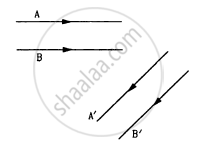
Concept: undefined >> undefined
The rays of different colours fail to converge at a point after going through a converging lens. This defect is called
Concept: undefined >> undefined
Mark the correct options.
Concept: undefined >> undefined
Which of the following (referred to a spherical mirror) do (does) not depend on whether the rays are paraxial or not?
(a) Pole
(b) Focus
(c) Radius of curvature
(d) Principal axis
Concept: undefined >> undefined
A light ray falling at an angle of 45° with the surface of a clean slab of ice of thickness 1.00 m is refracted into it at an angle of 30°. Calculate the time taken by the light rays to cross the slab. Speed of light in vacuum = 3 × 10⁸ m s−1.
Concept: undefined >> undefined
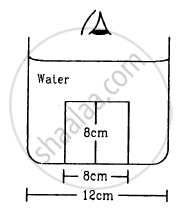
A cylindrical vessel of diameter 12 cm contains 800π cm3 of water. A cylindrical glass piece of diameter 8.0 cm and height 8.0 cm is placed in the vessel. If the bottom of the vessel under the glass piece is seen by the paraxial rays (see figure), locate its image. The index of refraction of glass is 1.50 and that of water is 1.33.
Concept: undefined >> undefined
A small object is placed at the centre of the bottom of a cylindrical vessel of radius 3 cm and height 4 cm filled completely with water. Consider the ray leaving the vessel through a corner. Suppose this ray and the ray along the axis of the vessel are used to trace the image. Find the apparent depth of the image and the ratio of real depth to the apparent depth under the assumptions taken. Refractive index of water = 1.33.
Concept: undefined >> undefined
A light ray is incident at an angle of 45° with the normal to a √2 cm thick plate (μ = 2.0). Find the shift in the path of the light as it emerges out from the plate.
Concept: undefined >> undefined
