Advertisements
Advertisements
Concept: undefined >> undefined
Two spherical conductors each of capacity C are charged to potential V and -V. These are then connected by means of a fine wire. The loss of energy is ______.
Concept: undefined >> undefined
Advertisements
A constant voltage is applied between the two ends of a uniform metallic wire, heat ‘H’ is developed in it. If another wire of the same material, double the radius and twice the length as compared to the original wire is used then the heat developed in it will be -
Concept: undefined >> undefined
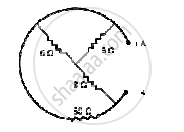
The equivalent resistance between A and B is ____________.
Concept: undefined >> undefined
The gyro-magnetic ratio of an electron in an H-atom, according to Bohr model, is ______.
- independent of which orbit it is in.
- negative.
- positive.
- increases with the quantum number n.
Concept: undefined >> undefined
An electron and a positron are released from (0, 0, 0) and (0, 0, 1.5R ) respectively, in a uniform magnetic field B = B0î, each with an equal momentum of magnitude p = e BR. Under what conditions on the direction of momentum will the orbits be non-intersecting circles?
Concept: undefined >> undefined
An electron with angular momentum L moving around the nucleus has a magnetic moment given by ______.
Concept: undefined >> undefined
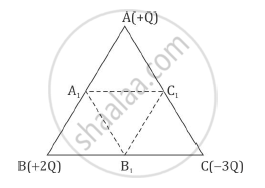
Three point charges, + Q + 2Q and – 3Q are placed at the vertices of an equilateral triangle ABC of side l. If these charges are displaced to the mid-point A1, B1 and C1, respectively, find the amount of the work done in shifting the charges to the new locations.
Concept: undefined >> undefined
Write the relation between the velocity of propagation and the magnitudes of electric and magnetic fields.
Concept: undefined >> undefined
In a hydrogen atom, the electron and proton are bound at a distance of about 0.53 Å:
(a) Estimate the potential energy of the system in eV, taking the zero of the potential energy at infinite separation of the electron from proton.
(b) What is the minimum work required to free the electron, given that its kinetic energy in the orbit is half the magnitude of potential energy obtained in (a)?
(c) What are the answers to (a) and (b) above if the zero of potential energy is taken at 1.06 Å separation?
Concept: undefined >> undefined
A small test charge is released at rest at a point in an electrostatic field configuration. Will it travel along the field line passing through that point?
Concept: undefined >> undefined
What is the work done by the field of a nucleus in a complete circular orbit of the electron? What if the orbit is elliptical?
Concept: undefined >> undefined
We know that electric field is discontinuous across the surface of a charged conductor. Is electric potential also discontinuous there?
Concept: undefined >> undefined
Guess a possible reason why water has a much greater dielectric constant (= 80) than say, mica (= 6).
Concept: undefined >> undefined
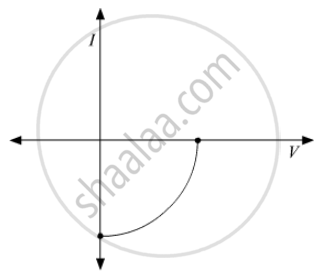
Name the junction diode whose I-V characteristics are drawn below:
Concept: undefined >> undefined
How does the path followed by the charge get affected if its velocity has a component parallel to \[\vec{B}\] .
Concept: undefined >> undefined
Velocity of light in glass is 2 × 10⁸ m/s and in air is 3 × 10⁸ m/s. If the ray of light passes from glass to air, calculate the value of critical angle.
Concept: undefined >> undefined
Three point charges +q each are kept at the vertices of an equilateral triangle of side 'l'. Determine the magnitude and sign of the charge to be kept at its centroid so that the charges at the vertices remain in equilibrium.
Concept: undefined >> undefined
Why must electrostatic field be normal to the surface at every point of a charged conductor?
Concept: undefined >> undefined
Suppose a charged particle moves with a velocity v near a wire carrying an electric current. So, a magnetic force acts on it. If the same particle is seen from a frame moving with velocity v in the same direction, the charge will be found to be at rest. Will the magnetic force become zero in this frame? Will the magnetic field become zero in this frame?
Concept: undefined >> undefined
