Please select a subject first
Advertisements
Advertisements
What is the effect of adding a catalyst on Activation energy (Ea)
Concept: undefined >> undefined
What type of isomerism is shown by the complex [Co(NH3)5(SCN)]2+?
Concept: undefined >> undefined
Advertisements
The cell in which the following reaction occurs:
`2Fe^(3+) (aq) + 2I^(-) (aq) ---> 2Fe^(2+) (aq) + I_2 (s)` has `E_"cell"^@` = 0.236 V at 298 K. Calculate the standard Gibbs energy of the cell reaction. (Given : 1 F = 96,500 C mol−1)
Concept: undefined >> undefined
A first-order reaction is 50% completed in 40 minutes at 300 K and in 20 minutes at 320 K. Calculate the activation energy of the reaction. (Given : log 2 = 0·3010, log 4 = 0·6021, R = 8·314 JK–1 mol–1)
Concept: undefined >> undefined
What type of isomerism is exhibited by the complex [Co(NH3)5Cl]SO4?
Concept: undefined >> undefined
Write the structures of the main products of the following reactions:

Concept: undefined >> undefined
Write the structures of the main products of the following reactions:

Concept: undefined >> undefined
Write the structures of the main products of the following reactions:

Concept: undefined >> undefined
Predict the products of the following reactions :
Concept: undefined >> undefined
Predict the products of the following reactions :
Concept: undefined >> undefined
A first order reaction takes 10 minutes for 25% decomposition. Calculate t1/2 for the reaction.
(Given : log 2 = 0.3010, log 3 = 0.4771, log 4 = 0.6021)
Concept: undefined >> undefined
Show that the time required for 99% completion is double of the time required for the completion of 90% reaction.
Concept: undefined >> undefined
Write the IUPAC name of the complex [Cr(NH3)4Cl2]+. What type of isomerism does it exhibit?
Concept: undefined >> undefined
Explain the following terms :
Half life period of a reaction (t1/2)
Concept: undefined >> undefined
Following reaction takes place in the cell:
`Zn(s) + Ag_2O(s)+H_2O(l) -> Zn^{2+}(aq) + 2Ag (s) + 2OH^- (aq)`
Calculate `Delta_r G^0` of the reaction
[Given ; `E^0_(Zn^{2+}//Zn)` = -0.76V
`E_((Zn^{2+}//Zn)) = 0.76V`
`E_(Ag^4//Ag)^0 = 0.80V, 1F = 96,500 C mol^-1 ]`
Concept: undefined >> undefined
Define the following terms with a suitable example of each:
Bactericidal antibiotics
Concept: undefined >> undefined
The decomposition of a hydrocarbon has value of rate constant as 2.5×10⁴s-1 At 27° what temperature would rate constant be 7.5×104 × 3 s-1if energy of activation is 19.147 × 10³ J mol-1 ?
Concept: undefined >> undefined
Write a condition under which a bimolecular reaction is kinetically first order. Give an example of such a reaction. (Given : log2 = 0.3010,log 3 = 0.4771, log5 = 0.6990).
Concept: undefined >> undefined
Predict the main product of the following reactions: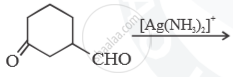
Concept: undefined >> undefined
Predict the main product of the following reaction:\[\begin{array}{c}
\ce{O\phantom{----}O\phantom{-}}\\
\ce{||\phantom{----}||\phantom{-}}\\
\ce{CH3-C-CH2-C-OCH3}
\end{array}\ce{->[(i)NaBH4][(ii)H+]}\]
Concept: undefined >> undefined
