Please select a subject first
Advertisements
Advertisements
Choose the incorrect statement about communalism.
Concept: undefined >> undefined
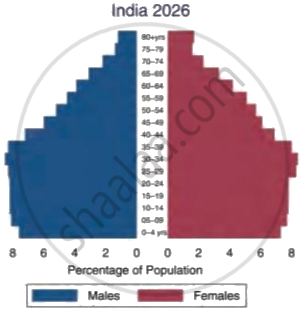
When does the bottom of a population pyramid become narrow?
Concept: undefined >> undefined
Advertisements
Which kind of society is depicted in this pyramid?
Concept: undefined >> undefined
This pyramid does not indicate which of the following?
Concept: undefined >> undefined
| The present study…deals with a Muslim biradri (community) called the Multani Lohars. ... Karkhanedar is a vernacular term used for a person engaged in the business of manufacturing of which he is generally the owner…The karkhanas under study operate in domestic conditions and, therefore, have certain pervasive effects on the life of the karkhanedars who work in them. …The following case illustrates this. Mahmood, aged forty years, was living with his two younger brothers, one of whom was married. He had three children and was the head of the complex household. …All the three brothers were employed in various karkhanas and factories as skilled workers. Mahmood successfully fabricated replica of a motor part the import of which had been banned. This greatly encouraged him to start his own karkhana…Later it was decided that two karkhanas should be set up to manufacture the motor part. One was to be owned by the two elder brothers, and the other by the youngest, provided he set up a separate household. Rasheed set up an independent household, consisting of his wife and unmarried children. Therefore, one complex household, comprising three married brothers, gave birth to a simple household as a result of new entrepreneurial opportunities. Excerpted from S.M. Akram Rizvi, ‘Kinship and Industry among the Muslim Karkhanedars in Delhi’, in Imtiaz Ahmad, ed. Family, Kinship and Marriage among Muslims in India, New Delhi, Manohar, 1976, pp. 27- 48. |
The given case states that the family type is:
Concept: undefined >> undefined
| The present study…deals with a Muslim biradri (community) called the Multani Lohars. ... Karkhanedar is a vernacular term used for a person engaged in the business of manufacturing of which he is generally the owner…The karkhanas under study operate in domestic conditions and, therefore, have certain pervasive effects on the life of the karkhanedars who work in them. …The following case illustrates this. Mahmood, aged forty years, was living with his two younger brothers, one of whom was married. He had three children and was the head of the complex household. …All the three brothers were employed in various karkhanas and factories as skilled workers. Mahmood successfully fabricated replica of a motor part the import of which had been banned. This greatly encouraged him to start his own karkhana…Later it was decided that two karkhanas should be set up to manufacture the motor part. One was to be owned by the two elder brothers, and the other by the youngest, provided he set up a separate household. Rasheed set up an independent household, consisting of his wife and unmarried children. Therefore, one complex household, comprising three married brothers, gave birth to a simple household as a result of new entrepreneurial opportunities. Excerpted from S.M. Akram Rizvi, ‘Kinship and Industry among the Muslim Karkhanedars in Delhi’, in Imtiaz Ahmad, ed. Family, Kinship and Marriage among Muslims in India, New Delhi, Manohar, 1976, pp. 27- 48. |
Along with family structures, which of the following has not undergone a change?
Concept: undefined >> undefined
| The present study…deals with a Muslim biradri (community) called the Multani Lohars. ... Karkhanedar is a vernacular term used for a person engaged in the business of manufacturing of which he is generally the owner…The karkhanas under study operate in domestic conditions and, therefore, have certain pervasive effects on the life of the karkhanedars who work in them. …The following case illustrates this. Mahmood, aged forty years, was living with his two younger brothers, one of whom was married. He had three children and was the head of the complex household. …All the three brothers were employed in various karkhanas and factories as skilled workers. Mahmood successfully fabricated replica of a motor part the import of which had been banned. This greatly encouraged him to start his own karkhana…Later it was decided that two karkhanas should be set up to manufacture the motor part. One was to be owned by the two elder brothers, and the other by the youngest, provided he set up a separate household. Rasheed set up an independent household, consisting of his wife and unmarried children. Therefore, one complex household, comprising three married brothers, gave birth to a simple household as a result of new entrepreneurial opportunities. Excerpted from S.M. Akram Rizvi, ‘Kinship and Industry among the Muslim Karkhanedars in Delhi’, in Imtiaz Ahmad, ed. Family, Kinship and Marriage among Muslims in India, New Delhi, Manohar, 1976, pp. 27- 48. |
As per the given passage, a complex household implies which of the following?
Concept: undefined >> undefined
| Another set of complications is created by the tension between the Indian state’s simultaneous commitment to secularism as well as the protection of minorities. The protection of minorities requires that they be given special consideration in a context where the normal working of the political system places them at a disadvantage vis-à-vis the majority community. But providing such protection immediately invites the accusation of favouritism or ‘appeasement’ of minorities. Opponents argue that secularism of this sort is only an excuse to favour the minorities in return for their votes or other kinds of support. Supporters argue that without such special protection, secularism can turn into an excuse for imposing the majority community’s values and norms on the minorities. |
As per the given passage, which of the following is true for India?
Concept: undefined >> undefined
| Another set of complications is created by the tension between the Indian state’s simultaneous commitment to secularism as well as the protection of minorities. The protection of minorities requires that they be given special consideration in a context where the normal working of the political system places them at a disadvantage vis-à-vis the majority community. But providing such protection immediately invites the accusation of favouritism or ‘appeasement’ of minorities. Opponents argue that secularism of this sort is only an excuse to favour the minorities in return for their votes or other kinds of support. Supporters argue that without such special protection, secularism can turn into an excuse for imposing the majority community’s values and norms on the minorities. |
The complication mentioned in the passage is not due to:
Concept: undefined >> undefined
| Another set of complications is created by the tension between the Indian state’s simultaneous commitment to secularism as well as the protection of minorities. The protection of minorities requires that they be given special consideration in a context where the normal working of the political system places them at a disadvantage vis-à-vis the majority community. But providing such protection immediately invites the accusation of favouritism or ‘appeasement’ of minorities. Opponents argue that secularism of this sort is only an excuse to favour the minorities in return for their votes or other kinds of support. Supporters argue that without such special protection, secularism can turn into an excuse for imposing the majority community’s values and norms on the minorities. |
Which of the following does not convey the meaning of secularisation?
Concept: undefined >> undefined
A small IT firm in India is developing a computer programme for a big company in England. Identify the most suitable term to refer this phenomenon.
Concept: undefined >> undefined
The positive impact of successes – such as the achievement of statehood for Jharkhand and Chattisgarh after a long struggle – is moderated by continuing problems. Many of the states of the North-East, for example, have been living for decades under special laws that limit the civil liberties of citizens. Thus, citizens of states like Manipur or Nagaland don’t have the same rights as other citizens of India because their states have been declared as disturbed areas’.
States like Jharkhand and Chattisgarh are examples of a federal structure of India. Mark the statement as true or false.
Concept: undefined >> undefined
The positive impact of successes – such as the achievement of statehood for Jharkhand and Chattisgarh after a long struggle – is moderated by continuing problems. Many of the states of the North-East, for example, have been living for decades under special laws that limit the civil liberties of citizens. Thus, citizens of states like Manipur or Nagaland don’t have the same rights as other citizens of India because their states have been declared as disturbed areas.
Mark the statement as true or false. Tribals have to use their own resources illegally today.
Concept: undefined >> undefined
The positive impact of successes – such as the achievement of statehood for Jharkhand and Chattisgarh after a long struggle – is moderated by continuing problems. Many of the states of the North-East, for example, have been living for decades under special laws that limit the civil liberties of citizens. Thus, citizens of states like Manipur or Nagaland don’t have the same rights as other citizens of India because their states have been declared as disturbed areas.
Which larger structures make the tribals powerless?
Concept: undefined >> undefined
Kumudtai’s journey into Sanskrit began with great interest and eagerness with Gokhale Guruji, her teacher at school…At the University, the Head of the Department was a well-known scholar and he took great pleasure in taunting Kumudtai…Despite the adverse comments she successfully completed her Masters in Sanskrit…. Source: Kumud Pawade (1938)
Read the source and answer the following question.
Do you think sanskritisation is a gendered process? Give a reason for your answer.
Concept: undefined >> undefined
Agricultural productivity increased sharply because of the new technology. India was able to become self-sufficient in food grain production for the first time in decades. It was primarily the medium and large farmers who were able to benefit from the new technology.
What is subsistence agriculture?
Concept: undefined >> undefined
Often it is thought that imparting knowledge of 'scientific' farming methods will improve the condition of Indian farmers. Is this statement true? Give one reason for your answer.
Concept: undefined >> undefined
What are the social consequences of the long working hours in the IT sector?
Concept: undefined >> undefined
Agricultural productivity increased sharply because of the new technology. India was able to become self-sufficient in food grain production for the first time in decades. It was primarily the medium and large farmers who were able to benefit from the new technology.
Who were able to reap the most benefits from Green Revolution and commercialisation of agriculture?
Concept: undefined >> undefined
The Right to Information campaign is an example of ______.
Concept: undefined >> undefined
