Advertisements
Advertisements
Concept: undefined >> undefined
Concept: undefined >> undefined
Advertisements
Concept: undefined >> undefined
Concept: undefined >> undefined
Concept: undefined >> undefined
Concept: undefined >> undefined
Concept: undefined >> undefined
Concept: undefined >> undefined
Which of the following property shows the property of ferromagnetic substances?
Concept: undefined >> undefined
Two identical bar magnets are fixed with their centres at a distance d apart. A stationary charge Q is placed at P in between the gap of the two magnets at a distance D from the centre O as shown in the figure. The force on the charge Q is ______.
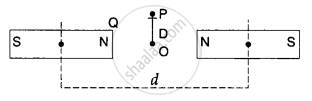
Concept: undefined >> undefined
A transformer works on the principle of ______.
Concept: undefined >> undefined
For an ideal step-down transformer, the quantity which is constant for both the coils is ______.
Concept: undefined >> undefined
Which among the following, is not a cause for power loss in a transformer?
Concept: undefined >> undefined
An air-cored solenoid with length 30 cm, area of cross-section 25 cm2 and number of turns 800, carries a current of 2.5 A. The current is suddenly switched off in a brief time of 10-3s. Ignoring the variation in magnetic field near the ends of the solenoid, the average back emf induced across the ends of the open switch in the circuit would be ______.
Concept: undefined >> undefined
If both the number of turns and core length of an inductor is doubled keeping other factors constant, then its self-inductance will be ______.
Concept: undefined >> undefined
Read the following paragraph and answer the question:

Long distance power transmissions
The large-scale transmission and distribution of electrical energy over long distances is done with the use of transformers. The voltage output of the generator is stepped up. It is then transmitted over long distances to an area sub-station near the consumers. There the voltage is stepped down. It is further stepped down at distributing sub-stations and utility poles before a power supply of 240 V reaches our homes.
Which of the following statement is true?
Concept: undefined >> undefined
Read the following paragraph and answer the question:
Long distance power transmissions
The large-scale transmission and distribution of electrical energy over long distances is done with the use of transformers. The voltage output of the generator is stepped up. It is then transmitted over long distances to an area sub-station near the consumers. There the voltage is stepped down. It is further stepped down at distributing sub-stations and utility poles before a power supply of 240 V reaches our homes.
If the secondary coil has a greater number of turns than the primary, ______.
Concept: undefined >> undefined
Read the following paragraph and answer the question:
Long distance power transmissions
The large-scale transmission and distribution of electrical energy over long distances is done with the use of transformers. The voltage output of the generator is stepped up. It is then transmitted over long distances to an area sub-station near the consumers. There the voltage is stepped down. It is further stepped down at distributing sub-stations and utility poles before a power supply of 240 V reaches our homes.
We need to step-up the voltage for power transmission, so that ______.
Concept: undefined >> undefined
Read the following paragraph and answer the question:
Long distance power transmissions
The large-scale transmission and distribution of electrical energy over long distances is done with the use of transformers. The voltage output of the generator is stepped up. It is then transmitted over long distances to an area sub-station near the consumers. There the voltage is stepped down. It is further stepped down at distributing sub-stations and utility poles before a power supply of 240 V reaches our homes.
A power transmission line feeds input power at 2300 V to a step down transformer with its primary windings having 4000 turns. The number of turns in the secondary in order to get output power at 230 V are ______.
Concept: undefined >> undefined
A transformer is essentially an a.c. device. It cannot work on d.c. It changes alternating voltages or currents. It does not affect the frequency of a.c. It is based on the phenomenon of mutual induction. A transformer essentially consists of two coils of insulated copper wire having different numbers of turns and wound on the same soft iron core.
The number of turns in the primary and secondary coils of an ideal transformer is 2000 and 50 respectively. The primary coil is connected to a main supply of 120 V and secondary coil is connected to a bulb of resistance 0.6 Ω.
The value of voltage across the secondary coil is ______.
Concept: undefined >> undefined
