Please select a subject first
Advertisements
Advertisements
On what issue the villagers related to the Chipko movement protested?
Concept: undefined >> undefined
What was the main demand of the Chipko Movement?
Concept: undefined >> undefined
Advertisements
Which of these statements are incorrect regarding The Chipko Movement.
Concept: undefined >> undefined
Chipko Movement started in which of the following states?
Concept: undefined >> undefined
In which year agreement took place between Sheikh Abdullah and Prime Minister Indira Gandhi?
Concept: undefined >> undefined
Who was the leader of the Naga National Council?
Concept: undefined >> undefined
The first democratic election to Sikkim assembly in 1974 was swept by the:
Concept: undefined >> undefined
Which students group led the anti-foreigner movement in Assam?
Concept: undefined >> undefined
Which of the following statements is correct regarding ‘section Interest groups’?
Concept: undefined >> undefined
Which one of the political parties came to power in 2006?
Concept: undefined >> undefined
The single largest party in the 1996 parliamentary elections was ______
Concept: undefined >> undefined
On the question of diversity which approach is adopted by India?
Concept: undefined >> undefined
Prime Minister Rajiv Gandhi was assassinated in the year ______
Concept: undefined >> undefined
Which party pursued the politics of ‘Hindutva’ and adopted the strategy of mobilizing the Hindus?
Concept: undefined >> undefined
Observe the figure below and answer accordingly.
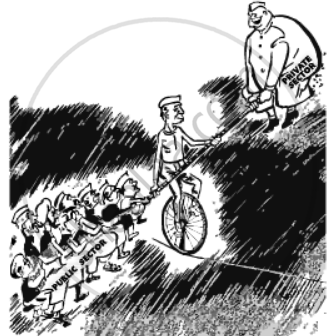
Who in the picture is balancing between the public and private sectors?
Concept: undefined >> undefined
Observe the figure below and answer accordingly.
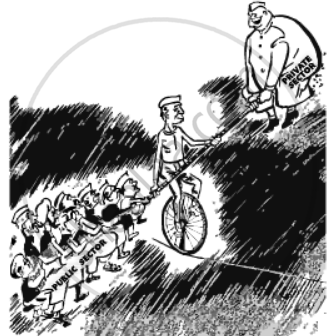
Why has a big tilt towards the public sector been shown in the cartoon?
Concept: undefined >> undefined
Observe the figure below and answer accordingly.
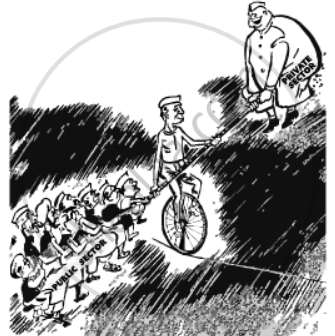
Which type of economic model was adopted by India?
Concept: undefined >> undefined
Study the following diagram and answer accordingly.

What message does this cartoon give to the international community?
Concept: undefined >> undefined
Read the following passage and answer accordingly.
Economist Jeffrey Sachs is widely associated with shock therapy. He developed a plan of shock therapy for post-communist Poland in 1990, for post-communist Russia in 1992, and several other countries, including Bolivia and Chile.
Bolivia, in particular, in 1985, had success as a result of shock therapy in ending a period of hyperinflation.
Poland also initially seemed to benefit from shock therapy as inflation was controlled, but it saw a sharp rise in unemployment that peaked at 16.9%.
Sachs did not like the term shock therapy, which he said was coined by the media and made the reform process sound more painful than it was.
In Russia, neo-liberal shock therapy did not produce favourable outcomes. Shock therapy was applied swiftly and in large scale, as opposed to how it was applied to other nations.
Almost all of Russia’s industries were undervalued and sold to private individuals and companies, with most acquired by a few Russian oligarchs.
With limited government intervention, most industries disappeared. The Russian currency declined, causing high inflation and the erosion of most citizens’ savings. Unemployment increased drastically, and government subsidies were removed, further pushing Russian families into poverty.
Which country benefited from Shock therapy in 1985?
Concept: undefined >> undefined
