Please select a subject first
Advertisements
Advertisements
Who left the Congress party and founded Bharatiya Kranti Dal in 1967?
Concept: undefined >> undefined
The Prime Minister of India during 1977-79 was:
Concept: undefined >> undefined
Advertisements
Mandal Commission was set up for the issue of ____________.
Concept: undefined >> undefined
Who led the Narmada Bachao Andolan?
Concept: undefined >> undefined
Congress was defeated in the Lok Sabha Elections of:
Concept: undefined >> undefined
Which of these groups promotes collective rather than selective goods?
Concept: undefined >> undefined
The Sardar Sarovar Dam is on the ______ river.
Concept: undefined >> undefined
Who headed the central government in India after the 1998 parliamentary elections?
Concept: undefined >> undefined
In which year, Sikkim becomes a part of India.
Concept: undefined >> undefined
Why do you think India is now considered as an important centre of power?
Concept: undefined >> undefined
Discuss the impact of the relationship between the Judiciary and the Executive during emergency period in India.
Concept: undefined >> undefined
‘Some of the most significant responses to the challenge of environmental degradation have come from the environmental movements’. Justify the statement with special reference to movements against the extraction of earth and against mega-dams.
Concept: undefined >> undefined
In the given outline political map of India, four states have been marked as (A), (B), (C) and (D). Identify these states on the basis of the information given below and write their correct names in your answer book along with the respective serial numbers of the information used and the concerned alphabets as per the format that follows:
- The state where a coalition led by the CPI formed the government in the year 1957.
- The state is related to leader Shyama Prasad Mukherjee.
- The state is related to Karpuri Thakur, which implemented reservations for the backward class.
- The state is related to K. Kamraj, who started the Mid Day Meal program for school students.
| Sr. Number for the information used | Alphabet Concerned | Name of the states |
| (i) | ______ | ______ |
| (ii) | ______ | ______ |
| (iii) | ______ | ______ |
| (iv) | ______ | ______ |

Concept: undefined >> undefined
In the given political outline map of India, four countries/states have been marked as A, B, C and D. Identify these on the basis of the information given below and write their correct names in your answer book along with their respective serial number of the information used and the concerned alphabet as per format that follows:
- The country with which India fought a battle in 1962.
- The country with which India has a dispute.
- The country which came into existence after the 1971 war.
- The Indian state which shares its border with China.
| S.No. of the Information used |
Concerned Alphabet in the map |
Name of the Countries/States |
| (i) | ||
| (ii) | ||
| (iii) | ||
| (iv) |
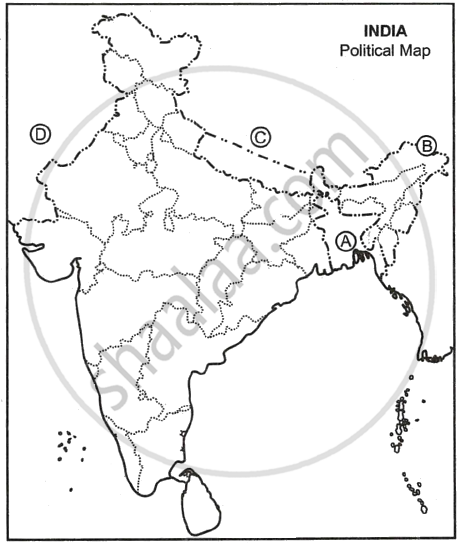
Concept: undefined >> undefined
Highlight any three factors which were responsible for the downfall of the Congress Party in the 1977 elections.
Concept: undefined >> undefined
“The ‘Arab Spring’ was the people’s revolution against injustice.” Support the statement with any two examples.
Concept: undefined >> undefined
Why was Operation desert storm fought against Iraq?
Concept: undefined >> undefined
Differentiate between the capitalist and the socialist models of development.
Concept: undefined >> undefined
Why did the superpowers need smaller states as their allies? Explain any four reasons.
Concept: undefined >> undefined
Why is it said that history of petroleum is also the history of war and struggles?
Concept: undefined >> undefined
