Advertisements
Advertisements
Four cylinders contain equal number of moles of argon, hydrogen, nitrogen and carbon dioxide at the same temperature. The energy is minimum in
Concept: undefined >> undefined
Show that the internal energy of the air (treated as an ideal gas) contained in a room remains constant as the temperature changes between day and night. Assume that the atmospheric pressure around remains constant and the air in the room maintains this pressure by communicating with the surrounding through the windows, doors, etc.
Use R = 8.314 J K-1 mol-1
Concept: undefined >> undefined
Advertisements
A metal block of heat capacity 80 J°C−1 placed in a room at 20°C is heated electrically. The heater is switched off when the temperature reaches 30°C. The temperature of the block rises at the rate of 2°C s−1 just after the heater is switched on and falls at the rate of 0.2°C s−1 just after the heater is switched off. Assume Newton's law of cooling to hold.
- Find the power of the heater.
- Find the power radiated by the block just after the heater is switched off.
- Find the power radiated by the block when the temperature of the block is 25°C.
- Assuming that the power radiated at 25°C represents the average value in the heating process, find the time for which the heater was kept on.
Concept: undefined >> undefined
State the law of equipartition of energy and hence calculate the molar specific heat of mono-atomic and di-atomic gases at constant volume and constant pressure.
Concept: undefined >> undefined
If universal gas constant is 8.3 joule/mole-Kand the Avogadro's number is 6 x 10²³, then mean kinetic energy of the oxygen molecules at 427 °C will be ______.
Concept: undefined >> undefined
Answer the following question based on the P-T phase diagram of carbon dioxide:
At what temperature and pressure can the solid, liquid and vapour phases of CO2 co-exist in equilibrium?
Concept: undefined >> undefined
Answer the following question based on the P-T phase diagram of carbon dioxide:
What is the effect of decrease of pressure on the fusion and boiling point of CO2?
Concept: undefined >> undefined
Answer the following question based on the P-T phase diagram of carbon dioxide:
What are the critical temperature and pressure for CO2? What is their significance?
Concept: undefined >> undefined
Which of the following ratios express pressure?
- Force/Area
- Energy/Volume
- Energy/Area
- Force/ Volume
Concept: undefined >> undefined
There are three forces F1, F2 and F3 acting on a body, all acting on a point P on the body. The body is found to move with uniform speed.
- Show that the forces are coplanar.
- Show that the torque acting on the body about any point due to these three forces is zero.
Concept: undefined >> undefined
Figure shows (vx, t) and (vy, t) diagrams for a body of unit mass. Find the force as a function of time.
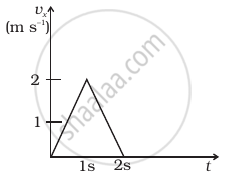 (a) |
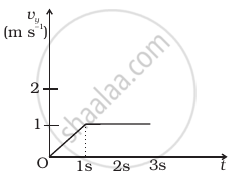 (b) |
Concept: undefined >> undefined
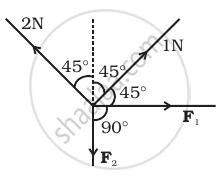
There are four forces acting at a point P produced by strings as shown in the figure, which is at rest. Find the forces F1 and F2.
Concept: undefined >> undefined
A body is falling freely under the action of gravity alone in vacuum. Which of the following quantities remain constant during the fall?
Concept: undefined >> undefined
Two inclined frictionless tracks, one gradual and the other steep meet at A from where two stones are allowed to slide down from rest, one on each track as shown in figure.
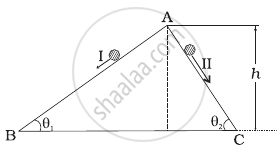
Which of the following statement is correct?
Concept: undefined >> undefined
Which of the diagrams shown in figure represents variation of total mechanical energy of a pendulum oscillating in air as function of time?
Concept: undefined >> undefined
A mass of 5 kg is moving along a circular path of radius 1 m. If the mass moves with 300 revolutions per minute, its kinetic energy would be ______.
Concept: undefined >> undefined
In a shotput event an athlete throws the shotput of mass 10 kg with an initial speed of 1 ms–1 at 45° from a height 1.5 m above ground. Assuming air resistance to be negligible and acceleration due to gravity to be 10 ms–2, the kinetic energy of the shotput when it just reaches the ground will be ______.
Concept: undefined >> undefined
Why is electrical power required at all when the elevator is descending? Why should there be a limit on the number of passengers in this case?
Concept: undefined >> undefined
A body falls towards earth in air. Will its total mechanical energy be conserved during the fall? Justify.
Concept: undefined >> undefined
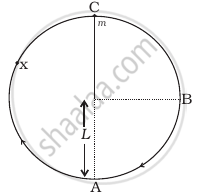
A bob of mass m suspended by a light string of length L is whirled into a vertical circle as shown in figure. What will be the trajectory of the particle if the string is cut at
- Point B?
- Point C?
- Point X?
Concept: undefined >> undefined
