Advertisements
Advertisements
Arrange the following set of compounds in the order of their decreasing relative reactivity with an electrophile. Give reason.

Concept: undefined >> undefined
The relative reactivity of 1°, 2°, 3° hydrogen’s towards chlorination is 1 : 3.8 : 5. Calculate the percentages of all monochlorinated products obtained from 2-methylbutane.
Concept: undefined >> undefined
Advertisements
The bromine atom possesses 35 electrons. It contains 6 electrons in 2p orbital, 6 electrons in 3p orbital and 5 electrons in 4p orbital. Which of these electron experiences the lowest effective nuclear charge?
Concept: undefined >> undefined
Among the following pairs of orbitals which orbital will experience the larger effective nuclear charge?
- 2s and 3s,
- 4d and 4f,
- 3d and 3p
Concept: undefined >> undefined
A reaction, A + B → C + D + q is found to have a positive entropy change. The reaction will be ______.
Concept: undefined >> undefined
For the reaction, \[\ce{2Cl_{(g)} → Cl_{2(g)}}\], what are the signs of ΔH and ΔS?
Concept: undefined >> undefined
What are the necessary conditions for any system to be aromatic?
Concept: undefined >> undefined
Explain why the following system is not aromatic?

Concept: undefined >> undefined
Explain why the following system is not aromatic?

Concept: undefined >> undefined
Explain why the following system is not aromatic?

Concept: undefined >> undefined
The ionization constant of propanoic acid is 1.32 × 10⁻⁵. Calculate the degree of ionization of the acid in its 0.05M solution and also its pH. What will be its degree of ionization if the solution is 0.01M in HCl also?
Concept: undefined >> undefined
One mole of any substance contains 6.022 × 10²³ atoms/molecules. Number of molecules of \[\ce{H2SO4}\] present in 100 mL of 0.02 M \[\ce{H2SO4}\] solution is ______.
Concept: undefined >> undefined
Which of the following statements about a compound is incorrect?
Concept: undefined >> undefined
16 g of oxygen has same number of molecules as in:
(i) \[\ce{16 g of CO}\]
(ii) \[\ce{28 g of N2}\]
(iii) \[\ce{14 g of N2}\]
(iv) \[\ce{1.0 g of H2}\]
Concept: undefined >> undefined
The entropy change can be calculated by using the expression ∆S = `q_(rev)/T`. When water freezes in a glass beaker, choose the correct statement amongst the following :
Concept: undefined >> undefined
The spontaneity means, having the potential to proceed without the assistance of external agency. The processes which occur spontaneously are:
(i) Flow of heat from colder to warmer body.
(ii) Gas in a container contracting into one corner.
(iii) Gas expanding to fill the available volume.
(iv) Burning carbon in oxygen to give carbon dioxide.
Concept: undefined >> undefined
Enthalpy diagram for a particular reaction is given in figure. Is it possible to decide spontaneity of a reaction from given diagram. Explain.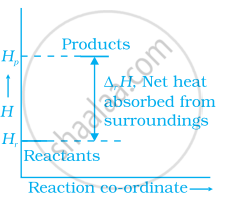
Concept: undefined >> undefined
Match the following processes with entropy change:
| Reaction | Entropy change |
| (i) A liquid vapourises | (a) ∆S = 0 |
| (ii) Reaction is non-spontaneous at all temperatures and ∆H is positive |
(b) ∆S = positive |
| (iii) Reversible expansion of an ideal gas | (c) ∆S = negative |
Concept: undefined >> undefined
Assertion (A): A liquid crystallises into a solid and is accompanied by decrease in entropy.
Reason (R): In crystals, molecules organise in an ordered manner.
Concept: undefined >> undefined
Four structures are given in options (i) to (iv). Examine them and select the aromatic structures.
| (i) |  |
| (ii) |  |
| (iii) |  |
| (iv) |  |
Concept: undefined >> undefined
