Please select a subject first
Advertisements
Advertisements
The variation of quantity A with quantity B, plotted in figure describes the motion of a particle in a straight line.
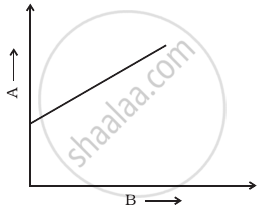
- Quantity B may represent time.
- Quantity A is velocity if motion is uniform.
- Quantity A is displacement if motion is uniform.
- Quantity A is velocity if motion is uniformly accelerated.
Concept: undefined >> undefined
A person of mass 50 kg stands on a weighing scale on a lift. If the lift is descending with a downward acceleration of 9 ms–2, what would be the reading of the weighing scale? (g = 10 ms–2)
Concept: undefined >> undefined
Advertisements
Calculate the power of a crane in watts, which lifts a mass of 100 kg to a height of 10 m in 20s.
Concept: undefined >> undefined
The average work done by a human heart while it beats once is 0.5 J. Calculate the power used by heart if it beats 72 times in a minute.
Concept: undefined >> undefined
A stone of mass m is tied to an elastic string of negligble mass and spring constant k. The unstretched length of the string is L and has negligible mass. The other end of the string is fixed to a nail at a point P. Initially the stone is at the same level as the point P. The stone is dropped vertically from point P.
- Find the distance y from the top when the mass comes to rest for an instant, for the first time.
- What is the maximum velocity attained by the stone in this drop?
- What shall be the nature of the motion after the stone has reached its lowest point?
Concept: undefined >> undefined
The angle of contact at the interface of water-glass is 0°, Ethylalcohol-glass is 0°, Mercury-glass is 140° and Methyliodide-glass is 30°. A glass capillary is put in a trough containing one of these four liquids. It is observed that the meniscus is convex. The liquid in the trough is ______.
Concept: undefined >> undefined
For a surface molecule ______.
- the net force on it is zero.
- there is a net downward force.
- the potential energy is less than that of a molecule inside.
- the potential energy is more than that of a molecule inside.
Concept: undefined >> undefined
Is surface tension a vector?
Concept: undefined >> undefined
The sap in trees, which consists mainly of water in summer, rises in a system of capillaries of radius r = 2.5 × 10⁻⁵ m. The surface tension of sap is T = 7.28 × 10⁻² Nm–1 and the angle of contact is 0°. Does surface tension alone account for the supply of water to the top of all trees?
Concept: undefined >> undefined
The free surface of oil in a tanker, at rest, is horizontal. If the tanker starts accelerating the free surface will be titled by an angle θ. If the acceleration is a ms–2, what will be the slope of the free surface?
Concept: undefined >> undefined
Two mercury droplets of radii 0.1 cm. and 0.2 cm. collapse into one single drop. What amount of energy is released? The surface tension of mercury T = 435.5 × 10⁻³ Nm–1.
Concept: undefined >> undefined
Two mercury droplets of radii 0.1 cm. and 0.2 cm. collapse into one single drop. What amount of energy is released? The surface tension of mercury T = 435.5 × 10⁻³ Nm–1.
Concept: undefined >> undefined
If a drop of liquid breaks into smaller droplets, it results in lowering of temperature of the droplets. Let a drop of radius R, break into N small droplets each of radius r. Estimate the drop in temperature.
Concept: undefined >> undefined
The sufrace tension and vapour pressure of water at 20°C is 7.28 × 10⁻² Nm–1 and 2.33 × 10³ Pa, respectively. What is the radius of the smallest spherical water droplet which can form without evaporating at 20°C?
Concept: undefined >> undefined
This model of the atmosphere works for relatively small distances. Identify the underlying assumption that limits the model.
Concept: undefined >> undefined
Surface tension is exhibited by liquids due to force of attraction between molecules of the liquid. The surface tension decreases with increase in temperature and vanishes at boiling point. Given that the latent heat of vaporisation for water Lv = 540 k cal kg–1, the mechanical equivalent of heat J = 4.2 J cal–1, density of water ρw = 103 kg l–1, Avagadro’s No NA = 6.0 × 1026 k mole–1 and the molecular weight of water MA = 18 kg for 1 k mole.
- Estimate the energy required for one molecule of water to evaporate.
- Show that the inter–molecular distance for water is `d = [M_A/N_A xx 1/ρ_w]^(1/3)` and find its value.
- 1 g of water in the vapor state at 1 atm occupies 1601 cm3. Estimate the intermolecular distance at boiling point, in the vapour state.
- During vaporisation a molecule overcomes a force F, assumed constant, to go from an inter-molecular distance d to d ′. Estimate the value of F.
- Calculate F/d, which is a measure of the surface tension.
Concept: undefined >> undefined
A hot air balloon is a sphere of radius 8 m. The air inside is at a temperature of 60°C. How large a mass can the balloon lift when the outside temperature is 20°C? (Assume air is an ideal gas, R = 8.314 J mole–1K–1, 1 atm. = 1.013 × 10⁵ Pa; the membrane tension is 5 Nm–1.)
Concept: undefined >> undefined
Change in temperature of the medium changes ______.
Concept: undefined >> undefined
As you have learnt in the text, a geostationary satellite orbits the earth at a height of nearly 36,000 km from the surface of the earth. What is the potential due to earth’s gravity at the site of this satellite? (Take the potential energy at infinity to be zero). Mass of the earth = 6.0 × 1024 kg, radius = 6400 km
Concept: undefined >> undefined
The rate of change of total momentum of a many-particle system is proportional to the ______ on the system.
Concept: undefined >> undefined
