Advertisements
Advertisements
Read the source given below and answer the questions that follow:
|
Maharashtra is a state located in western India, with a population of over 110 million people. The state is home to several large cities, including Mumbai, and has a significant agricultural sector. However, the state is facing a severe water crisis, with its water resources coming under increasing pressure due to climate change, industrialization, and urbanization. The main challenges faced by water resource management in Maharashtra are:
|
- Mention any one reasons for the water crisis faced by the state of Maharashtra.
- Propose any one solution to mitigate the water crisis faced by Maharashtra state.
- Despite being the second highest rainfall-receiving state of the country, Maharashtra still faces water crisis. Substantiate this statement in 40 words.
Concept: undefined >> undefined
Read the source given below and answer the questions that follow:
|
For comparing countries, their income is considered to be one of the most important attributes. Countries with higher incomes are more developed than others with less income. This is based on the understanding that more income means more of all things that human beings need. Whatever people like, and should have, they will be able to get with greater income. So, greater income itself is considered to be one important goal. Now, what is the income of a country? Intuitively, the income of the country is the income of all the residents of the country. This gives us the total income of the country. However, for comparison between countries, total income is not such a useful measure. Since, countries have different populations, comparing total income will not tell us what an average person is likely to earn. Are people in one country better off than others in a different country? Hence, we compare the average income which is the total income of the country divided by its total population. The average income is also called per capita income. In World Development Reports, brought out by the World Bank, this criterion is used in classifying countries. Countries with per capita income of US \[\ce{$}\]49,300 per annum and above in 2019, are called high-income or rich countries and those with per capita income of US \[\ce{$}\]2500 or less are called low-income countries. The rich countries, excluding countries of the Middle East and certain other small countries are generally called developed countries.
|
Concept: undefined >> undefined
Advertisements
Read the given case and answer the questions that follow:
|
Mahatma Gandhi's thoughts on Satyagraha 'It is said of "passive resistance" that it is the weapon of the weak, but the power which is the subject of this article can be used only by the strong. This power is not passive resistance; indeed it calls for intense activity. The movement in South Africa was not passive but active ....' 'Satyagraha is not a physical force. A satyagrahi does not inflict pain on the adversary, he does not seek his destrudion ... In the use of satyagraha, there is no ill-will whatever.' 'Satyagraha is pure soul-force. Truth is the very substance of the soul. That's why this force is called satyagraha. The soul is informed with knowledge. In it burns the flame of love ... Non-violence is the supreme dharma.' 'It is certain that India cannot rival Britain or Europe in force of arms. The British worship the war god and they can all become, bearers of arms. The hundreds of millions in India can never carry arms. They have made the religion of non-violence their own....' |
- What type of movement Gandhiji organised in South Africa?
- Why is satyagraha considered as pure soul- force?
- How has Gandhiji described passive resistance?
Concept: undefined >> undefined
In which one of the following institutions in India was a system of reservation for women made by amending the Constitution In 1992?
Concept: undefined >> undefined
Read the arguments given the favour of power sharing and choose the correct option.
- Reduce the likelihood of bias.
- Barricades the decision-making process
- Accommodates diversities
- Increases the participation of people in power
Concept: undefined >> undefined
Which one of the following statements best describes the meaning of 'Globalisation'?
Concept: undefined >> undefined
Describe any three features of commercial farming.
Concept: undefined >> undefined
“Foreign trade results in connecting the markets in different countries.” Support the statement in the context of globalisation.
Concept: undefined >> undefined
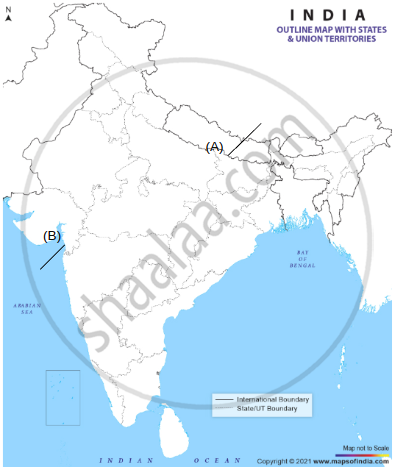
(a) Two places, 'A' and 'B', have been marked on the given political outline map of India. Identify them with the help of the following information and write their correct names on the lines drawn near them:
- The place where Gandhiji started Satyagraha for indigo peasants. (1)
- The place where Gandhiji broke the Salt Law. (1)
(b) On the same political outline map of India, locate and label any three of the following with suitable symbols: (3)
- Naharkatiya - Oil field
- Talcher - Major Coal Mines
- Narora - Atomic Power Plant
- Tuticorin - Major Sea Port
Concept: undefined >> undefined
Read the given text and answer the following questions:
| ‘It is said of “passive resistance” that it is the weapon of the weak, but the power which is the subject of this article can be used only by the strong. This power is not passive resistance; indeed, it calls for intense activity. The movement in South Africa was not passive but active … ‘Satyagraha is not physical force. A satyagrahi does not inflict pain on the adversary; he does not seek his destruction … In the use of satyagraha, there is no ill-will whatever. ‘Satyagraha is pure soul-force. Truth is the very substance of the soul. That is why this force is called satyagraha. The soul is informed with knowledge. In it burns the flame of love. … Nonviolence is the supreme dharma …‘It is certain that India cannot rival Britain or Europe in force of arms. The British worship the war-god and they can all of them become, as they are becoming, bearers of arms. The hundreds of millions in India can never carry arms. They have made the religion of non-violence their own ...’ |
- Why did Gandhiji consider nonviolence as supreme dharma?
- How was Gandhian satyagraha taken by the people who believed in his philosophy?
- Why was Gandhian satyagraha considered as a novel way to resist injustice?
Concept: undefined >> undefined
Suppose your parents want to purchase gold jewellery along with you, then which logo will you look for on the jewellery?
Concept: undefined >> undefined
Why has the ‘National Manufacturing Competitiveness Council’ been set up?
Concept: undefined >> undefined
What is the meaning of concentration camps?
Concept: undefined >> undefined
Explain with the example how you can use the right to seek redressal.
Concept: undefined >> undefined
How do banks play an important role in the economy of India? Explain.
Concept: undefined >> undefined
Which one of the following laws was enacted by the Government of India in October 2005?
(A) The Right to Property Act
(B) The Right to Education Act
(C) The Consumer Protection Act
(D) The Right to Information Act
Concept: undefined >> undefined
Which one of the following is the certification maintained for standardisation of electrical goods?
(A) ISO
(B) ISI
(C) Hallmark
(D) Agmark
Concept: undefined >> undefined
How do democracies accommodate various social divisions? Explain with examples
Concept: undefined >> undefined
If any damage is done to a consumer by a trader, under which consumer right one can move to consumer court to get compensation?
Concept: undefined >> undefined
Who was proclaimed the King of United Italy in 1861?
Concept: undefined >> undefined
