Please select a subject first
Advertisements
Advertisements
How do social divisions affect politics? Give two examples.
Concept: undefined >> undefined
State different forms of communal politics with one example each.
Concept: undefined >> undefined
Advertisements
State different forms of communal politics with one example each.
Concept: undefined >> undefined
Consider the following statements on the meaning of communal politics. Communal politics is based on the belief that:
Α. One religion is superior to that of others.
Β. People belonging to different religions can live together happily as equal citizens.
C. Followers of a particular religion constitute one community.
D. State power cannot be used to establish the domination of one religious group over others.
Which of the statements is/are correct?
Concept: undefined >> undefined
Consider the following statements on the meaning of communal politics. Communal politics is based on the belief that:
Α. One religion is superior to that of others.
Β. People belonging to different religions can live together happily as equal citizens.
C. Followers of a particular religion constitute one community.
D. State power cannot be used to establish the domination of one religious group over others.
Which of the statements is/are correct?
Concept: undefined >> undefined
Among the following, which country suffered disintegration due to political fights on the basis of religious and ethnic identities?
Concept: undefined >> undefined
Organisations that undertake activities to promote the interests of specific social sections such as workers, employees, teachers, and lawyers are called _____________ groups.
Concept: undefined >> undefined
Answer the following question in one sentence.
What is a political party?
Concept: undefined >> undefined
What are the characteristics of a political party?
Concept: undefined >> undefined
What is the guiding philosophy of the Bharatiya Janata Party?
Concept: undefined >> undefined
Development of a country can generally be determined by
Concept: undefined >> undefined
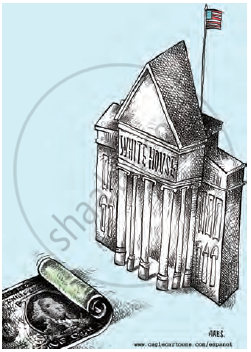
This cartoon represents a challenge to democracy. Please describe what that challenge is. Also place it in one of the three categories mentioned below.
- foundational challenge to democracy
- challenge of expansion of democracy
- challenge of deepening of democracy

Concept: undefined >> undefined
This cartoon represents a challenge to democracy. Please describe what that challenge is. Also place it in one of the three categories mentioned below.
- foundational challenge to democracy
- challenge of expansion of democracy
- challenge of deepening of democracy

Concept: undefined >> undefined
Assume there are four families in a country. The average per capita income of these families is Rs 5000. If the income of three families is Rs 4000, Rs 7000 and Rs 3000 respectively, what is the income of the fourth family?
Concept: undefined >> undefined
This cartoon represents a challenge to democracy. Please describe what that challenge is. Also place it in one of the three categories mentioned below.
- foundational challenge to democracy
- challenge of expansion of democracy
- challenge of deepening of democracy

Concept: undefined >> undefined
This cartoon represents a challenge to democracy. Please describe what that challenge is. Also place it in one of the three categories mentioned below.
- foundational challenge to democracy
- challenge of expansion of democracy
- challenge of deepening of democracy
Concept: undefined >> undefined
Why do we use averages? Are there any limitations to their use? Illustrate with your own examples related to development.
Concept: undefined >> undefined
Kerala, with lower per capita income, has a better human development ranking than Punjab. Hence, per capita income is not a useful criterion at all and should not be used to compare states. Do you agree? Discuss.
Concept: undefined >> undefined
Write a description of the challenges for democracy in the following situations.
|
Case and Context
|
Your description of the challenges for democracy in that situation |
|
Chile: General Pinochet's government was defeated, but military was still in control of many institutions. |
|
|
Poland: After the first success of solidarity, the government imposed martial law and banned solidarity. |
|
|
Ghana: Just attained independence, Nkrumah elected the President.
|
|
|
Mynamar: Suu Kyi under house arrest for more than 15 years, army rulers getting global acceptance.
|
|
|
International Organisations: US as the only superpower disregards the UN and takes unilateral action. |
|
|
Mexico: Second free election after the defeat of PRI in 2000; defeated candidates alleges rigging. |
|
|
China: The Communist party adopts economic reforms but maintains a monopoly over political power. |
|
|
Pakistan: General Musharraf holds referendum, allegations of fraud in the voter's list. |
|
|
Iraq: Widespread sectarian violence as the new government fails to establish its authority. |
|
|
South Africa: Mandela retires from active politics; pressure on his successor Mbeki to withdraw some concessions given to the white minority. |
|
|
US, Guantanamo Bay: UN Secretary General calls this a violation of international law; US refused to respond. |
|
|
Saudi Arabia: Women were not allowed to take part in public activities, no freedom of religion for the minority. |
|
|
Yugoslavia: Ethnic tension between Serbs and Albanians on the rise in the province of Kosovo; Yugoslavia disintegrated. |
|
|
Belgium: One round of constitutional change taken place, but the Dutch speakers not satisfied; they want more autonomy. |
|
|
Sri Lanka: Peace talks between the government and LTTE breaks down, renewed violence. |
|
|
US, Civil Rights: Blacks have won equal rights, but they are still poor, less educated and marginalised. |
|
|
Northern Ireland: The civil war has ended but Catholics and Protestants yet to develop trust. |
|
|
Nepal: Constituent Assembly about to be elected; unrest in Taraiareas; Maoists have not surrendered arms. |
|
|
Bolivia: Morales, a supporter of water struggle, becomes the Prime Minister, MNC's threaten to leave the country. |
Concept: undefined >> undefined
Given below are some spheres or sites of democratic politics. You may place against each of these the specific challenges that you noted for one or more countries or cartoons in the previous section. In addition to that write one item for India for each of these spheres. In case you find that some challenges do not fit into any of the categories given below, you can create new categories and put some items under that.
|
Constitutional design |
|
|
Democratic rights |
|
|
Working of institutions |
|
|
Elections |
|
|
Federalism, decentralization |
|
|
Accommodation of diversity |
|
|
Political Organisation |
|
|
Religious and equality |
Concept: undefined >> undefined
