Advertisements
Advertisements
Read the following passage carefully and do the given activities:
A.1) True or False:
Write the statements and state whether they are true or false:
(i) Those who choose to live well must help others.
(ii) If neighbors grow inferior corn, cross-pollination will steadily improve the quality.
(iii) The farmer grew award-winning corn.
(iv) The reporter discovered that the farmer didn’t share his seed corn with his neighbors.
There once was a farmer who grew award-winning corn. Each year he entered his corn in the state fair where it won a blue ribbon. One year a newspaper reporter interviewed him and learned something interesting about how he grew it. The reporter discovered that the farmer shared his sweet corn with his neighbors. “How can you afford to share your best seed corn with your neighbors when they are entering corn in competition with yours each year?” the reporter asked.
“Why sir”, said the farmer, “didn’t you know? The wind picks up pollen from the ripening corn and swirls it from field to field. If my neighbors grow inferior corn, cross-pollination will steadily degrade the quality of my corn. If I am to grow good corn, I must help my neighbors grow good corn.” He is very much aware of the connectedness of life. His corn cannot improve unless his neighbor's corn also improves. So it is with our lives. Those who choose to live in peace must help their neighbors to live in peace. Those who choose to live well must help others to live well, for the value of a life is measured by the lives it touches.
The lesson for each of us is this: if we are to grow good corn, we must help our neighbors grow good corn.
A.2) Consequences:
Write the consequences:
(i) The farmer shares the corn.
(ii) The farmer doesn’t share the corn.
A.3) Antonyms:
Find out the words opposite in meaning from the passage:
(i) superior x _______
(ii) lost x _______
(iii) improve x _______
(iv) inconstantly x _______
A.4) Language study:
(i) We must help our neighbors. (Replace the modal auxiliary showing advice).
(ii) The wind picks up pollen from ripening corn and swirls it field to field. (Use “not only…….. but also” and rewrite)
A.5) Personal Response:
What do you learn from the story? Suggest a suitable title.
Concept: Reading Skills
Read the following passage and do the given activities:
B.1) Comparison
Write the comparison between the parts of the modular phone and the human body:
| Modular Phone | Parts of Human Body |
Every phone you buy, no matter how costly and latest it is, will go out of date in a year or so. That’s how quickly the smartphone world is moving right now. To keep yourself up to date with the current specification you will have to keep switching phones every once a while. What’s the solution to this problem?
MODULAR PHONES!
A modular device is a phone, tablet or another device where individual components such as the screen, camera, CPU, battery, memory can be removed by the user and replaced by others with a different specification. Imagine your body to be your phone and your clothes as the components, you can wear anything according to your needs and moods. Similarly, modular phones let you choose between components of different properties and specifications.
This would mean we’ll have the liberty to customize our phones, just like Lego building blocks! The main components of the phone will be Brain (processor), Spine (frame, screen) and Heart (battery). The other components may include a camera, storage memory, GPS, audio jack, speakers, USB module, etc. and the phone will have a motherboard, i.e. a base that will hold all components together
B.2) Give examples:
Write two examples that give the liberty to customize our phone.
• ____________________
• ____________________
B.3) Framing sentence:
Use the given phrases in sentences of your own:
(i) up to date
(ii) once a while
B.4) Write as instructed:
Rewrite the sentence as interrogative:
(i) We’ll have the liberty to customize our phones.
(ii) We will have the liberty to customize our phones. (Rewrite using the present participle form of the underlined word)
B.5) Personal Response
If given a chance to design a modular phone, what new features would you add?
Concept: Reading Skills
Complete the call-outs:
A.1)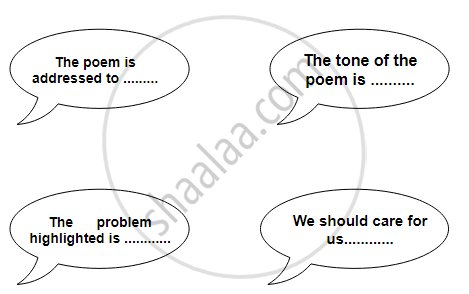
Our world is an institution
Of environmental pollution
We choose not to care
For our future generations
And I for one am guilty
For buying the hundreds of electronic gadgets
That attracts the industries to produce like maggots
environmental pollution is at the heart of our planet
The forests are dying
Wildlife is crying
Millions of fish are dying
Mother earth is sighing
Tell me is it right
That we sleep well at night
Replenishing ourselves
For tomorrow’s greedy fight
Overcrowded trains
Overloaded brains
Where is the light? What is our plight?
While the river break their banks
And greedy industries play their polluted pranks.
A.2) Find the examples that show that we do not care for our future generation
A.3) Match:
Match the lines in Column ‘A’ with the figures of speech in Column ‘B’:
| Column ‘A’ | Column ‘B’ | ||
| (i) | Our world is an institution | (a) | Personification |
| (ii) | Mother earth is sighing | (b) | Simile |
| (c) | Metaphor |
Concept: Reading Skills
Read the following extract and do the given activities:
B.1) Fill in the Balloons with suitable ideas from the poem:
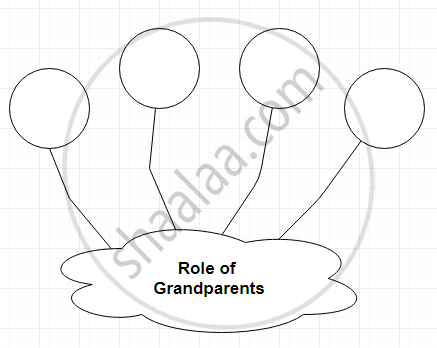 “Oh, the value of the elderly! How could anyone not know?
They hold so many keys, so many things they can show.
We all will read the other side this I firmly believe
And the elderly are closest oh what clues we could retrieve.
For their characters are closest to how we’ll be on high.
They are the ones most developed, you can see it if you try.
They’ve let go of the frivolous and kept things that are dear
The memories of so sweet, of loved ones that were near.
As a nation, we are missing our greatest true resource,
To get to know our elders and let them guide our course.”
B.2) Find Evidence:
Pick out the line from the extract which supports the given ideas:
(i) The elders have many things to share.
(ii) Everybody knows the value of elderly people.
(iii) The elderly people have vast experience.
(iv) The elderly people are a boon to the nation.
B.3) Write a pair from the extract that rhymes with the given word:
| Fear | ........................... | .......................... |
Concept: Reading Skills
Read the following passage and do the given activities:
A.1) True or False
State whether the following statements are true or false:
(i) The patient stirred and looked about in cheerful anticipation
(ii) The patient’s wife wanted to know the truth …………
The lady went away to the kitchen. She felt restless. She felt she must know the truth whatever it was. Why was the great man so evasive? The suspense was unbearable. Perhaps he could not speak so near the patient’s bed. She beckoned to him from the kitchen doorway.
The doctor rose and went over. She asked, “What about him now? How is he?” The doctor bit his lips and replied, looking at the floor, “Don’t get excited. Unless you must know about it, don’t ask now.” Her eyes opened wide in terror. She clasped her hands together and implored, “Tell me the truth.” The doctor replied, “I would rather not talk to you now.” He turned around and went back to his chair. terrible wailing shot through the still house; the patient stirred and looked about in bewilderment. The doctor got up again, went over to the kitchen door, drew it in securely and shut off the wail.
A.2) Give reasons for the following:
(i) Her eyes opened wide in terror.
(ii) The lady went away to the kitchen.
A.3) How, according to you, should the nature of the doctor be?
Concept: Reading Skills
A. Read the following passage and do the given activities:
A1. List the benefits of Yoga (02)
- ______
- ______
- ______
- ______
We give undue importance to our health and the treatment of diseases. A large number of medicines treat only the symptoms of the disease, and not the root cause. In fact, the cause of many chronic ailments is still being researched. It is here that Yoga therapy comes to our assistance. Yoga emphasizes the treatment of the root cause of an ailment. It works in a slow, subtle and miraculous manner. Modern medicine can claim to save a life at a critical stage, but, for complete recovery and regaining of normal health, one must believe in the efficiency of Yoga therapy.
The Yogic way of life includes a code of ethics, regulations, discipline, combined with prayer and meditation. Even a discussion of these subjects helps one relieve mental tensions and change attitudes. Simple Asana has helped to stretch and relax the whole body and release tensions. The sincere practice of Yoga postures is beneficial, for the mind and body.
The continued practice of Yoga has a profound effect on the inner dimensions of life. Yoga aims at developing mental, physical, spiritual, and emotional facilities. Other forms of physical exercises, like aerobics, assure only physical well-being. They have little to do with the development of the soul and mind.
A2. Complete the following statement according to the passage: (02)
- One must believe in the ________
- Aerobics assure only __________
A3. Fill up the word-formation chart: (02)
| Noun | Verb | Adjective |
| development | ______ | ______ |
| ______ | believe | ______ |
A4.
- Yoga emphasizes the treatment of the root cause of an ailment.
(Frame ‘Wh-‘ Question to get the underlined part as an answer) (02) - We give undue importance to our health.
(Begin with Undue importance......) (02)
A5. Do you believe Yoga Asanas are better than physical exercises? Justify your answer.
B. Summary Writing (5)
Write a short summary of the passage given in above and suggest a suitable title.
Concept: Unseen Passage Comprehension
A. Read the following passage and do the given activities:-
A1. Answer in one word or two:- (02)
- The Queen of the spices.
- The areas of cultivation of the first type of cardamom.
- Anyone area of cultivation of the second type of cardamom
- The small variety of cardamom is known for-
Cardamom, the Queen of all spices, has a history as old as the human race. It is the dried fruit of a herbaceous perennial plant. Warm humid climate, loamy soil rich in organic matter, distributed rainfall and special cultivation and processing methods all combine to make Indian cardamom truly unique in aroma, flavour, size and it has a parrot green colour.
Two types of cardamom are produced in India. The first type is the large one, which has not much significance as it is not traded in the international market. It is cultivated in the North-eastern area of the country. The second type is produced in the Southern states and these are traded in the international market. These are mainly cultivated in Kerala, Tamil Nadu, and Karnataka. As per the international market rules, only 7 mm quality was previously traded in exchanges. But later, it relaxed its norms, and now 6 mm quality is also traded in the exchanges. Special to Indian taste buds, cardamom is not only unique to our land but also to our senses. The addition of this fragrant spice can add layers of taste to your tea, food, and overall dining experience.
The small variety is known for its exotic quality throughout the world. Traditional auction markets also exist for trading in small cardamom in the country.
A2. Provide information: Indian cardamom is said to be unique in aroma, flavor, size, and colour due to -- (02)
- ______
- ______
- ______
- ______
A3. Write the synonyms for the following from the passage :- (02)
- unusual
- pleasant smell
- importance
- holding moisture
A4. Do as directed:- (02)
- The first type is the large one, which has not much significance.
(Identify the subordinate clause) - Cardamom is not only unique to our land but also to our senses.
(Rewrite the sentence using ‘as well as’)
A5. Indian food is incomplete without spices. State your view. (02)
B. Write a short summary of the passage given in above and suggest a suitable title. (05)
Concept: Unseen Passage Comprehension
Read the following extract and do the given activities:
A1. Match the describing words from the Cloud ‘A’ with Cloud ‘B’: (02)
| Cloud ‘A’ | Cloud ‘B’ | ||
| 1. | broad | a. | noise |
| 2. | humorous | b. | jest |
| 3. | chuckling | c. | way |
| 4. | trifling | d. | grin |
| “There to the printer,” I exclaimed, And, in my humorous way, I added (as a trifling jest,) “There’ll be the devil to pay. He took the paper, and I watched, And saw him peep within At the first line, he read, his face Was all upon the grin He read the next; the grin grew broad. And shot from ear to ear; He read the third; a chuckling noise I now began to hear. The fourth; he broke into a roar; The fifth; his waistband split; The sixth; he burst five buttons off And tumbled in a fit. |
A2. Pick out two lines from the extract that indicate humour. (02)
A3. Write two pairs of rhyming words from the extract. (01)
Concept: Unseen Poem Comprehension
Read the following passage and complete the activities:
|
Time is the most valuable resource available to every individual. Time is a resource to measure quantitatively but its nature is unclear. Time is a fleeting, limited, and intangible human resource which is always calculated and used accordingly. The time of the day is as shown on the clock or announced on the media like radio, television constantly guides us in carrying out daily activities, distribution of time for work, rest, entertainment and checking the progress during the day. |
A1. State whether the following statements are True or False. (02)
- Time is the most valueless resource.
- The importance of time management is self-evident.
- Allow the time to flow and pass away.
- Time’s nature is clear.
A2. What are the secrets of a good time manager? (02)
A3.
- Pick out two adverbs from the given passage.
- Write the root word for the following:
- utilization
- entertainment
A4. Do as Directed: (02)
- Rewrite the sentence using ‘Not only ……. But also’
For the achievement of goals, proper planning and utilization of time are important. - Do not allow the time to flow. (Make the sentence assertive)
A5. “Time once lost, is lost forever.” Justify (02)
Concept: Unseen Passage Comprehension
Read the following passage and complete the activities:
A1. Complete the chart on the life stages of fireflies: (2)

|
Fireflies are beetles and go through several life stages, starting out as an egg, then hatching into larvae. At the juvenile stage, they turn into pupae and then, finally adults. Fireflies spend most of their lives in a larval stage, hidden away. There are 2000 different species of fireflies. But they all go through a long juvenile stage and a short adult life, which is mainly about courtship, mating and reproduction. The juveniles living underground or underwater, are very different though-they're hunters, they eat snails and soft-bodied insects and they have very different habitats. Conserving them is essential for human life as fireflies are a key part of the food web. They are predators of agricultural pests. In turn, they are prey for spiders and other insects. They are completely enmeshed in the web of life. In addition, about 70 years ago, scientists unravelled the mystery of fireflies' light-producing talents. Since then, the bio-chemical reactions that fireflies experience have been used in detecting bacterial contamination in foods, testing drugs against cancer, developing drought-resistant crops. They have been used in space exploration. So fireflies give us beauty and inventions. Fireflies carry oxygen, calcium, magnesium and a natural chemical called luciferin. These react together to produce the photons. This is how the fireflies glow. Firefly tourism is growing across the world. In Maharashtra, for example, a particular species monsoon fireflies, emerge before the rains. They're beautiful and a festival is held in Purushwadi, encouraging firefly tourism. Its wonderful that people around the world go to see fireflies in their natural habitat. We need to be cautious. Too many people can disturb adult and larval habitats. Fireflies need darkness to communicate with each other and we need fireflies because they are harbingers of hope. |
A2. Write two reasons for the conservation of fireflies. (2)
A3. Make antonyms of the following words using prefix: (2)
- different × ______
- experience × ______
- bacterial × ______
- natural × ______
A4. Do as directed: (2)
(i) Too many people can disturb adult and larval habitat.
(Rewrite using 'as well as')
(ii) These react together to produce photons.
(Pick out the infinitive from the given sentence)
A5. Can you think of any other insect that teaches us some values of life? Explain with examples. (2)
Concept: Unseen Passage Comprehension
Read the following passage and do the given activities:
A1. Match the columns A with B correctly: (2)
| A | B |
| (i) Rocket programming | (a) IIT (Bombay) |
| (ii) Graduation | (b) ISRO |
| (iii) Masters in Engineering | (c) S. T. Hindu College |
| (iv) Ph.D | (d) IISC |
|
The humble son of a farmer from Sarakkalvilai village in Tamil Nadu's Kanyakumari district, Dr. K. Sivan as Indian Space Research Organization (ISRO) chairman was leading the Chandrayaan-2 mission to the moon. Sivan studied in a Tamil medium government school. After graduating from S.T. Hindu College in Nagercoil, Sivan completed a Master's in Engineering from IISC in 1982. In 2006, he received Ph.D in Aerospace Engineering from IIT Bombay. Sivan is the first graduate in his family. His brother and two sisters were unable to complete higher education due to their poverty. "When I was in college, I used to help my father in the field. That was the reason he got me admitted to a college near our house." Sivan told TOI, "Only when I had completed my B.Sc. (Mathematics) with 100% marks his mind changed." Sivan said he had spent his childhood days without a shoe or sandal. I continued wearing a vesti (dhoti) till college. I wore pants for the first time when I entered MIT." He joined ISRO in 1982 and worked on almost all rocket programmes. Before taking charge as an ISRO chairman in January 2018, he was the director, of Vikram Sarabhai Space Centre (VSSC) which develops rockets. He is known as ISRO's 'Rocket Man'. |
A2. Answer the following questions in a few words. (One or two words) (2)
- What is Dr. Sivan known as?
- In which subject Dr. Sivan scored 100% marks in B.Sc.?
- When did Dr. Sivan join ISRO?
- In which space centre Dr. Sivan was the director?
A3. Match the word connectors from the passage and use one of the connectors in your own sentence: (2)
| A | B |
| (i) Tamil | (a) School |
| (ii) Government | (b) Medium |
| (c) Centre |
A4. Do as directed: (2)
- Sivan is the first graduate in his family. (Rewrite as a negative sentence)
- His brother and two sister were unable to complete higher education due to their poverty.
(Rewrite the above sentence using 'neither ____nor')
A5. Personal Response: (2)
What inspiration can we draw from Dr. Sivan's success?
Concept: Unseen Passage Comprehension
