Advertisements
Advertisements
In the given figure, M is the centre of the circle and seg KL is a tangent segment.
If MK = 12, KL = \[6\sqrt{3}\] then find –
(1) Radius of the circle.
(2) Measures of ∠K and ∠M.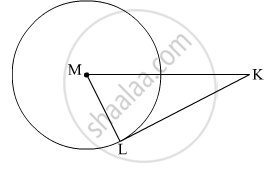
Concept: Tangent Segment Theorem
In the given figure, O is the centre of the circle. Seg AB, seg AC are tangent segments. Radius of the circle is r and `l`(AB) = r, Prove that ▢ABOC is a square. 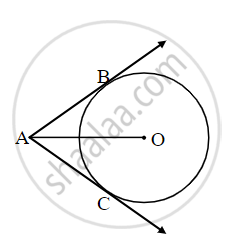
Proof: Draw segment OB and OC.
`l`(AB) = r ...[Given] (i)
AB = AC ...[`square`] (ii)
But OB = OC = r ...[`square`] (iii)
From (i), (ii) and (iii)
AB = `square` = OB = OC = r
∴ Quadrilateral ABOC is `square`
Similarly, ∠OBA = `square` ...[Tangent Theorem]
If one angle of `square` is right angle, then it is a square.
∴ Quadrilateral ABOC is a square.
Concept: Tangent Segment Theorem
`square`PQRS is a parallelogram. Write the sum of measures of ∠P and ∠ Q.
Concept: Property of Sum of Measures of Arcs
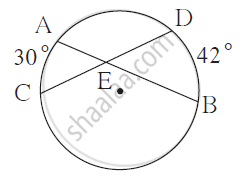
From the information given in the figure, find the measure of ∠ AEC.
Concept: Property of Sum of Measures of Arcs
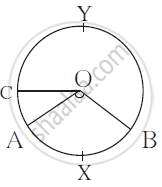
In the following figure ‘O’ is the centre of the circle.
∠AOB = 1100, m(arc AC) = 450.
Use the information and fill in the boxes with proper numbers.
(i) m(arcAXB) =
(ii)m(arcCAB) =
(iv)∠COB =
(iv)m(arcAYB) =
Concept: Tangent Segment Theorem
Find the equation of a lined passage through (3,6) and making intercepts equal magnitude but opposite in sign-on both the axes.
Concept: Inscribed Angle & Intercepted Arc
The perpendicular height of a cone is 12 cm and its slant height is 13 cm. Find the radius of the base of the cone.
Concept: Tangent Segment Theorem
Choose the correct alternative:
If the points, A, B, C are non-collinear points, then how many circles can be drawn which passes through points A, B, and C?
Concept: Circles Passing Through One, Two, Three Points

In the above figure, the circles with P, Q, and R intersect at points B, C, D, and E as shown. Lines CB and ED intersect in point M. Lines are drawn from point M to touch the circles at points A and F. Prove that MA = MF.
Concept: Circles Passing Through One, Two, Three Points
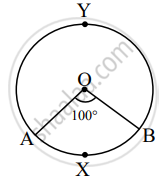
In the figure given above, O is the centre of the circle. Using given information complete the following table:
| Type of arc | Name of the arc | Measure of the arc |
| Minor arc | `square` | `square` |
| Major arc | `square` | `square` |
Concept: Property of Sum of Measures of Arcs
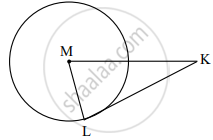
In the given figure, M is the centre of the circle and seg KL is a tangent segment. L is a point of contact. If MK = 12, KL = `6sqrt3`, then find the radius of the circle.
Concept: Tangent Segment Theorem
The chords corresponding to congruent arcs of a circle are congruent. Prove the theorem by completing following activity.
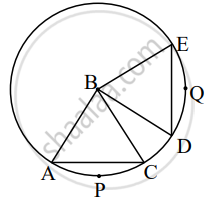
Given: In a circle with centre B
arc APC ≅ arc DQE
To Prove: Chord AC ≅ chord DE
Proof: In ΔABC and ΔDBE,
side AB ≅ side DB ...`square`
side BC ≅ side `square` ...`square`
∠ABC ≅ ∠DBE ...[Measure of congruent arcs]
∆ABC ≅ ∆DBE ...`square`
Concept: Tangent Segment Theorem
If AB and CD are the common tangents in the circles of two unequal (different) radii, then show that seg AB ≅ seg CD.
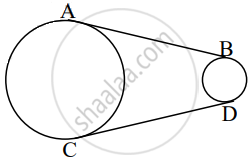
Concept: Tangent Segment Theorem
Prove that, tangent segments drawn from an external point to the circle are congruent.
Concept: Tangent Segment Theorem
In a parallelogram ABCD, ∠B = 105°. Determine the measure of ∠A and ∠D.
Concept: Tangent Segment Theorem
In the following figure, XY = 10 cm and LT = 4 cm. Find the length of XT.

Concept: Tangent Segment Theorem
Find the value of y, if the points A(3, 4), B(6, y) and C(7, 8) are collinear.
Concept: Circles Passing Through One, Two, Three Points
A pizza has 8 slices all equally spaced. Suppose pizza is a flat circle of radius 28 cm, find the area covered between 3 slices of pizza.
Concept: Secant and Tangent

A circle touches side BC at point P of the ΔABC, from outside of the triangle. Further extended lines AC and AB are tangents to the circle at N and M respectively. Prove that : AM = `1/2` (Perimeter of ΔABC)
Concept: Tangent Segment Theorem
Draw an equilateral ΔABC with side 6.2 cm and construct its circumcircle
Concept: Construction of Similar Triangle
