Advertisements
Advertisements
In the given diagram, ΔABC ∼ ΔPQR. If AD and PS are the bisectors of ∠BAC and ∠QPR, respectively, then ______.

Concept: Criteria for Similarity of Triangles
In the given diagram, ΔADB and ΔACB are two right-angled triangles with ∠ADB = ∠BCA = 90°. If AB = 10 cm, AD = 6 cm, BC = 2.4 cm and DP = 4.5 cm.

- Prove that ΔAPD ∼ ΔBPC
- Find the length of BD and PB
- Hence, find the length of PA
- Find area ΔAPD : area ΔBPC.
Concept: Criteria for Similarity of Triangles
Use ruler and compasses only for the following questions. All constructions lines and arcs must be clearly shown.
Construct the locus of points at a distance of 3.5 cm from A.
Concept: Points Equidistant from Two Given Points
Use ruler and compasses only for the following questions. All constructions lines and arcs must be clearly shown
Construct the locus of points equidistant from AC and BC.
Concept: Points Equidistant from Two Given Points
Use ruler and compasses only for the following questions. All constructions lines and arcs must be clearly shown
Mark 2 points X and Y which are a distance of 3.5 cm from A and also equidistant from AC and BC. Measure XY.
Concept: Points Equidistant from Two Given Points
Construct a triangle ABC with AB = 5.5 cm, AC = 6 cm and ∠BAC = 105°
Hence:
1) Construct the locus of points equidistant from BA and BC
2) Construct the locus of points equidistant from B and C.
3) Mark the point which satisfies the above two loci as P. Measure and write the length of PC.
Concept: Points Equidistant from Two Intersecting Lines
Use ruler and compasses only for this question:
I. Construct ABC, where AB = 3.5 cm, BC = 6 cm and ABC = 60o.
II. Construct the locus of points inside the triangle which are equidistant from BA and BC.
III. Construct the locus of points inside the triangle which are equidistant from B and C.
IV. Mark the point P which is equidistant from AB, BC and also equidistant from B and C. Measure and records the length of PB.
Concept: Points Equidistant from Two Intersecting Lines
Use ruler and compass to answer this question. Construct ∠ABC = 90°, where AB = 6 cm, BC = 8 cm.
- Construct the locus of points equidistant from B and C.
- Construct the locus of points equidistant from A and B.
- Mark the point which satisfies both the conditions (a) and (b) as 0. Construct the locus of points keeping a fixed distance OA from the fixed point 0.
- Construct the locus of points which are equidistant from BA and BC.
Concept: Points Equidistant from Two Intersecting Lines
Use ruler and compasses for the following question taking a scale of 10 m = 1 cm. A park in a city is bounded by straight fences AB, BC, CD and DA. Given that AB = 50 m, BC = 63 m, ∠ABC = 75°. D is a point equidistant from the fences AB and BC. If ∠BAD = 90°, construct the outline of the park ABCD. Also locate a point P on the line BD for the flag post which is equidistant from the corners of the park A and B.
Concept: Summary of Important Results on Locus
In the figure, m∠DBC = 58°. BD is the diameter of the circle. Calculate:
1) m∠BDC
2) m∠BEC
3) m∠BAC
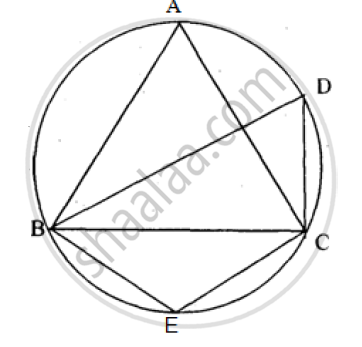
Concept: Theorems on Angles in a Circle
In the given figure, ∠BAD = 65°, ∠ABD = 70°, ∠BDC = 45°
1) Prove that AC is a diameter of the circle.
2) Find ∠ACB
Concept: Theorems on Angles in a Circle
Calculate the area of the shaded region, if the diameter of the semicircle is equal to 14 cm. Take `pi = 22/7`
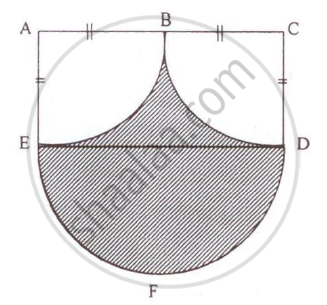
Concept: Theorems on Angles in a Circle
Using ruler and a compass only construct a semi-circle with diameter BC = 7cm. Locate a point A on the circumference of the semicircle such that A is equidistant from B and C. Complete the cyclic quadrilateral ABCD, such that D is equidistant from AB and BC. Measure ∠ADC and write it down.
Concept: Theorems on Angles in a Circle
In the given figure, PQ is a tangent to the circle at A. AB and AD are bisectors of ∠CAQ and ∠PAC. if ∠BAQ = 30°. Prove that:
- BD is a diameter of the circle.
- ABC is an isosceles triangle.

Concept: Construction of Tangents to a Circle
Draw a line AB = 5 cm. Mark a point C on AB such that AC = 3 cm. Using a ruler and a compass only, construct:
- A circle of radius 2.5 cm, passing through A and C.
- Construct two tangents to the circle from the external point B. Measure and record the length of the tangents.
Concept: Construction of Tangents to a Circle
In the figure given below, O is the centre of the circle and SP is a tangent. If ∠SRT = 65°,
find the value of x, y and z.
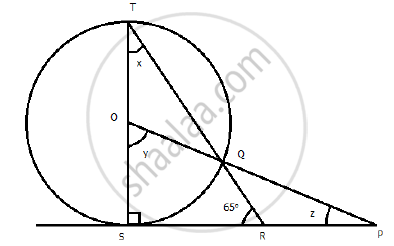
Concept: Construction of Tangents to a Circle
In the figure given below, diameter AB and chord CD of a circle meet at P. PT is a tangent to the circle at T. CD = 7.8 cm, PD = 5 cm, PB = 4 cm. Find:
1) AB.
2) the length of tangent PT.
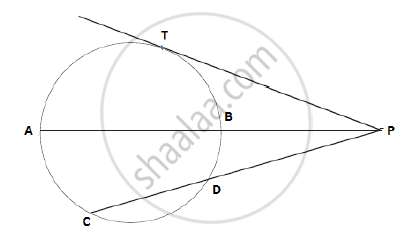
Concept: Construction of Tangents to a Circle
Use ruler and compass only for answering this question.
Draw a circle of radius 4 cm. Mark the centre as O. Mark a point P outside the circle at a distance of 7 cm from the centre. Construct two tangents to the circle from the external point P.
Measure and write down the length of any one tangent.
Concept: Construction of Tangents to a Circle
Using ruler and compass construct a triangle ABC in which AB = 6 cm, ∠BAC = 120° and AC = 5 cm. Construct a circle passing through A, B and C. Measure and write down the radius of the circle.
Concept: Construction of Tangents to a Circle
A certain number of metallic cones, each of radius 2 cm and height 3 cm are melted and recast into a solid sphere of radius 6 cm. Find the number of cones.
Concept: Mensuration of a Sphere
