Advertisements
Advertisements
If x – 2 is a factor of x3 – kx – 12, then the value of k is ______.
Concept: Factor Theorem
Find the value of 'a' if x – a is a factor of the polynomial 3x3 + x2 – ax – 81.
Concept: Factor Theorem
Factorize completely using factor theorem:
2x3 – x2 – 13x – 6
Concept: Applications of Factor Theorem
What must be subtracted from the polynomial x3 + x2 – 2x + 1, so that the result is exactly divisible by (x – 3)?
Concept: Remainder Theorem
The polynomial 3x3 + 8x2 – 15x + k has (x – 1) as a factor. Find the value of k. Hence factorize the resulting polynomial completely.
Concept: Applications of Factor Theorem
A polynomial in ‘x’ is divided by (x – a) and for (x – a) to be a factor of this polynomial, the remainder should be ______.
Concept: Remainder Theorem
Find the sum of first 51 terms of an AP whose second and third terms are 14 and 18 respectively.
Concept: Sum of First ‘n’ Terms of an Arithmetic Progressions
For what value of n, the nth terms of the arithmetic progressions 63, 65, 67, ... and 3, 10, 17, ... equal?
Concept: Sum of First ‘n’ Terms of an Arithmetic Progressions
In a Arithmetic Progression (A.P.) the fourth and sixth terms are 8 and 14 respectively. Find that:
(i) first term
(ii) common difference
(iii) sum of the first 20 terms.
Concept: Sum of First ‘n’ Terms of an Arithmetic Progressions
The sum of the first three terms of an Arithmetic Progression (A.P.) is 42 and the product of the first and third term is 52. Find the first term and the common difference.
Concept: Sum of First ‘n’ Terms of an Arithmetic Progressions
The sum of first 15 terms of an A.P. is 750 and its first term is 15. Find its 20th term.
Concept: Sum of First ‘n’ Terms of an Arithmetic Progressions
The 5th term and the 9th term of an Arithmetic Progression are 4 and – 12 respectively.
Find:
- the first term
- common difference
- sum of 16 terms of the AP.
Concept: Sum of First ‘n’ Terms of an Arithmetic Progressions
Which term of the Arithmetic Progression (A.P.) 15, 30, 45, 60...... is 300?
Hence find the sum of all the terms of the Arithmetic Progression (A.P.)
Concept: Sum of First ‘n’ Terms of an Arithmetic Progressions
The nth term of an Arithmetic Progression (A.P.) is given by the relation Tn = 6(7 – n)..
Find:
- its first term and common difference
- sum of its first 25 terms
Concept: Sum of First ‘n’ Terms of an Arithmetic Progressions
The point (3, 0) is invariant under reflection in:
Concept: Advanced Concept of Reflection in Mathematics
Use graph sheet to Solution this question. Take 2 cm = 1 unit alogn both the axes.
- Plot A, B, C where A(0, 4), B(1, 1) and C(4, 0)
- Reflect A and B on the x-axis and name them as E and D respectively.
- Reflect B through the origion and name it F. Write down the coordinates of F.
- Reflect B and C on the y-axis and name them as H and G respectively.
- Join points A, B, C, D, E, F, G, H and A in order and name the closed figure formed.
Concept: Advanced Concept of Reflection in Mathematics
Use graph sheet for this question. Take 2 cm = 1 unit along the axes.
- Plot A(0, 3), B(2, 1) and C(4, –1).
- Reflect point B and C in y-axis and name their images as B' and C' respectively. Plot and write coordinates of the points B' and C'.
- Reflect point A in the line BB' and name its images as A'.
- Plot and write coordinates of point A'.
- Join the points ABA'B' and give the geometrical name of the closed figure so formed.
Concept: Advanced Concept of Reflection in Mathematics
Study the graph and answer each of the following:
- Write the coordinates of points A, B, C and D.
- Given that, point C is the image of point A. Name and write the equation of the line of reflection.
- Write the coordinates of the image of the point D under reflection in y-axis.
- Whats the name given to a point whose image is the point itself?
- On joining the points A, B, C, D and A in order, a figure is formed. Name the closed figure.

Concept: Advanced Concept of Reflection in Mathematics
In the given figure ∠BAP = ∠DCP = 70°, PC = 6 cm and CA = 4 cm, then PD : DB is ______.

Concept: Criteria for Similarity of Triangles
In the given figure, AC || DE || BF. If AC = 24 cm, EG = 8 cm, GB = 16 cm, BF = 30 cm.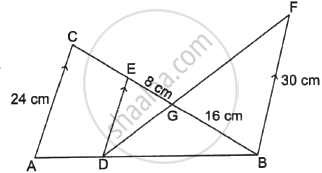
- Prove ΔGED ∼ ΔGBF
- Find DE
- DB : AB
Concept: Basic Proportionality Theorem
