Advertisements
Advertisements
Question
Using the Remainder and Factor Theorem, factorise the following polynomial:
`x^3 + 10x^2 - 37x + 26`
Advertisements
Solution
`f(x) = x^3 + 10x^2 - 37x + 26`
For x = 1
`f(1) = (1)^2 + 10(1)^2 - 37(1) + 26`
= 1 + 10 - 37 + 26
= 0
=> (x - 1) is a factor of `x^3 + 10x^2 - 37x + 26`
Now
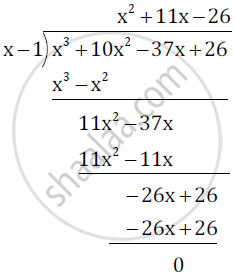
Thus by factor theorem
`=> x^3 + 10x^2 - 37x + 26 = (x - 1)(x^2 + 11x - 26)`
`= (x - 1) (x^2 + 13x - 2x - 26)`
`= (x - 1)(x(x + 13) - 2(x + 13))`
`=> x^3 + 10x^2 - 37x + 26 = (x - 1)(x + 13)(x - 2)`
APPEARS IN
RELATED QUESTIONS
Find 'a' if the two polynomials ax3 + 3x2 – 9 and 2x3 + 4x + a, leaves the same remainder when divided by x + 3.
When divided by x – 3 the polynomials x3 – px2 + x + 6 and 2x3 – x2 – (p + 3) x – 6 leave the same remainder. Find the value of ‘p’.
Divide the first polynomial by the second polynomial and find the remainder using remainder theorem.
(54m3 + 18m2 − 27m + 5) ; (m − 3)
What number should be added to polynomial f(x)= 12x3 + 16x2 - 5x - 8 so that the resulting polynomial is exactly divisible by (2x - 1) ?
If p(x) = 4x3 - 3x2 + 2x - 4 find the remainderwhen p(x) is divided by:
x + 2
Find ‘a’ if the two polynomials ax3 + 3x2 – 9 and 2x3 + 4x + a, leaves the same remainder when divided by x + 3.
Use the Remainder Theorem to factorise the following expression:
2x3 + x2 – 13x + 6
Find the remainder when 2x3 – 3x2 + 4x + 7 is divided by x + 3
Determine which of the following polynomials has x – 2 a factor:
4x2 + x – 2
If the polynomials az3 + 4z2 + 3z – 4 and z3 – 4z + a leave the same remainder when divided by z – 3, find the value of a.
