Advertisements
Advertisements
Look at the picture given below and answer the following question:
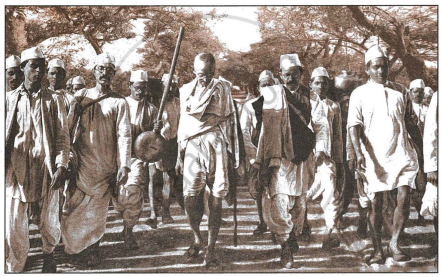
Which movement did this march launch?
Concept: Civil Disobedience Movement (1930-1934)
Name the incident which led to the suspension of this movement.
Concept: Suspension of the Non-Cooperation Movement
Mahatma Gandhi and Lord Irwin signed a pact in 1931.
Mention any two conditions that the congress agreed according to this pact.
Concept: Round Table Conference
Mention any two conditions that the British Government agreed to according to this pact.
Concept: Round Table Conference
The Rowlatt Act was called the Black Act because the Indians ______.
Concept: Causes that Led to the Non-Cooperation Movement
Read the two statements given below about the Civil Disobedience Movement and select the option that shows the correct relationship between (A) and (R).
Assertion (A): The Civil Disobedience Movement was renewed by Mahatma Gandhi.
Reason (R): The Second Round Table Conference was a failure.
Concept: Round Table Conference
Read the excerpt given below and answer the question that follow:
|
The March, which took place in India, was led by Mohandas Gandhi to protest British rule in India. During the march, thousands of Indians followed Gandhi from his religious retreat near Ahmedabad to the Arabian Sea coast, a distance of some 240 miles. The march resulted in the arrest of nearly 60,000 people, including Gandhi himself. - The Marion (Ohio) Star [Edited] |
Mention any four clauses of the Gandhi-Irwin Pact.
Concept: Round Table Conference
The Quit India Resolution in 1942 was one of the final calls given by Gandhi for the British to leave India. Moving towards Independence, Lord Mountbatten’s Plan was significant. In this context, answer the following:
State two reasons for the launching of the Quit India Movement.
Concept: Events Leading to Quit India Movement
The Quit India Resolution in 1942 was one of the final calls given by Gandhi for the British to leave India. Moving towards Independence, Lord Mountbatten’s Plan was significant. In this context, answer the following:
Give any three effects of the Quit India Movement launched by Gandhi in 1942 that was significant to the last phase of the National Movement of India.
Concept: Events Leading to Quit India Movement
The Congress Working Committee passed the famous ‘Quit India Resolution’ at Wardha in July 1942. With reference to this, answer the following questions:
- What were the reasons behind the passing of this resolution?
- What was the British Government's reaction to the Quit India Movement?
- What was the impact and significance of this movement?
Concept: Events Leading to Quit India Movement
Mention any two causes of the Quit India Movement.
Concept: Events Leading to Quit India Movement
State two important objectives of the Indian National Army.
Concept: Indian National Army (INA)
The heroism of the Indians was revealed by the courage of Subhas Chandra Bose and the Indian National Army. With reference to this, answer the following question:
Who was the founder of the Indian National Army?
Concept: Indian National Army (INA)
The heroism of the Indians was revealed by the courage of Subhas Chandra Bose and the Indian National Army. With reference to this, answer the following question:
Mention any three objectives of the Forward Bloc.
Concept: Forward Bloc
Read the two statements given below and select the option that shows the correct relationship between (A) and (R):
Assertion (A): Forward Bloc had the objective of abolishing Zamindari System.
Reason (R): Subhash Chandra Bose wanted to establish a socialist state.
Concept: Forward Bloc
Read the description and identify the person -
He established the Forward Bloc and coined the slogan, 'Delhi Chalo'.
Concept: Indian National Army (INA)
The period between 1920 to 1947 was marked with major events and reforms that finally led to us to our independence. In this context, answer the following questions:
How did the Congress and the Muslim League respond to the Cabinet Mission Plan?
Concept: Cabinet Mission in India >> Clauses of Cabinet Mission Plan
The period between 1920 to 1947 was marked with major events and reforms that finally led to us to our independence. In this context, answer the following questions:
Mention any four clauses of the Cabinet Mission Plan.
Concept: Cabinet Mission in India >> Clauses of Cabinet Mission Plan
With reference to the transfer of power to India, answer the following:
Explain the Cabinet Mission’s proposals regarding the setting up of a Constitution making body
Concept: Cabinet Mission in India >> Clauses of Cabinet Mission Plan
With reference to the transfer of power to India, answer the following:
Mention any two clauses of the India Independence Act, 1947.
Concept: The Indian Independence Act, 1947
