Advertisements
Advertisements
Match the List I with the List II.
| List I | List II | ||
| A. | Indigenous people of the Cordillera region | (i) | Chile |
| B. | Mapuche | (ii) | Bangladesh |
| C. | Tribal people of the Chittagong Hill Tracts | (iii) | Philippines |
| D. | Kuna tribe | (iv) | East of Panama Canal |
Concept: The Indigenous Peoples and Their Rights
Read the passage given below and answer the questions that follow:
| ‘Commons’ are those resources which are not owned by anyone but rather shared by a community. This could be a ‘common room’, a ‘community centre’, a park or a river. Similarly, there are some areas or regions of the world which are located outside the sovereign jurisdiction of any one state, and therefore require common governance by the international community. These are known as res communis humanitatis or global commons. |
- Which of the following is a part of global commons?
- Ocean floor
- River Narmada
- Thar desert
- Nilgiris
- The Earth Summit was held in ______.
- Kyoto
- Rio- de- Janeiro
- Rome
- Montreal
- Which of the following agencies of the United Nations is associated in dealing with environmental issues?
- UNESCO
- ECOSOC
- UNEP
- UNFCCC
- Why is cooperation over global commons not easy?
- Task cannot be monitored
- Lack of consensus on common environmental agendas.
- Similar approach to environment between the global north and south.
- All of the above
Concept: The Protection of Global Commons
Study the given cartoon and answer the questions that follow:
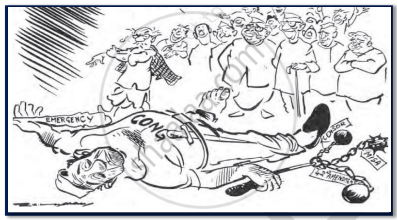
- Identify any two leaders shown in the cartoon who had won the 1977 elections.
- Explain the term MISA.
- Why was the Congress voted out of power?
Concept: Declaration of Emergency
Explain any two lessons learnt from the emergency imposed in 1975.
Concept: Controversies Regarding Emergency
What does the special status given to Jammu and Kashmir under Articles 370 mean?
Concept: The Kashmir Situation
Why is it said that history of petroleum is also the history of war and struggles?
Concept: India as an Arena of Globalization and Struggle Against It
What was 'Operation Blue Star'? Why did it hurt the sentiments of the Sikh Community?
Concept: Punjab Crisis and the Anti Sikh Riots of 1984
Examine the conditions responsible for the growth of Naxalite Movement in India. Suggest ways and means to crush it.
Concept: Anti-globalisation Movements
Globalisation does not always reduce state capacity. The primacy of the state continues to be unchallenged basis of political community. The old jealousies and rivalries between countries have not ceased to matter in world politics. The state continues to discharge its essential functions (law and order national security) and consciously withdraws from certain domains from which it wishes to. States continue to be important
Indeed, in some respects state capacity has received a boost as a consequence of globalisation, with enhanced technologies available at the disposal of the state to collect information about its citizens.
Read the passage given above carefully and answer the following questions:-
- What are the two most essential functions of the state?
- How do enhanced technologies enable the state to rule better?
- Justify with the help of an example that globalisation gives a boost to the state capacity.
Concept: Debates on the Nature of Consequences of Globalisation
In the given outline map of South Asia, five countries have been marked as (A), (B), (C), (D) and (E). Identify them on the basis of the information given below and write their correct names in your answer book with their respective serial number of the information used and the alphabet concerned as per the following format:

| SR. No. of the Information used | Alphabet concerned | Name of the country |
Information used
(i) to (v)
(i) The country has experienced civilian as well as military rule both.
(ii) Democracy was restored in this country in 2006.
(iii) This country is still a monarchy.
(iv) The Parliament of this country voted unanimously to introduce multiparty system in June 2005.
(v) This country is a part of India's 'Look East Policy via Myanmar'.
Concept: India as an Arena of Globalization and Struggle Against It
Read the following passage carefully and answer the following questions:
Above all, the linguistic states underlined the acceptance of the principle of diversity. When we say that India adopted democracy, it does not simply mean that India embraced a democratic constitution, nor does it merely mean that India adopted the format of elections. The choice was larger than that. It was a choice in favour of recognising and accepting the existence of differences which could at times be oppositional. Democracy, in other words, was associated with plurality of ideas and ways of life.
- What is meant by 'linguistic states'?
- Why were linguistic states formed in India? Explain any two reasons.
- How is democracy in India associated with plurality of ideas and ways of life?
Concept: Rise of Regional Parties
Describe any three effects of globalisation on the culture of a country.
Concept: Economic, Cultural and Political Manifestations
Differentiate between 'regionalism' and 'separatism'
Concept: Rise of Regional Parties
What was the main outcome of the Rajiv Gandhi -Longowal Accord in July 1985?
Concept: Punjab Crisis and the Anti Sikh Riots of 1984
Study the given political outline map of north-East India in which six states have been marked as A, B, C, D, E and F. Identify these states with the help of information provided below and write their names along with their respective letters i.e. A, B, C, D, E, and F in your answer book.

i. Two states which were not part of the state of Assam were at the time of India’s independence.
ii. The state whose leader signed an agreement with Rajiv Gandhi in 1986.
iii. The state which declared independence from India in 1951.
iv. The state which was carved out of Assam in 1972.
v. The 22nd state of India due to its merger.
Concept: Economic, Cultural and Political Manifestations
Regional demands from different parts of India exemplify the principle of unity with diversity. Do you agree? Give reasons.
Concept: Region and the Nation
‘Bodo’ is a community in ______ state of India.
Concept: Challenges and Responses in the North East
Name the leader who led a peoples’ march to Parliament in 1975 and state as to what was unique about this march.
Concept: Political Consequences
Highlight any two issues that dominate the politics of North-East India.
Concept: Challenges and Responses in the North East
How far did the Rajiv Gandhi-Longowal Accord succeed in bringing normalcy to Punjab?
Concept: Punjab Crisis and the Anti Sikh Riots of 1984
