Advertisements
Advertisements
Explain the need for land reforms implemented in the agriculture sector.
Concept: Agriculture
How do infrastructure facilities boost production?
Concept: Infrastructure
Choose the correct alternative from given options:
Shift from Point A on Production Possibility Curve X1Y1 to point B on X2Y2 in the given figure indicates:
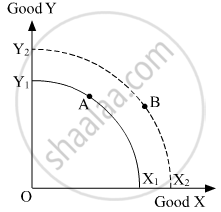
Concept: Concepts of Production Possibility Frontier
Fill up the blank.
A Production Possibility Curve (PPC) would be convex to the origin if the Marginal Rate of Transformation (MRT) is ___________.
Concept: Concepts of Production Possibility Frontier
Answer the following question.
Define net exports. How is it different from the net factor income from abroad?
Concept: Methods of Measurement of National Income >> Expenditure Method
Answer the following question.
Why is a Production Possibility Curve concave to the origin? Explain.
Concept: Concepts of Production Possibility Frontier
Why does an economic problem arise? Explain.
Concept: Central Problems of an Economy
Answer the following question.
What precautions should be taken while estimating national income by value-added method? Explain.
Concept: Circular Flow of Income and Methods of Calculating National Income
Distinguish between positive economics and normative economics, with suitable examples.
Concept: Positive and Normative Economics
Do you agree with the given statement? Give valid reasons in support of your answer.
"Higher Gross Domestic Product (GDP) means greater per capita availability of goods in the economy."
Concept: GDP and Welfare
Define the following: Value Addition
Concept: Circular Flow of Income and Methods of Calculating National Income
Assertion (A): Public goods are those goods and services that are collectively consumed by the public.
Reason (R): Public goods are excludable and rivalrous in nature.
Concept: Factor Cost, Basic Prices and Market Prices
Giving valid reasons explain which of the following will not be included in estimation of National Income of India?
- Purchase of shares of X. Ltd. by an investor in the National Stock Exchange.
- Salaries paid by the French Embassy, New Delhi to the local workers of the housekeeping department.
- Compensation paid by the Government of India to the victims of floods.
Concept: Factor Cost, Basic Prices and Market Prices
Study the following information and compare the Economies of India and Singapore on the grounds of ‘Investment in infrastructure as a percentage of GDP’
| Some Infrastructure in India and other Countries, 2018 | |||||
| Country | Investment* in Infrastructure as a % GDP | Percentage of people using safely managed | Mobile Subscribers/100 People | Consumption of energy (mL tonnes of oil equivalent) | |
| Drinking Water Sources | Sanitation Services | ||||
| China | 44 | 96 | 72 | 115 | 3274 |
| Hong Kong | 22 | 100 | 92 | 259 | 31 |
| India | 30 | 94 | 40 | 87 | 809 |
| South Korea | 31 | 98 | 100 | 130 | 301 |
| Pakistan | 16 | 35 | 64 | 73 | 85 |
| Singapore | 28 | 100 | 100 | 146 | 88 |
| Indonesia | 34 | 87 | 61 | 120 | 186 |
Sources: World Development Indicators 2019, World Bank website: www.worldbank.org.; BP Statistical Review of World Energy 2019. 69th Edition.
Note: (*) refers to Gross Capital Formation.
Concept: Factor Cost, Basic Prices and Market Prices
Explain how ‘Non-Monetary Exchanges’ impact the use of Gross Domestic Product as an index of economic welfare.
Concept: GDP and Welfare
Distinguish between ‘Value of Output’ and ‘Value Added’.
Concept: Circular Flow of Income and Methods of Calculating National Income
Read the following figure carefully and choose the correct pair from the alternatives given below:

Concept: Methods of Measurement of National Income >> Income Method
State and discuss any two precautions to be considered while estimating national income by Expenditure Method.
Concept: Methods of Measurement of National Income >> Expenditure Method
_________ committee was set up for the development and promotion of small scale industries in India.
Concept: Industry and Trade
First Industrial Policy Resolution of Independent India was announced in the year ______.
Concept: Industry and Trade
