Definitions [1]
Organic compounds containing carbon-oxygen double bond, i.e. \[\mathrm{>C=O}\] group, are known as carbonyl compounds.
Key Points
- Carbonyl group: The ≻C=O group (carbonyl carbon + carbonyl oxygen) — a key functional group in organic chemistry.
- Carbonyl compounds: Aldehydes and ketones, both containing ≻C=O as their functional group.
- Aldehydes: –CHO (formyl group); carbonyl C bonded to at least one H.
- Ketones: ≻C=O (ketonic carbonyl group); carbonyl C bonded to two alkyl/aryl groups (R=R′ or R≠R′).
- Carboxylic acids: –COOH (carboxyl group); –OH attached to ≻C=O makes them distinct from aldehydes/ketones.
- Ether C–O cleavage reactions: With HX (100 °C) → R–OH + R–X; PCl₅ → R–Cl + R′–Cl; dil. H₂SO₄ → R–OH + R′–OH; R′COCl/(R′CO)₂O with AlCl₃ → esters.
- Reactivity order of HX with ethers: HI > HBr > HCl.
- Preparation of ethers: Dehydration of alcohols (conc. H₂SO₄, 443 K), catalytic dehydration (Al₂O₃, 250 °C), Williamson synthesis (Sₙ2), and alkyl halides + dry Ag₂O.
- Carbonyl compounds classification: Aldehydes (R–CHO, Ar–CHO), ketones (aliphatic/aromatic — simple or mixed), and carboxylic acids (RCOOH, ArCOOH).
- Carboxylic acid types: Mono- (propionic acid), di- (oxalic acid), and tri-carboxylic acid (citric acid).
| Functional group | Types | IUPAC system (Basic rules) | Examples |
|---|---|---|---|
| Aldehydes | Aliphatic compounds | Parent name: Alkane → Alkanal; Prefix – Formyl | Hexanal, 3-Formylhexanoic acid |
| Alicyclic compounds | Parent name: Cycloalkanecarbaldehyde | Cyclohexanecarbaldehyde | |
| Aromatic compounds | Suffix – Benzaldehyde (one –CHO group); Prefix – Formyl | 3-Methylbenzaldehyde, 4-Formylbenzoic acid | |
| Ketones | Aliphatic compounds | Parent name: Alkane → Alkanone; Prefix – Oxo | Hexan-2-one, 3-Oxobutanal |
| Alicyclic compounds | Parent name: Cycloalkanone | 4-Methylcyclohexanone | |
| Aromatic compounds | Suffix – phenone | Benzophenone | |
| Carboxylic acids | Aliphatic compounds | Parent name: Alkane → Alkanoic acid | Hexanoic acid |
| Alicyclic compounds | Parent name: Cycloalkanecarboxylic acid | Cyclohexanecarboxylic acid | |
| Aromatic compounds | Suffix – Benzoic acid (one –COOH group) | 2-Hydroxybenzoic acid |
Preparation of aliphatic aldehydes and ketones
By oxidation of alcohols:
\[\ \begin{array}{r@{\;}c@{\;}l} \mathrm{R} & & \\ & \backslash & \\ & & \mathrm{CH}-\mathrm{OH} \\ & / & \\ \mathrm{R}' & & \end{array} + [\mathrm{O}] \xrightarrow[\text{Or KMnO}_4]{\text{K}_2\text{Cr}_2\text{O}_7/\text{H}_2\text{SO}_4} \begin{array}{r@{\;}c@{\;}l} \mathrm{R} & & \\ & \backslash & \\ & & \mathrm{C}=\mathrm{O} \\ & / & \\ \mathrm{R}' & & \end{array} + \mathrm{H}_2\mathrm{O}\]
When,
- R' = H then 1° alcohol to aldehyde.
- R' = alkyl group then 2º alcohol to ketone.
By dehydrogenation of alcohols:
\[ \begin{array}{r@{\;}c@{\;}l} \mathrm{R} & & \\ & \backslash & \\ & & \mathrm{CH}-\mathrm{OH} \\ & / & \\ \mathrm{R}' & & \end{array} \xrightarrow[\text{573 K}]{\text{Cu}} \begin{array}{r@{\;}c@{\;}l} \mathrm{R} & & \\ & \backslash & \\ & & \mathrm{C}=\mathrm{O} \\ & / & \\ \mathrm{R}' & & \end{array} + \mathrm{H}_2 \]
When
- R' = H then 1° alcohol to aldehyde.
- R' = alkyl group the 2° alcohol to ketone.
By acid chloride:
\[ \mathrm{R} - \overset{\displaystyle \mathrm{O}}{\overset{||}{\mathrm{C}}} - \mathrm{Cl} + \mathrm{H}_2 \xrightarrow[\text{Rosenmund Reduction}]{\text{Pd}-\text{BaSO}_4} \underset{\text{Aldehyde}}{\mathrm{R} - \overset{\displaystyle \mathrm{O}}{\overset{||}{\mathrm{C}}} - \mathrm{H}} + \mathrm{HCl} \]
2RMgX + CdCl2 → R2Cd + 2MgXCl
\[\ 2\mathrm{R}' - \overset{\displaystyle \mathrm{O}}{\overset{||}{\mathrm{C}}} - \mathrm{Cl} + \mathrm{R}_2\mathrm{Cd} \longrightarrow 2\mathrm{R}' - \underset{\text{Ketone}}{\overset{\displaystyle \mathrm{O}}{\overset{||}{\mathrm{C}}}} - \mathrm{R} + \mathrm{CdCl}_2 \]
From nitriles and esters:
\[ \mathrm{R} - \mathrm{CN} \xrightarrow[\text{(ii) }\mathrm{H}_2\mathrm{O}]{\text{(i) }\mathrm{AlH}(i\text{Bu})_2} \underset{\text{Aldehyde}}{\mathrm{R} - \mathrm{CHO}} \]
\[ \mathrm{CH}_3(\mathrm{CH}_2)_9 - \overset{\displaystyle \mathrm{O}}{\overset{||}{\mathrm{C}}} - \mathrm{OC}_2\mathrm{H}_5 \xrightarrow[\text{(ii) }\mathrm{H}_2\mathrm{O}]{\text{(i) DIBAL-H}} \mathrm{CH}_3(\mathrm{CH}_2)_9 - \underset{\text{Aldehyde}}{\overset{\displaystyle \mathrm{O}}{\overset{||}{\mathrm{C}}} - \mathrm{H}} \]
 From hydrocarbons
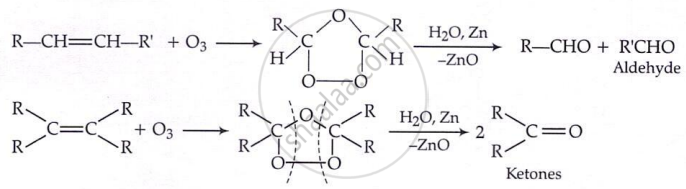
By ozonolysis:
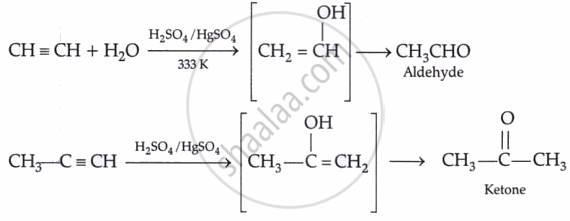
By hydration:
- Special preparations: Benzoic acid from cumene (KMnO₄/KOH, Δ → H₃O⁺); adipic acid from cyclohexene (KMnO₄/dil. H₂SO₄, Δ).
- Aldehyde preparation: From 1° alcohol (K₂Cr₂O₇/H₂SO₄ or Cu/573 K), alkene (ozonolysis), alkyne (dil. H₂SO₄/HgSO₄), acid chloride (Rosenmund), nitrile (Stephen/DIBAL-H); aromatic via Etard, CrO₃/(CH₃CO)₂O, Cl₂/hν, Gatterman–Koch.
- Aldehyde reactions: HCN → cyanohydrin; NaHSO₃ → bisulphite adduct; R′OH → acetal; RMgBr → 2° alcohol; NH₂OH → aldoxime; NH₂NH₂ → hydrazone; K₂Cr₂O₇ → COOH; Clemmensen/Wolf–Kishner → alkane.
- Carboxylic acid preparation: From nitriles (hydrolysis), acyl chloride/anhydride/ester + H₂O, CO₂ + RMgX (dry ether, H₃O⁺), alkylbenzene (KMnO₄–KOH).
- Carboxylic acid reactions: PCl₅/SOCl₂ → RCOCl; NH₃ → amide; P₂O₅ → anhydride; NaOH + CaO (Δ) → alkane; LiAlH₄ → 1° alcohol; ROH/conc. H₂SO₄ → ester.
- Most aldehydes are liquids (except HCHO = gas); ketones of lower order are colourless liquids with a pleasant odour.
- Higher BP than corresponding hydrocarbons but lower than alcohols (no H-bonding between molecules, but dipole-dipole interactions).
- Lower members are soluble in water (H-bonding with water); higher members are insoluble (large alkyl groups).
- Solubility: Decreases with an increase in the size of the hydrocarbon part.
- Miscibility: Lower carboxylic acids (up to 4 C atoms) are miscible with water due to H-bonding.
- Boiling point: Carboxylic acids have higher B.P. than ketones, aldehydes, and alcohols of comparable molecular mass due to intermolecular H-bonding.
- Order of B.P. (carboxylic acids & aldehydes): Valeric > Butyric > Propionic > Acetic > Formic acid; Hexanal > Pentanal > Butanal > Propanal.
- Order of B.P. (ketones): Hexan-2-one > Pentan-2-one > Butan-2-one > Propanone.
- In the carbonyl group, the π-electron cloud is displaced towards the more electronegative oxygen, making carbon partially positive (δ+) and oxygen partially negative (δ−).
- The polarity of the carbonyl group is also explained by resonance, with electron delocalisation shown through two principal resonance forms.
- Aldehydes are more reactive than ketones towards nucleophilic attack due to two factors: electronic effect and steric effect.
- Electronic effect: Aldehydes have only one electron-donating group (EDG) attached to the carbonyl carbon, making them more electrophilic than ketones.
- Steric effect: Aldehydes have less steric hindrance than ketones, so nucleophiles can attach more easily; note that aromatic aldehydes are less reactive than aliphatic aldehydes in nucleophilic addition reactions.
- Oxidation: Aldehydes → RCOOH (same C) with dil. HNO₃/KMnO₄/K₂Cr₂O₇; Ketones undergo C–C cleavage with CrO₃, giving two carboxylic acids.
- Reduction: Clemmensen (Zn-Hg/conc. HCl) and Wolf-Kishner (NH₂-NH₂ then KOH/HOCH₂CH₂OH, Δ) both convert >C=O to >CH₂.
- Electrophilic Substitution: –CHO is EWG (inductive + resonance); deactivates ring; directs electrophile (NO₂⁺) to meta position.
- Lab Tests: Schiff (pink), Tollens (silver mirror), Fehling (red Cu₂O ppt) — for aldehydes; Sodium nitroprusside (red) — for ketones.
- Nucleophilic Reactions: HCN → cyanohydrin; NaHSO₃ → bisulphite adduct; ROH/dry HCl → hemiacetal/acetal/ketal; NaOI → haloform (CHI₃); dil. NaOH → Aldol condensation; No α-H + NaOH → Cannizzaro reaction.
- Acid strength order: Greater halogen electronegativity → stronger acid, smaller pKₐ; F–CH₂COOH > Cl–CH₂COOH > Br–CH₂COOH > I–CH₂COOH > CH₃COOH.
- Substituent effect: EWG (–Cl, –CN, –NO₂) ↑ acidity; EDG (–CH₃, –OH, –OCH₃) ↓ acidity; 4-nitrobenzoic acid > Benzoic acid > 4-methyl benzoic acid.
- Tests for –COOH: Litmus (blue → red), NaHCO₃ (CO₂↑), Ester test (with C₂H₅OH/H⁺ gives ester).
- Key conversions: SOCl₂/PCl₃/PCl₅ → acyl chloride; NH₃ (Δ) → amide; P₂O₅ (Δ) → acid anhydride.
- Decarboxylation & reduction: RCOONa + NaOH/CaO (Δ) → R–H + Na₂CO₃; RCOOH + LiAlH₄/dry ether → RCH₂OH.
Concepts [10]
- Concepts of Aldehydes, Ketones, and Carboxylic Acids
- Classification of Aldehydes, Ketones and Carboxylic Acids
- Nomenclature of Aldehydes, Ketones and Carboxylic Acids
- Preparation of Aldehydes and Ketones
- Methods of Preparation of Carboxylic Acids
- Physical Properties of Aldehydes and Ketones
- Physical Properties of Carboxylic Acids
- Polarity of Carbonyl Group
- Chemical Properties of Aldehydes and Ketones
- Chemical Properties of Carboxylic Acids
