Definitions [2]
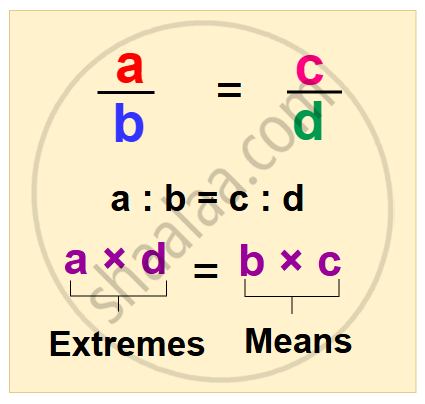
Four non-zero quantities, a, b, c, and d, are said to be in proportion (or are proportional) if:
a : b = c : d.
The above equation is expressed as a : b :: c : d
This is read as “a is to b as c is to d.”
Three numbers are in continued proportion if:
a:b, then a, b, and c are in continued proportion.
-
b is the mean proportional between a and c.
-
c is the third proportional to a and b.
Formulae [1]
a : b = b : c
\[\frac{a}{b}\] = \[\frac{b}{c}\]
⇒ b × b = a × c
⇒ `(b^2)` = ac and
b = \[\sqrt{ac}\]
Theorems and Laws [7]
If a, b, c, d are in continued proportion, prove that: `((a - b)/c + (a - c)/b)^2 - ((d - b)/c + (d - c)/b)^2 = (a - d)^2 (1/c^2 - 1/b^2)`.
a, b, c, d are in continued proportion
∴ `a/b = b/c = c/d` = k(say)
∴ c = dk, b = dk2, a = bk = dk2. k = dk3
L.H.S.
= `((a - b)/c + (a - c)/b)^2 - ((d - b)/c + (d - c)/b)^2`
= `((dk^3 - dk^2)/(dk) + (dk^3 - dk)/(dk^2))^2 - ((d - dk^2)/(dk) + (d - dk)/(dk^2))^2`
= `((dk^2(k - 1))/(dk) + (dk(k^2 - 1))/(dk^2))^2 - ((d(1 - k^2))/(dk) + (d( 1 - k^2))/(dk^2))^2`
= `((k(k - 1) + (k^2 - 1))/k)^2 - ((1 - k^2)/k + (1 - k)/k^2)^2`
= `((k^2(k - 1) + (k^2 - 1))/k)^2 - ((k (1- k^2) + 1 - k)/k^2)^2`
= `((k^3 - 1)^2)/k^2 - (-k^3 + 1)^2/k^4`
= `(k^3 - 1)^2/k^2 - (1 - k^3)^2/k^4`
= `((k^3 - 1)/k^2)^2 ((1 - 1)/k^2)`
= `((k^3 - 1)^2(k^2 - 1))/k^4`
= `((k^3 - 1)^2(k^2 - 1))/k^4`
R.H.S.
= `(a - d)^2(1 / c^2 - 1/b^2)`
= `(dk^3 - d)^2(1 / (d^2k^2) - (1)/(d^2k^4))`
= `d^2(k^3 - 1)^2((k^2 - 1)/(d^2k^4))`
= `((k^3 - 1)^2(k^2 - 1))/k^4`
∴ L.H.S. = R.H.S.
If `a/c = c/d = e/f` prove that: `(a^3 + c^3)^2/(b^3 + d^3)^2 = e^6/f^6`
`a/c = c/d = e/f` = k(say)
∴ a = bk, c = dk, e =fk
L.H.S.
= `(a^3 + c^3)^2/(b^3 + d^3)^2`
= `(b^3k^3 + d^3k^3)^2/(b^3 + d^3)^2`
= `[k^3(b^3 + d^3)]^2/(b^3 + a^3)^2`
= `(k^6(b^3 + d^3)^2)/(b^3 + d^3)^2`
= k6
R.H.S. = `e^6/f^6`
= `f^6k^6/f^6`
= k6
∴ L.H.S. = R.H.S.
If x, y, z are in continued proportion, prove that: `(x + y)^2/(y + z)^2 = x/z`.
x, y, z are in continued proportion
Let `x/y = y/z = k`
Then y = kz
x = yk
= kz × k
= k2z
Now L.H.S.
= `(x + y)^2/(y + z)^2`
= `(k^2 z + kz)^2/(kz + z)^2`
= `{kz(k + 1)}^2/{z(k + 1)}^2`
= `(k^2z^2(k + 1)^2)/(z^2(k + 1)^2)`
= k2
R.H.S. = `x/z`
= `(k^2z)/z`
= k2
∴ L.H.S. = R.H.S.
If x, y and z are in continued proportion, Prove that:
`x/(y^2.z^2) + y/(z^2.x^2) + z/(x^2.y^2) = 1/x^3 + 1/y^3 + 1/z^3`
Given: x, y and z are in continued proportion.
∴ `x/y = y/z`
⇒ y2 = xz
To prove: `x/(y^2.z^2) + y/(z^2.x^2) + z/(x^2.y^2) = 1/x^3 + 1/y^3 + 1/z^3`
Proof: Solving L.H.S.:
`x/(y^2.z^2) + y/(z^2.x^2) + z/(x^2.y^2)`
⇒ `(x^3 + y^3 + z^3)/(x^2.y^2.z^2)`
⇒ `(x^3 + y^3 + z^3)/(x^2.xz.z^2)`
⇒ `(x^3 + y^3 + z^3)/(x^3.z^3)`
⇒ `x^3/(x^3.z^3) + y^3/(x^3.z^3) + z^3/(x^3.z^3)`
⇒ `1/z^3 + y^3/(xz)^3 + 1/x^3`
⇒ `1/z^3 + y^3/(y^2)^3 + 1/x^3`
⇒ `1/z^3 + y^3/y^6 + 1/x^3`
⇒ `1/z^3 + 1/y^3 + 1/x^3`
Since L.H.S. = R.H.S.
Hence proved.
If a, b, c, d are in continued proportion, prove that: `(a^3 + b^3 + c^3)/(b^3 + c^3 + d^3) = a/d`
a, b, c, d are in continued proportion
∴ `a/b = b/c = c/d` = k(say)
∴ c = dk, b = ck = dk2, a = bk = dk3
L.H.S.
= `(a^3 + b^3 + c^3)/(b^3 + c^3 + d^3)`
= `((dk^3)^3 + (dk^2)^3 + (dk)^3)/((dk^2)^3 + (dk)^3 + d^3)`
= `(d^3k^9 + d^3k^6 + d^3k^3)/(d^3k^6 + d^3k^3 + d^3)`
= `(d^3k^3(k^6 + k^3 + 1))/(d^3(k^6 + k^3 + 1)`
= k3
R.H.S.
= `a/d`
= `(dk^3)/d`
= k3
∴ L.H.S. = R.H.S.
If a, b, c, d are in continued proportion, prove that: (a + d)(b + c) – (a + c)(b + d) = (b – c)2
a, b, c, d are in continued proportion
∴ `a/b = b/c = c/d` = k(say)
∴ c = dk, b = ck = dk. k = dk2,
a = bk = dk2. k = dk3
L.H.S. = (a + d)(b + c) – (a + c)(b + d)
= (dk3 + d) (dk2 + dk) – (dk3 + dk) (dk2 + d)
= d(k3 + 1) dk(k + 1) – dk (k2 + 1) d(k2 + 1)
= d2k(k + 1) (k3 + 1) – d2k (k2 + 1) (k2 + 1)
= d2k[k4 + k3 + k + 1 – k4 - 2k2 - 1]
= d2k[k3 – 2k2 + k]
= d2k2[k2 – 2k + 1]
= d2k2(k – 1)2
R.H.S. = (b – c)2
= (dk2 – dk)2
= d2k2(k – 1)2
∴ L.H.S. = R.H.S.
Hence proved.
If a + c = mb and `1/b + 1/d = m/c`, prove that a, b, c and d are in proportion.
a + c = mb and `1/b + 1/d = m/c`
a + c = mb ...(1)
`1/b + 1/d = m/c` ...(2)
Step 1: Simplify the second condition
`1/b + 1/d = m/c`
Take LCM of b and d:
`(d + b)/(bd) = m/c`
c(d + b) = mbd
cd + cb = mbd ...(3)
Step 2: Use the first condition
a + c = mb
Multiply both sides by d:
d(a + c) = mbd
ad + cd = mbd ...(4)
Step 3: Compare equations (3) and (4)
cd + cb = mbd
ad + cd = mbd
ad + cd = cd + cb
Subtract cdcdcd from both sides:
ad = cb
Step 4: Convert to ratio form
ad = bc
Divide both sides by bd:
`a/b = c/d`
Thus,
a : b = c : d
Hence, a, b, c and d are proportional.
