- A concave mirror has an inward-curved reflecting surface, while a convex mirror has an outward-curved reflecting surface.
- Important parts of a spherical mirror: Pole (P), Centre of Curvature (C), Principal Axis, and Principal Focus (F).
- For spherical mirrors, the relation is R = 2f, where R is the radius of curvature and f is the focal length.
- In concave mirrors, parallel rays converge at the focus; in convex mirrors, they appear to diverge from the focus behind the mirror.
Definitions [39]
Definition: Reflection of Light
The phenomenon of bouncing back of light rays in the same medium on striking a surface is called reflection of light.
Define Regular reflection.
The phenomenon due to which a parallel beam of light traveling through a certain medium, on striking some polished surface, bounces off from it, as a parallel beam, in some other direction, is called regular reflection.
Define the term Principle axis.
The principal axis is the straight line passing through the pole and the centre of curvature.
Define reflection.
The bouncing of light by any smooth or polished surface is called.
Define the following term
Normal
Normal: The perpendicular line drawn from, the point of incidence to the plane of reflecting surface is called normal.
Define the following term
Angle of incidence
Angle of incidence: The angle formed between the incident ray PO and the normal ‘ON’ is angle of incidence.
Define the following term
Incident ray
Incident ray- The ray of light that falls on the surface of the reflection materials.
Define the following term
Reflected ray
Reflected ray: The ray of light that comes from the point when the incident ray falls on the reflection material.
Define the following terms :
Incident ray, Refracted ray, Angle of incidence, Angle of refraction.
INCIDENT RAY AB: The ray light AB which is in air strikes the glass slab at B.
Or
“A ray of light falling on the surface separating the two media.”
REFRACTED RAY BK: A ray of light which after passing the first medium is in second medium i.e. ray BK.
“A ray of light travelling in other medium in the changed direction.”
ANGLE OF INCIDENCE: “The angle which the incident ray makes with the normal is called angle of incidence.”
i.e. ∠i
ANGLE OF REFRACTION: “The angle which the refracted ray makes with the normal is called angle of refraction.”
i.e. ∠r

By drawing a neat diagram define the following:
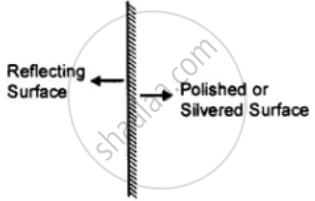
Mirror
The mirror is a highly polished and smooth surface that reflects almost the entire light falling on it. A plane mirror is made by silvering one side of a glass plate as shown in the figure.
Representation of plane mirror
Explain the following term:
Normal Draw
diagram/diagrams to show them.
Normal: The perpendicular drawn at the point of incidence, to the surface of the mirror is called normal.

Define the following term in relation to concave mirror.
Principal axis
An imaginary line passing through the pole and the centre of curvature of a spherical mirror is called principal axis.
Define the following term in relation to concave mirror.
Radius of curvature
The linear distance between the pole and the center of curvature is called the radius of curvature.
Define the following term in relation to concave mirror.
Focal length
The linear distance between the pole and the principal focus is called focal length.
Define the term Focus of a concave mirror.
The focus of a concave mirror is a point on the principal axis of the mirror, where all the rays travelling parallel to the principal axis and close to it after reflection from the mirror converge to that point.
Define the term Normal.
Normal to the surface of a mirror at any point is the straight line at the right angle to the tangent drawn at that point.
Define the following term in relation to concave mirror.
Principal focus
It is a point on the principal axis, where a beam of light, parallel to the principal axis, after reflection actually meet.
Define focal length.
The distance between the pole and the principal focus is called the focal length (f) of a spherical mirror.
Define the term Pole.
Pole is the centre of the reflecting surface, in this case, a spherical mirror.
Define the term Aperture.
Aperture is the distance between the extreme points on the periphery of the mirror.
Define the term Centre of curvature.
Centre of curvature is the centre of the imaginary sphere to which the mirror belongs.
Define the term Principle focus.
Principal focus of a spherical mirror is a point on the principal axis of the mirror, where all the rays travelling parallel to the principal axis and close to it after reflection from the mirror, converge to or appear to diverge from.
Define the following term:
spherical mirror
“A mirror which is made from a part of a hollow sphere is called Spherical Mirror.
Define the following term:
convex mirror
“A mirror made by silvering the inner surface such that reflection takes place from the bulging surface” is called Convex Mirror.
The Centre of curvature is towards the silvered surface.
Define the following term:
concave mirror
“A mirror made by silvering the outer or the bulging surface such that the reflection takes place from the concave surface.” Centre of curvature is towards the reflecting surface.
Define the following term in relation to concave mirror.
Pole
Pole “is the mid-point of the mirror”.
Define the following term in relation to concave mirror.
Center of curvature
The centre of a hollow sphere of which the mirror forms a part is called the centre of curvature.
Definition: Convex Mirror
A spherical mirror whose reflecting surface is curved outwards, is called a convex mirror.
OR
A convex mirror is one whose reflecting surface is away from the centre of the sphere of which the mirror is a part.
OR
The reflecting surface is on the outer side of the sphere (diverging mirror).
Definition: Radius of Curvature
The radius of the sphere of which the reflecting surface of a spherical mirror forms a part is called the radius of curvature of the mirror. It is represented by the letter R.
OR
The radius of the sphere of which the mirror forms a part, is called the 'radius of curvature' of the mirror.
Definition: Principal Axis
A straight line passing through the pole and the centre of curvature of a spherical mirror. This line is called the principal axis.
OR
The straight line joining the pole and the centre of curvature of the mirror and extended on both sides is called the 'principal axis' of the mirror.
Definition: Pole
The centre of the reflecting surface of a spherical mirror is a point called the pole. The pole is usually represented by the letter P.
OR
The central point of the reflecting surface of the mirror is called the 'pole' of the mirror.
Definition: Centre of Curvature
The reflecting surface of a spherical mirror forms a part of a sphere. This sphere has a centre. This point is called the centre of curvature of the spherical mirror. It is represented by the letter C.
OR
The centre of the sphere of which the mirror forms a part, is called the ‘centre of curvature' of the mirror.
Definition: Spherical Mirrors
Mirrors whose reflecting surfaces are spherical are called spherical mirrors.
OR
A spherical mirror is a part of a hollow sphere, whose one side is silvered and coated with red oxide and the other side is the reflecting surface.
OR
A spherical mirror is a piece cut out of a spherical surface, which can be concave or convex.
Definition: Concave Mirror
A spherical mirror, whose reflecting surface is curved inwards, that is, faces towards the centre of the sphere, is called a concave mirror.
OR
A concave mirror is one whose reflecting surface is towards the centre of the sphere of which the mirror is a part.
OR
The reflecting surface is on the inner side of the sphere (converging mirror).
Define the principal focus of a concave mirror.
Light rays that are parallel to the principal axis of a concave mirror converge at a specific point on its principal axis after reflecting from the mirror. This point is known as the principal focus of the concave mirror.
Define principal focus of the concave mirror.
Principal focus (F): The point on the principal axis of the spherical mirror where the rays of light parallel to the principal axis meet or appear to meet after reflection from the spherical mirror.
Definition: Object Distance
In a spherical mirror, the distance of the object from its pole is called the object distance (u).
Definition: Image Distance
The distance of the image from the pole of the mirror is called the image distance (v).
Definition: Focal Length
The distance of the principal focus from the pole is called the focal length (f).
Formulae [5]
Formula: Number of Images in Inclined Mirrors
n = \[\frac {360°}{θ}\]
- If n is even → N = n − 1
- If n is odd → N = n (object not on bisector); N = n − 1 (object on bisector)
- If n is a fraction → N = integral part of n
Write the formula for a lens connecting image distance (v), object distance (u) and the focal length (f). How does the lens formula differ from the mirror formula?
Lens formula is:
`1/v-1/u=1/f`
Now, the mirror formula is given by:
`1/v+1/u=1/f`
In both the formulas,
u = Object distance
v = Image distance
f = Focal length
In the mirror formula, a positive sign is present between the reciprocals of the image distance and object distance.
In lens formula, a negative sign is present between the reciprocals of image distance and object distance.
Write down a formula for the magnification produced by a concave mirror.
In terms of height of object and height of image.
m = `h_i/h_o`
Formula: Mirror Formula
\[\frac {1}{v}\] + \[\frac {1}{u}\] = \[\frac {1}{f}\]
Formula: Magnification
Magnification (m) = \[\frac{\text{Height of the image (}h'\text{)}}{\text{Height of the object (}h\text{)}}\] = \[\frac {h'}{h}\]
Magnification in terms of object and image distances:
Magnification (m) = \[\frac {h'}{h}\] = -\[\frac {v}{u}\]
Theorems and Laws [2]
Law: Laws of Reflection
- The angle of incidence ∠i = angle of reflection ∠r.
- The incident ray, reflected ray, and normal lie in one plane; both rays are on either side of the normal.
Law: Laws of Reflection
- The angle of reflection is equal to the angle of incidence.
- The incident ray, the reflected ray, and the normal lie in the same plane.
- The incident ray and the reflected ray are on opposite sides of the normal.
Key Points
Key Points: Reflection of Light
- Reflection occurs when light bounces off a smooth surface like a mirror, following fixed laws.
- Plane mirrors always form virtual, erect, and same-sized images that are laterally inverted.
- Curved surfaces (like a spoon) act as spherical mirrors, changing the image size and orientation depending on the object's position.
Key Points: Spherical Mirrors
Key Points: Image Formation by Concave Mirror
| No. | Object Position | Image Position | Nature of Image | Size of Image |
|---|---|---|---|---|
| 1 | At infinity | At focus (F) | Real, Inverted | Highly diminished (point-sized) |
| 2 | Beyond centre of curvature (C) | Between F and C | Real, Inverted | Diminished |
| 3 | At centre of curvature (C) | At centre of curvature (C) | Real, Inverted | Same size as object |
| 4 | Between C and F | Beyond C | Real, Inverted | Enlarged (magnified) |
| 5 | At focus (F) | At infinity | Real, Inverted | Highly enlarged (very large) |
| 6 | Between focus (F) and pole (P) | Behind the mirror | Virtual, Erect | Enlarged (magnified) |
Key Points: Sign Convention
- Pole (mirror) or optical centre (lens) is the origin; principal axis is the X-axis.
- Distances to the right are positive, to the left are negative; heights above the axis are positive, below are negative.
- Concave mirror: and R are negative; Convex mirror: and R are positive.
- Real images: image distance and magnification are negative; Virtual images: both are positive.
- Lenses are always negative; they are positive for real images and negative for virtual images; they are positive for convex lenses and negative for concave lenses.
Concepts [26]
- Reflection of Light
- Terms Used in Reflection of Light
- Law of Reflection of Light
- Verification of the Law of Reflection of Light
- Formation of Image by Reflection: Real and Virtual Image
- Formation of Image of a Point Object by a Plane Mirror
- Image of an Extended Object Formed by a Plane Mirror
- Position of Image
- Lateral Inversion
- Plane Mirror
- Images Formed by a Plane Mirrors
- Images Formed in Two Inclined Mirrors
- Images Formed in a Pair of Mirrors Placed Parallel to Each Other
- Images Formed by Two Mirrors Placed Perpendicular to Each Other
- Spherical Mirrors
- Rules to Trace the Image Formed by Spherical Mirrors
- Factors Affecting Focal Length of a Lens
- Position and Nature of Image Formed by Spherical Mirrors
- Spherical Mirror > Concave Mirror
- Image Formation by Concave Mirror
- Spherical Mirror > Convex Mirror
- Image Formation by Convex Mirror
- Relation Between Focal Length and Radius of Curvature of a Spherical Mirror
- Coordinate Geometry Sign Convention for Measuring Distances and Lengths
- Ray Optics - Mirror Formula
- Distinction Between a Plane Mirror, Concave Mirror and Convex Mirror
