The forces which are applied on a body through a connector, are called contact forces. Forces like Frictional force, Mechanical force, etc., are the forces of contact.
Definition: Force
Force is defined as the rate of change of linear momentum of a body with respect to time.
Define an Inclined plane.

An inclined plane is usually a smooth, flat rigid surface inclined at an angle (θ) to the horizontal. It is used to raise heavy loads with a relatively small force. The longer the slope, the smaller is the effort needed.
1 dyne is that force which when acting on a body of mass 1 gram, produces an acceleration of 1 cm s-2 in it.
1 dyne = 1 g × 1 cm s-2.
Define inertia. Give its classification.
Inertia: The inherent property of a body to resist any change in its state of rest or the state of uniform motion, unless it is influenced upon by an external unbalanced force, is known as ‘inertia’.
Types of Inertia
- Inertia of rest
- Inertia of motion
- Inertia of direction
Definition: Rotational Motion
Now consider a body pivoted at a point, i.e., not free to move, and a force is applied on the body at a suitable point, it rotates the body about the axis passing through the pivoted point. This is the turning effect of the force and the motion of the body is called rotational motion.
Definition: Transitional Motion
When a force acts on a stationary rigid body that is free to move, the body starts moving in a straight path in the direction of the applied force. This is called linear or translational motion.
Name the physical quantity whose unit is kgf. Define it.
The physical quantity is force.
Force is a push or pull that can change or tend to change the state of rest, motion, or shape of a body.
Its gravitational unit is kilogram-force (kgf).
Define the moment of force.
The turning effect produced by a force on a rigid body about a point, pivot or fulcrum is called the moment of force or torque. It is measured by the product of force and the perpendicular distance of the pivot from the line of action of force.
Moment of a force = Force × perpendicular distance of the pivot from the force.
The turning effect of force acting on a body about an axis is called the moment of force.
Define non-contact forces.
The forces which act on a body without the help of any connector, are called non-contact forces or forces of distance. Gravitational force, Mechanical force, etc., are non-contact forces.
Definition: Torque
The moment of a force (or torque) is equal to the product of the magnitude of the force and the perpendicular distance of the line of action of the force from the axis of rotation.
Force is a physical cause that changes or may tend to change the state of rest or the state of motion of an object.
Definition: Couple Arm
The perpendicular distance between the two forces is AB ( = d), which is called the couple arm.
Define the moment of a couple.
The moment of a couple is equal to the product of either force and the perpendicular distance between the line of action of both the forces.
Definition: Couple
Two equal and opposite parallel forces, not acting along the same line, form a couple. A couple is always needed to produce a rotation.
Define Newton’s second law of motion.
Newton’s second law of motion states that the rate of change of momentum is directly proportional to force applied and takes place in the direction of the force.
Definition: Impulse of a Force
The quantity ‘change in momentum’ is separately named as the Impulse of the force.
OR
The quantity change in momentum is called impulse.
OR
Impulse
The product of a large force applied on a body for a very short interval of time, which produces a finite change in the momentum of the body, with SI unit Ns (or kg-ms⁻¹) and dimension [MLT⁻¹], is called impulse.
J = Ft = m(v − u) = change in momentum
Definition: Universal Law of Gravitation
"Every particle of matter attracts every other particle of matter with a force which is directly proportional to the product of their masses and inversely proportional to the square of the distance between them."
Definition: Acceleration Due to Gravity
The gravitational force due to the earth on a body results in its acceleration. This is called acceleration due to gravity and is denoted by ‘g’.
OR
When a body falls towards the Earth under gravity, then the acceleration produced in the body due to gravity is called acceleration due to gravity, which is denoted by g.
Formula: Force
\[\overset{\rightarrow}{\operatorname*{F}}=\frac{d\overset{\rightarrow}{\operatorname*{p}}}{dt}=\frac{d(m\overset{\rightarrow}{\operatorname*{v}})}{dt}\]
or
\[\begin{array}
{rcl}\vec{F} & = & m\vec{a}
\end{array}\](if mass m is constant)
Formula: Newton's First Law of Motion
\[\vec F\] = m \[\frac{d\vec{\mathrm{v}}}{dt}\] = m\[\vec a\] ... (for constant mass)
Thus, if \[\vec F\] = 0, \[\vec v\] is constant. Hence, if there is no force, velocity will not change. This is nothing but Newton's first law of motion.
Formula: Torque or Moment of Force
Moment of force = Force × perpendicular distance from the point (axis) of rotation
τ = F × d
Write the expression for calculating the moment of force about a given axis.
Moment of force = Force (F) × Perpendicular distance (d)
Formula: Moment of Couple
Moment of Couple = Either force x perpendicular distance between the two forces (or couple arm)
Formula: Newton's Second Law of Motion
General Form: \[\vec F\] =\[\frac{d\vec{p}}{dt}\]
For Constant Mass: \[\vec F\] = m\[\vec a\]
Momentum: \[\vec p\] = m\[\vec v\]
Formula: Impulse
\[{\vec{\mathrm{J}}=\vec{\mathrm{F}}t}=\mathrm{m}(\vec{\mathrm{v}}-\vec{\mathrm{u}})\]
Formula: Newton's Third Law of Motion
\[\vec{F}=\frac{d\vec{p}}{dt}=\frac{d\left(m\vec{\mathrm{v}}\right)}{dt}\]
Formula: Universal Law of Gravitation
The gravitational force of attraction (F) between two bodies of mass m1 and m2 separated by a distance r is:
\[\mathbf{F} = \mathbf{G}\frac{m_1 m_2}{r^2}\]
- F: Gravitational Force of attraction (in Newtons, N).
- \[m_1, m_2\]: Masses of the two objects (in kilograms, kg).
- r (or d in the first part): Distance between the two objects (in meters, m).
- G: The constant of proportionality, called the Universal gravitational constant.
- Value in SI units: \[G=6.67\times10^{-11}\mathrm{N}\cdot\mathrm{m}^2/\mathrm{kg}^2\]
- Dimensions: \[[G]=[\mathrm{L}^3\mathrm{M}^{-1}\mathrm{T}^{-2}]\]
Formula: Acceleration due to gravity
The value of the acceleration due to gravity (g) on the surface of the Earth is given by the formula:
Where:
- g = Acceleration due to gravity (in m/s²).
- G = Newton's Universal Gravitational Constant (≈ 6.67 × 10⁻¹¹ N · m² / kg²).
- M = Mass of the Earth (≈ 6 × 1024 kg).
- R = Radius of the Earth (≈ 6.4 × 10⁶ m).
Law: Newton's First Law of Motion
Statement:
Every inanimate object continues to be in a state of rest or of uniform unaccelerated motion along a straight line, unless it is acted upon by an external, unbalanced force.
Importance:
- It shows the equivalence between the state of rest and the state of uniform motion along a straight line — the distinction lies only in the choice of frame of reference.
- It defines force as a physical entity that brings about a change in the state of motion or rest of an object.
- It defines inertia as a fundamental and inherent property of every physical body by virtue of which it resists any change in its state of rest or uniform motion along a straight line.
Law: Principle of Moments
Statement:
In equilibrium, the sum of anticlockwise moments equals the sum of clockwise moments about the pivot.
Explanation/Proof:
When several forces act on a pivoted body, they tend to rotate it about an axis passing through the pivot. The resultant moment is obtained by taking the algebraic sum of the moments of all the forces about the pivoted point. By convention, anticlockwise moments are taken as positive and clockwise moments as negative.
A metre rule is suspended at its centre (point O). Two weights W₁ and W₂ are hung on either side at distances l₁ and l₂ using spring balances.
- W₁ creates a clockwise moment = W₁ × l₁
- W₂ creates an anticlockwise moment = W₂ × l₂
By adjusting the weights or positions, the rule becomes horizontal (in equilibrium).
Conclusion:
At balance, W₁ × l₁ = W₂ × l₂, which confirms the principle of moments.
Law: Newton’s Second Law of Motion
Statement:
The rate of change of linear momentum of a rigid body is directly proportional to the applied (external unbalanced) force and takes place in the direction of force.
F = Δp = m\[\frac {dv}{dt}\] = ma
Importance:
- It provides a mathematical formulation for the quantitative measure of force: F = \[\frac {Δp}{Δt}\] = ma.
- It defines momentum as the product of mass and velocity: p = mv.
- Aristotle's fallacy is overcome by establishing that it is the resultant unbalanced force — not force itself — that is required to maintain a change in the state of motion.
Law: Impulse-Momentum Theorem
Statement: The impulse of a force equals the change in momentum of the body.
\[\int_{t_1}^{t_2}Fdt=\int_{p_i}^{p_f}dp\]
- Impulse from a force-time graph = Area under the F-t graph.
- For constant force: J = Ft
Law: Newton's Third Law of Motion
Statement:
To every action (force) there is always an equal and opposite reaction (force).
Importance:
- It defines action and reaction as a pair of equal and opposite forces acting along the same line — whenever one object exerts a force on another, the second object exerts an equal and opposite force on the first.
- Action and reaction forces always act on different objects and therefore never cancel each other out.
Law: Universal Law of Gravitation
Statement:
The law which states that every particle of matter attracts every other particle in the universe with a force whose magnitude is directly proportional to the product of masses and inversely proportional to the square of the distance between them is called Newton's Law of Gravitation.
Derivation:
Newton's Universal Law of Gravitation states that every particle of matter attracts every other particle of matter with a force which is the following:
- Directly proportional to the product of their masses: F ∝ m₁ ⋅ m₂
- Inversely proportional to the square of the distance between them: F ∝ \[\frac {1}{r^2}\]
Combining both, the gravitational force is expressed as follows:
F = G\[\frac{m_1m_2}{r^2}\]
where G is the universal gravitational constant, measured by Henry Cavendish using the Cavendish balance, with the value:
G = 6.67 × 10⁻¹¹ Nm2/kg2
Write the answer of the question with reference to laws of gravitation.
State the universal law of gravitation.
The universal law of gravitation states that every object in the universe attracts every other object with a force called the gravitational force. The force acting between two objects is directly proportional to the product of their masses and inversely proportional to the square of the distance between their centres.
F ∝ m M (masses of two bodies m and M)
F ∝ `1/"d"^2` (d is the distance between the two bodies.)
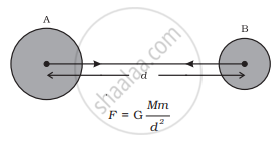
A and B are two bodies, the distance between which is given as d.
F = force with which one body is attracting the other.
G = proportionality constant.
