- Free fall occurs when an object moves only under the influence of gravity, with no other forces acting on it.
- In free fall, initial velocity (u) = 0 and acceleration = g (acceleration due to gravity).
- The equations of motion for free fall are:
• v = gt
• s = \[\frac {1}{2}\]gt2
• v2 = 2gs - True free fall occurs in a vacuum, as air resistance affects motion on Earth.
- The Moon and satellites are in free fall because they move only under Earth’s gravitational field.
Definitions [12]
Define the term “weight of a body”
The weight of the body is the force with which the earth attracts it towards the centre. It depends on acceleration due to gravity.
Answer the following.
Define weight.
The gravitational force acting on an object is called the weight of the object.
Definition: Contact Force
A force is seen to act through direct contact of the objects or via one more object. Such a force is called 'Contact force.'
OR
The forces experienced by a body due to physical contact with another object, e.g., frictional force, normal force, are called contact forces.
Definition: Non-Contact Force
A force is applied between two objects even if the two objects are not in contact; such a force is called a 'Non-contact force.'
OR
The forces experienced by a body without any physical contact with another object, e.g., gravitational force, electrostatic force, are called non-contact forces.
Define inertia. Give its classification.
Inertia: The inherent property of a body to resist any change in its state of rest or the state of uniform motion, unless it is influenced upon by an external unbalanced force, is known as ‘inertia’.
Types of Inertia
- Inertia of rest
- Inertia of motion
- Inertia of direction
Define Newton’s second law of motion.
Newton’s second law of motion states that the rate of change of momentum is directly proportional to force applied and takes place in the direction of the force.
Definition: Acceleration Due to Gravity
The gravitational force due to the earth on a body results in its acceleration. This is called acceleration due to gravity and is denoted by ‘g’.
OR
When a body falls towards the Earth under gravity, then the acceleration produced in the body due to gravity is called acceleration due to gravity, which is denoted by g.
Define acceleration due to gravity.
The acceleration produced in a body due to the gravitational force of the earth is called the acceleration due to gravity.
Definition: Weight
The weight of an object is defined as the force with which the earth attracts the object.
Definition: Mass
Mass is the amount of matter present in the object. The SI unit of mass is kg.
Define absolute units of force in CGS as well as the SI system.
Absolute unit of force in the CGS system is dyne and in SI system is Newton (N).
One dyne: When the body of mass 1 gram moves with an acceleration of 1 cms−2, then the force acting on the body is called one dyne.
1 dyne = 1 g cms−2
One Newton: When a body of mass 1 kg moves with an acceleration of 1 ms−2, then force acting on the body is said to be one newton.
OR
That force is said to be one newton, which producers an acceleration of 1 ms−2 in a body of mass 1 kg.
1 N = 1 kg ms−2
Definition: Universal Law of Gravitation
"Every particle of matter attracts every other particle of matter with a force which is directly proportional to the product of their masses and inversely proportional to the square of the distance between them."
Formulae [5]
Formula: Newton's First Law of Motion
\[\vec F\] = m \[\frac{d\vec{\mathrm{v}}}{dt}\] = m\[\vec a\] ... (for constant mass)
Thus, if \[\vec F\] = 0, \[\vec v\] is constant. Hence, if there is no force, velocity will not change. This is nothing but Newton's first law of motion.
Formula: Newton's Second Law of Motion
General Form: \[\vec F\] =\[\frac{d\vec{p}}{dt}\]
For Constant Mass: \[\vec F\] = m\[\vec a\]
Momentum: \[\vec p\] = m\[\vec v\]
Formula: Newton's Third Law of Motion
\[\vec{F}=\frac{d\vec{p}}{dt}=\frac{d\left(m\vec{\mathrm{v}}\right)}{dt}\]
Formula: Acceleration due to gravity
The value of the acceleration due to gravity (g) on the surface of the Earth is given by the formula:
\[g = \frac{G M}{R^2}\]
Where:
- g = Acceleration due to gravity (in m/s²).
- G = Newton's Universal Gravitational Constant (≈ 6.67 × 10⁻¹¹ N · m² / kg²).
- M = Mass of the Earth (≈ 6 × 1024 kg).
- R = Radius of the Earth (≈ 6.4 × 10⁶ m).
Formula: Universal Law of Gravitation
The gravitational force of attraction (F) between two bodies of mass m1 and m2 separated by a distance r is:
\[\mathbf{F} = \mathbf{G}\frac{m_1 m_2}{r^2}\]
- F: Gravitational Force of attraction (in Newtons, N).
- \[m_1, m_2\]: Masses of the two objects (in kilograms, kg).
- r (or d in the first part): Distance between the two objects (in meters, m).
- G: The constant of proportionality, called the Universal gravitational constant.
- Value in SI units: \[G=6.67\times10^{-11}\mathrm{N}\cdot\mathrm{m}^2/\mathrm{kg}^2\]
- Dimensions: \[[G]=[\mathrm{L}^3\mathrm{M}^{-1}\mathrm{T}^{-2}]\]
Theorems and Laws [5]
Law: Newton's First Law of Motion
Statement:
Every inanimate object continues to be in a state of rest or of uniform unaccelerated motion along a straight line, unless it is acted upon by an external, unbalanced force.
Importance:
- It shows the equivalence between the state of rest and the state of uniform motion along a straight line — the distinction lies only in the choice of frame of reference.
- It defines force as a physical entity that brings about a change in the state of motion or rest of an object.
- It defines inertia as a fundamental and inherent property of every physical body by virtue of which it resists any change in its state of rest or uniform motion along a straight line.
Law: Newton’s Second Law of Motion
Statement:
The rate of change of linear momentum of a rigid body is directly proportional to the applied (external unbalanced) force and takes place in the direction of force.
F = Δp = m\[\frac {dv}{dt}\] = ma
Importance:
- It provides a mathematical formulation for the quantitative measure of force: F = \[\frac {Δp}{Δt}\] = ma.
- It defines momentum as the product of mass and velocity: p = mv.
- Aristotle's fallacy is overcome by establishing that it is the resultant unbalanced force — not force itself — that is required to maintain a change in the state of motion.
Law: Newton's Third Law of Motion
Statement:
To every action (force) there is always an equal and opposite reaction (force).
Importance:
- It defines action and reaction as a pair of equal and opposite forces acting along the same line — whenever one object exerts a force on another, the second object exerts an equal and opposite force on the first.
- Action and reaction forces always act on different objects and therefore never cancel each other out.
Write the answer of the question with reference to laws of gravitation.
State the universal law of gravitation.
The universal law of gravitation states that every object in the universe attracts every other object with a force called the gravitational force. The force acting between two objects is directly proportional to the product of their masses and inversely proportional to the square of the distance between their centres.
F ∝ m M (masses of two bodies m and M)
F ∝ `1/"d"^2` (d is the distance between the two bodies.)
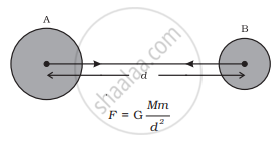
A and B are two bodies, the distance between which is given as d.
F = force with which one body is attracting the other.
G = proportionality constant.
Law: Universal Law of Gravitation
Statement:
The law which states that every particle of matter attracts every other particle in the universe with a force whose magnitude is directly proportional to the product of masses and inversely proportional to the square of the distance between them is called Newton's Law of Gravitation.
Derivation:
Newton's Universal Law of Gravitation states that every particle of matter attracts every other particle of matter with a force which is the following:
- Directly proportional to the product of their masses: F ∝ m₁ ⋅ m₂
- Inversely proportional to the square of the distance between them: F ∝ \[\frac {1}{r^2}\]
Combining both, the gravitational force is expressed as follows:
F = G\[\frac{m_1m_2}{r^2}\]
where G is the universal gravitational constant, measured by Henry Cavendish using the Cavendish balance, with the value:
G = 6.67 × 10⁻¹¹ Nm2/kg2
Key Points
Key Points: Newton's First Law of Motion
- Newton's First Law states that a body at rest or in uniform motion stays that way unless an external unbalanced force acts on it.
- The law explains inertia, which is an object's resistance to changing its state of motion on its own.
- The 'state of rest' and 'state of uniform motion' are considered equivalent; both require a net unbalanced force to change.
- Force is defined by the law as the entity that changes a body’s state of motion.
- A balanced force results in a net force of zero, meaning no acceleration.
- An unbalanced force results in a net force that causes acceleration and changes the state of motion.
- Inertia is quantitatively measured by the object's mass (inertial mass).
Key Points: Variation in Acceleration due to Gravity
- Due to Altitude: The acceleration due to gravity decreases with altitude as we move away from the surface of the Earth. As h↑, g↓.
- Due to Depth: The acceleration due to gravity decreases as we move into the Earth's interior, i.e., with increasing depth. As d↑, g↓.
- Due to Latitude: The acceleration due to gravity increases with latitude. At the poles (θ = 90°), g = gmax; at the equator (θ = 0°), g = gmin.
- Due to the shape of the Earth: The equatorial radius of the Earth is greater than the polar radius. Since g ∝ \[\frac {1}{R^2}\], the acceleration due to gravity is greater at the poles compared to the equator, i.e., Requator > Rpole and gequator < gpole.
Key Points: Free Fall
Key Points: Newton's Universal Law of Gravitation
Concepts [16]
- Effect of Force
- Types of Forces>Contact and Non-Contact Forces
- Newton's First Law of Motion
- Inertia and Mass
- Types of Inertia
- Linear Momentum
- Change in Momentum
- Rate of Change of Momentum
- Newton’s Second Law of Motion
- Newton's Third Law of Motion
- Force Due to Gravity
- Acceleration Due to Gravity (Earth’s Gravitational Acceleration)
- Free Fall
- Mass and Weight
- Gravitational Units of Force
- Newton's Universal Law of Gravitation
