- Electric potential is a scalar quantity, and it is positive near a positive charge and negative near a negative charge.
- Electric potential is taken as zero at infinity because the force between charges becomes zero at infinite separation.
- The potential difference between two points is measured using a voltmeter, which is connected in parallel with the circuit, with its positive terminal at the higher-potential point.
Definitions [17]
Definition: Electric Charge
The basic property of matter due to which it experiences electric force and shows attraction or repulsion, is called electric charge.
Define a unit charge.
One coulomb is the amount of charge which, when placed at a distance of one metre from another charge of the same magnitude in vacuum, experiences a force of 9.0 × 10⁹ N.
Definition: Volume Charge Density
The charge per unit volume in a region of space, is called volume charge density.
\[\rho=\frac{\Delta Q}{\Delta V}\]
Definition: Surface Charge Density
The charge per unit area on a surface, is called surface charge density.
\[\sigma=\frac{\Delta Q}{\Delta S}\]
Definition: Linear Charge Density
The charge per unit length along a line (such as a wire), is called linear charge density.
\[\lambda=\frac{\Delta Q}{\Delta l}\]
Definition: Continuous Charge Distribution
A charge distribution in which charge is treated as continuously spread over a line, surface, or volume (ignoring microscopic discreteness), is called continuous charge distribution.
Definition: Electric Field
The space surrounding an electric charge q in which another charge q0 experiences a (electrostatic) force of attraction or repulsion, is called the electric field of the charge q.
OR
Electric field due to a charge Q at a point in space may be defined as the force that a unit positive charge would experience if placed at that point.
Define electric field.
The region in which the charge experiences an electric force is the electric field around the charge.
Definition: Electric Lines of Force
“An electric line of force is an imaginary smooth curve drawn in an electric field along which a free, isolated positive charge moves. The tangent drawn at any point on the electric line of force gives the direction of the force acting on a positive charge placed at that point.”
Definition: Electric Dipole
An electric dipole is a pair of equal and opposite point-charges placed at a short distance apart.
Define electric dipole moment.
The electric dipole moment is defined as the product of the magnitude of one of the charges and the distance between the two equal and opposite charges.
Definition: Direction of Dipole Axis
“The line joining the two charges, pointing from the negative charge to the positive charge. This is known as the ‘direction of dipole axis’.”
Define the following:
Potential difference
Potential difference: The potential difference between two points may be defined as the work done in moving a unit positive charge from one point to the other.
Definition: Potential at a Point
The potential at a point is defined as the amount of work done per unit charge in bringing a positive test charge from infinity to that point.
Define Electric potential.
Electric potential is a measure of work done on the unit's positive charge to bring it to that point against all electrical forces. It is represented as ‘V’.
Definition: Potential Difference
The potential difference (p.d.) between two points is equal to the work done per unit charge in moving a positive test charge from one point to the other.
OR
The work done per unit positive charge in moving a charge from one point to another in an electric field, is called potential difference between those two points.
Define Electric Flux.
The number of electric field lines crossing a given area, kept normal to the electric field lines, is called electric flux.
Formulae [5]
Formula: Electric Field Due to a Continuous Charge Distribution
\[\vec{E}=\frac{1}{4\pi\varepsilon_0}\sum\frac{\rho\Delta V}{r^{\prime2}}\hat{r}^{\prime}\]
Formula: Electric Field Due to a Point Charge
\[\vec{E}=\frac{1}{4\pi\varepsilon_0}\frac{Q}{r^2}\hat{r}\]
Formula: Electric Field at a Point
E = \[\frac{1}{4\pi\varepsilon_{0}}\frac{q}{r^{2}}\] newton / coulomb
where \[\frac{1}{4\pi\varepsilon_{0}}\] = 9.0 × 10⁹ newton meter2 / coulomb2.
Formula: Torque on a Dipole in a Uniform Electric Field
\[\vec τ\] = \[\vec p\] × \[\vec E\]
Magnitude: τ = pE sin θ
Formula: Electric Potential at a Point
V = \[\frac {W}{Q}\]
or
W = QV
Theorems and Laws [4]
Law: Coulomb’s Law
Statement
Coulomb’s law states that the electrostatic force between two stationary point charges is directly proportional to the product of the magnitudes of the charges and inversely proportional to the square of the distance between them. The force acts along the line joining the two charges and is repulsive for like charges and attractive for unlike charges.
Explanation/Mathematical Form
Let two point charges q1 and q2 be placed at a distance r apart in vacuum (or air).
According to Coulomb’s law:
F ∝ q1q2
Combining the above relations:
F = k\[\frac {q_1q_1}{r^2}\]
where
F = electrostatic force between the charges,
r = distance between the charges,
k = proportionality constant.
In vacuum (or air),
k = 9.0 × 10⁹ N m2C−2
Hence,
F = \[\frac{1}{4\pi\varepsilon_0}\frac{q_1q_2}{r^2}\]
where ε0 is the permittivity of free space, given by
ε0 = 8.85 × 10⁻¹² C2N−1m−2
If the charges are placed in a dielectric medium of permittivity ε,
F = \[\frac{1}{4\pi\varepsilon}\frac{q_1q_2}{r^2}\]
and since ε = Kε0,
F = \[\frac{1}{4\pi K\varepsilon_0}\frac{q_1q_2}{r^2}\]
where K is the dielectric constant of the medium.
Conclusion
Coulomb’s law quantitatively describes the force of attraction or repulsion between two point charges.
The force:
- depends on the magnitudes of charges,
- varies inversely as the square of the distance,
- acts along the line joining the charges, and
- decreases in a dielectric medium by a factor equal to its dielectric constant.
Law: Principle of Superposition of Electric Forces
Statement
The principle of superposition states that the net electric force acting on a given charge due to a number of other charges is equal to the vector sum of the individual forces exerted on it by each charge taken separately, assuming the other charges are absent.
Explanation / Mathematical Form
Consider a system of nnn point charges q1,q2,q3,…,qn.
The force acting on charge q1 due to the other charges is:
where
\[\vec F_{12}\] is the force on q1 due to q2,
\[\vec F_{13}\] is the force due to q3, and so on.
According to Coulomb’s law, the force on q1 due to q2 is:
\[\vec F_{12}\] = \[\frac{1}{4\pi\varepsilon_0}\frac{q_1q_2}{r_{12}^2}\hat{r}_{12}\]
Similarly, forces due to other charges can be written, and their vector sum gives the resultant force on q1.
Thus, the force between any two charges is independent of the presence of other charges.
Conclusion
The principle of superposition shows that:
- Electric forces obey vector addition.
- Each pair of charges interacts independently.
- The net force on a charge in a multi-charge system is found by adding all individual Coulomb forces vectorially.
State Gauss’s law on electrostatics and drive expression for the electric field due to a long straight thin uniformly charged wire (linear charge density λ) at a point lying at a distance r from the wire.
Gauss' Law states that the net electric flux through any closed surface is equal to `1/epsilon_0` times the net electric charge within that closed surface.
`oint vec" E".d vec" s" = (q_(enclosed))/epsilon_o`
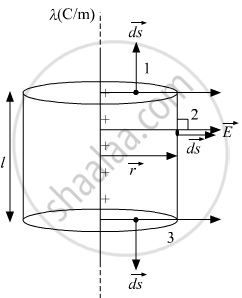
In the diagram, we have taken a cylindrical gaussian surface of radius = r and length = l.
The net charge enclosed inside the gaussian surface `q_(enclosed) = lambdal`
By symmetry, we can say that the Electric field will be in radially outward direction.
According to gauss' law,
`oint vec"E".d vec"s" = q_(enclosed)/epsilon_o`
`int_1 vec"E" .d vec"s" + int_2 vec"E" .d vec"s" + int_3 vec"E". d vec"s" = (lambdal)/epsilon_o`
`int_1 vec"E". d vec"s" & int_3 vec"E". d vec"s" "are zero", "Since" vec"E" "is perpendicular to" d vec"s"`
`int_2 vec"E" . d vec"s" = (lambdal)/epsilon_o`
`"at" 2, vec"E" and d vec"s" "are in the same direction, we can write"`
`E.2pirl = (lambdal)/epsilon_o`
`E = lambda/(2piepsilon_o r)`
State Gauss’ Law.
The electric flux (ΦE) through any closed surface is equal to `1/in_0` times the ‘net’ change q enclosed by the surface.
ΦE = `oint vec E d vec A`
= `q/in_0`
∈0 = Permittivity of free space.
Gauss’ theorem states that the net electric flux over a closed surface is `1/epsilon_0` times the net electric charge enclosed by the surface.
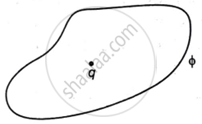
Φ = `oint vec E * d vec A`
= `q/epsilon_0`
Key Points
Key Points: Concept of Charge
- Thales (≈2500 years ago) observed that amber rubbed with wool attracts light objects like paper and straw.
- William Gilbert (1600) showed that many materials, such as glass, ebonite, and sulphur, also show this effect.
- This attractive property is produced by rubbing (friction); a material showing it is said to be electrified, and the process is called frictional electricity.
- An electrified material possesses electric charge and is therefore called a charged body.
- Electric charge is quantised (q = ±ne, e = 1.6 × 10⁻¹⁹ C); there are two types of charges (positive and negative), as charges repel, unlike charges attract, and the SI unit of charge is coulomb (C).
Key Points: Electric Field
- A charge creates an electric field around it, even if no other charge is present.
- The electric field does not depend on the test charge used to measure it (if the test charge is very small).
- The field of a positive charge points outward; the field of a negative charge points inward.
- The strength of the electric field decreases as the distance from the charge increases.
- At equal distances from a point charge, the electric field has the same magnitude (spherical symmetry).
Key Points: Properties of the Electric Lines of Force
- Electric field lines originate from positive charges and terminate on negative charges (or at infinity).
- The tangent to a field line at any point gives the direction of the electric field; in a uniform field, the lines are parallel and straight.
- No two electric field lines intersect, as this would imply more than one direction of the electric field at a point.
- Electric field lines do not pass through a conductor, showing that the electric field inside a conductor is zero.
- The density of field lines indicates field strength—closer lines represent a stronger field, while wider spacing represents a weaker field; the lines are continuous and imaginary, though the field is real.
Key points: Potential and Potential Difference
Key Points: Applications of Gauss' Theorem
Concepts [22]
- Concept of Electrostatics
- Electric Charge
- Methods of Charging a Conductor
- Conductors and Insulators Related to Electric Field
- Free Charges and Bound Charges Inside a Conductor
- Scalar Form of Coulomb’s Law
- Principle of Superposition
- Continuous Charge Distribution
- Electric Field
- Electric Lines of Force
- Electric Field Intensity Due to a Point-Charge
- Motion of a Charged Particle
- Electric Dipole
- Dipole in a Uniform External Field
- Potential and Potential Difference
- Electric Potential Due to a Point Charge, a Dipole and a System of Charges
- Equipotential Surfaces
- Electrical Potential Energy of a System of Two Point Charges and of Electric Dipole in an Electrostatic Field
- Electric Flux
- Gauss’s Law
- Applications of Gauss' Theorem
- Energy Density of Charged Conductor
