Definitions [3]
An equation of the form ax + by + c = 0 represents a straight line and is known as a linear equation.
An equation of the form ax² + 2hxy + by² = 0 in which the sum of powers of x and y in every term is the same (here 2) is called a homogeneous equation of the second degree.
e.g. 2x² − xy − y² = 0 and 6x² + 5xy − 4y² = 0
Equation of the form ax² + 2hxy + by² + 2gx + 2fy + c = 0 is called a general second-degree equation.
- The necessary conditions for a general second-degree equation to represent a pair of lines are: (i) abc + 2fgh − af² − bg² − ch² = 0, (ii) h² − ab ≥ 0
Formulae [7]
From general form:
- Slope (m) = −a / b
- Y-intercept = −c / b
If ax² + 2hxy + by² + 2gx + 2fy + c = 0 represents a pair of parallel straight lines, then the distance between them is given by
\[2\sqrt{\frac{g^{2}-ac}{a(a+b)}}\mathrm{or}2\sqrt{\frac{f^{2}-bc}{b(a+b)}}\]
For point (x₁, y₁) and line ax + by + c = 0,
\[p=\frac{|ax_1+by_1+c|}{\sqrt{a^2+b^2}}\]
For lines ax + by + c₁ = 0 and ax + by + c₂ = 0,
P = \[\left|\frac{c_{1}-c_{2}}{\sqrt{a^{2}+b^{2}}}\right|\]
\[m_1+m_2=-\frac{2h}{b}\]
\[m_1m_2=\frac{a}{b}\]
For equation: ax² + 2hxy + by² = 0
\[\Theta=\tan^{-1}\left\{\frac{2\sqrt{(h^{2}-ab)}}{\mid a+b\mid}\right\}\]
or \[\Theta=\sin^{-1}\left\{\frac{2\sqrt{h^{2}-ab}}{\sqrt{\left(a-b\right)^{2}+4h^{2}}}\right\}\]
or \[\Theta=\cos^{-1}\left\{\frac{|a+b|}{\sqrt{\left(a-b\right)^{2}+4h^{2}}}\right\}\]
\[\frac{x^2-y^2}{a-b}=\frac{xy}{h}\]
Theorems and Laws [1]
Prove that the acute angle θ between the lines represented by the equation ax2 + 2hxy+ by2 = 0 is tanθ = `|(2sqrt(h^2 - ab))/(a + b)|` Hence find the condition that the lines are coincident.
Let m1 and m2 be slopes of lines represented by the equation
ax2 + 2hxy + by2 = 0.
∴ `m_1 + m_2 = (-2h)/b and m_1 m_2 = a/b`
∴ `(m_1 - m_2)^2 = (m_1 + m_2)^2 - 4m_1 m_2`
= `((2h)/b)^2 - 4(a/b)`
= `(4h^2)/b^2 - (4a)/b`
= `(4h^2 - 4ab)/b^2`
= `(4(h^2 - ab))/b^2`
∴ `m_1 - m_2 = ± (2sqrt(h^2 - ab))/b`
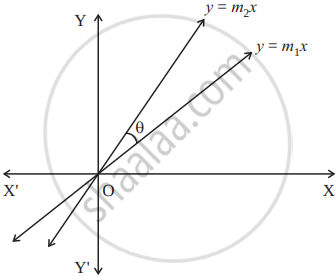
As θ is the acute angle between the lines, then:
`tan theta = |(m_1 - m_2)/(1 + m_1m_2)|`
`= |((2sqrt(h^2 - ab))/(b))/(1 + a/b)|`
`tan theta = |(2sqrt(h^2 - ab))/(a + b)|`
Now, if the lines are coincident,
then θ = 0
tan θ = 0
Lines represented by ax2 + 2hxy + by2 = 0 are coincident if and only if m1 = m2
∴ m1 - m2 = 0
∴ `(2sqrt(h^2 - ab))/b = 0`
∴ `h^2 - ab = 0`
∴ `h^2 = ab`
Lines represented by ax2 + 2hxy + by2 = 0 are coincident if and only if h2 = ab.
Key Points
| Form | Formula |
|---|---|
| X-axis | y = 0 |
| Y-axis | x = 0 |
| Parallel to the X-axis | y = b or y = -b |
| Parallel to the Y-axis | x = a or x = -a |
| Slope-point form | y − y₁ = m(x − x₁) |
| Two-point form | \[\frac{y-y_{1}}{y_{1}-y_{2}}=\frac{x-x_{1}}{x_{1}-x_{2}}\] |
| Slope-intercept form | y = mx + c |
| Intercept form | \[\frac{x}{\mathrm{a}}+\frac{y}{\mathrm{b}}=1\] |
| Normal form | x cosα + y sinα = p |
| Parametric form | \[\frac{x-x_{1}}{\cos\theta}=\frac{y-y_{1}}{\sin\theta}=r\] |
Position of a Point:
For line: ax₁ + by₁ + c
- If ax₁ + by₁ + c = 0 → Point lies on the line
- If ax₁ + by₁ + c < 0 → Point lies on one side (origin side)
- If ax₁ + by₁ + c > 0 → Point lies on other side
| General Equation | Combined equation of a pair of lines through the origin | Combined equation of a pair of lines not passing through the origin |
|---|---|---|
| ax² + 2hxy + by² = 0 | ax² + 2hxy + by² + 2gx + 2fy + c = 0 | |
| Necessary Conditions for Real Lines | h² − ab ≥ 0 | \[\begin{vmatrix} \mathrm{a} & \mathrm{h} & \mathrm{g} \\ \mathrm{h} & \mathrm{b} & \mathrm{f} \\ \mathrm{g} & \mathrm{f} & \mathrm{c} \end{vmatrix}=0,\] h² − ab ≥ 0 |
| Point of intersection | (0, 0) | \[\left(\frac{\mathrm{hf-bg}}{\mathrm{ab-h^2}},\frac{\mathrm{gh-af}}{\mathrm{ab-h^2}}\right)\] |
| Angle between the lines | \[\tan\theta=\left|\frac{2\sqrt{\mathrm{h}^2-\mathrm{ab}}}{\mathrm{a}+\mathrm{b}}\right|\] | \[\tan\theta=\left|\frac{2\sqrt{\mathrm{h}^{2}-\mathrm{ab}}}{\mathrm{a}+\mathrm{b}}\right|\] |
| For parallel (coincident) lines | h² − ab = 0 | h² − ab = 0, bg² = af², \[\frac{\mathrm{a}}{\mathrm{h}}=\frac{\mathrm{h}}{\mathrm{b}}=\frac{\mathrm{g}}{\mathrm{f}}\] |
| For perpendicular lines | a + b = 0 | a + b = 0 |
| Condition | Nature |
|---|---|
| h² − ab > 0 | Real and distinct lines |
| h² − ab = 0 | Coincident lines |
| h² − ab < 0 | Imaginary lines |
Lines are perpendicular if: a + b = 0
Lines are parallel (coincident) if: h² = ab
Perpendicular Pair:
- Equation: bx² − 2hxy + ay² = 0
Parallel Lines through (x₁, y₁):
- Equation: a(x − x₁)² + 2h(x − x₁)(y − y₁) + b(y − y₁)² = 0
| Condition | Type of Lines |
|---|---|
| \[\Delta=0,h^2>ab\] | Intersecting lines |
| \[\Delta=0,h^2 = ab\] | Coincident lines |
| \[\Delta=0,h^2<ab\] | Imaginary lines |
| (\[\Delta=0,h^2=ab\] and \[bg^{2}=af^{2}\] | Parallel lines |
