Definitions [31]
The equation that combines Boyle's Law, Charles' Law, and Gay-Lussac's Law into a single relation for a fixed mass of gas, relating the quantities pressure (P), volume (V), and temperature (T) which describe the state of the gas, is called the Equation of State.
A gas whose molecules are identical, spherical, rigid, and perfectly elastic point masses, which keep colliding among themselves and with the walls of the containing vessel in perfectly elastic collisions (total energy before collision = total energy after collision), and between which no attractive or repulsive force acts, is called an ideal gas.
Define mean free path and write down its expression.
The average distance travelled by the molecule between collisions is called mean free path (λ).
λ = `"kT"/(sqrt(2)π"d"^2"p")`
The average distance travelled by a gas molecule between two successive collisions is called the mean free path.
OR
The distance travelled by a gas molecule between two successive collisions, during which it moves in a straight line with constant velocity, is called free path.
The force experienced per unit area by the walls of the container, due to continuous collision of gas molecules with the walls and the transfer of momentum during each collision, is called the pressure exerted by the gas.
The temperature at which the rms speed of molecules of a gas becomes zero (i.e., T = 0 K, vrms = 0) is called absolute zero.
The square root of the mean of the squares of the speeds of different molecules of a gas is called Root Mean Square Speed (vrms).
The square root of the mean of squares of the speeds of all the molecules of a gas at a given temperature is called root mean square speed.
The energy possessed purely by the motion of molecules in an ideal gas, where the molecules are non-interacting and hence there is no potential energy term, making the internal energy of the gas entirely kinetic in nature, is called the kinetic energy (internal energy) of an ideal gas.
The certain minimum value of temperature below which an object cannot be cooled, since the average kinetic energy of molecules has a minimum possible value of zero at this point, is called absolute zero.
The law which states that for any system in thermal equilibrium, the total energy is equally distributed among all its degrees of freedom, with energy \[\frac {1}{2}\]kT associated with each degree of freedom per molecule, is called the Law of Equipartition of Energy.
The degree of freedom exhibited at high temperatures corresponding to vibrational motion is called vibrational degree of freedom.
The number of degrees of freedom that depends on the structure of the molecule, corresponding to rotational motion, is called rotational degree of freedom.
The total number of coordinates or independent quantities required to describe the position and configuration of a system completely is called degrees of freedom (dof).
OR
The total number of independent modes (translational, rotational, vibrational) in which a system can possess energy — i.e., the number of independent ways in which a molecule or atom can exhibit motion — is called the degree of freedom.
Define the term degrees of freedom.
The minimum number of independent coordinates needed to specify the position and configuration of a thermo-dynamical system in space is called the degree of freedom of the system.
The maximum three degrees of freedom corresponding to translational motion is called translational degree of freedom.
Define heat capacity.
The heat capacity of a body is the quantity of heat required to raise its temperature by 1°C. It depends upon the mass and the nature of the body.
The amount of heat required to raise the temperature of one mole of a substance through a unit degree Celsius or Kelvin is called molar heat capacity.
The quantity of heat needed to raise the temperature of the whole body by 1°C (or 1 K) is called heat capacity.
OR
The amount of heat ΔQΔQ supplied to a substance to change its temperature from T to T + ΔT, per unit mass per unit degree change in temperature, is called specific heat:
-
Unit: J kg⁻¹ K⁻¹
The specific heat capacity of a substance is the amount of heat energy required to raise the temperature of unit mass of that substance through 1°C (or 1 K).
OR
Heat capacity of a body when expressed for the unit mass is called the specific heat capacity of the substance of that body.
OR
The amount of heat energy required to raise the temperature of a unit mass of an object by 1 °C is called the specific heat of that object.
OR
The amount of heat per unit mass absorbed or given out by a substance to change its temperature by one unit (one degree), i.e., 1°C or 1 K, is called specific heat capacity.
OR
The quantity of heat required to raise the temperature of a unit mass of a gas by one degree, whose exact value depends upon the mode of heating the gas and can range from zero to infinity or even be negative, is called the specific heat capacity of a gas.
The relation which states that the difference between the molar specific heat capacity at constant pressure (CP) and at constant volume (CV) of a gas is equal to the universal gas constant R, is called Mayer's Relation.
The ratio of the amount of thermal radiations transmitted (QtQt) by a body in a given time to the total amount of thermal radiations incident on the body in that time is called transmittance or transmitting power.
Define athermanous substance.
Athermanous substances that don't allow transmission of infrared radiation through them are called athermanous substances.
For example - wood, metal, CO2, water, benzene, etc.
Define diathermanous substance.
Diathermanous substances that allow transmission of infrared radiation through them are called diathermanous substances.
For example - rock salt, pure air, glass, etc.
The ratio of the amount of thermal radiations absorbed (QaQa) by a body in a given time to the total amount of thermal radiations incident on the body in that time is called absorptance or absorbing power.
The ratio of the amount of thermal radiations reflected (QrQr) by a body in a given time to the total amount of thermal radiations incident on the body in that time is called reflectance or reflecting power.
Substances through which thermal radiations can pass, such as Glass, Quartz, Sodium chloride, Hydrogen, Oxygen, and Dry air, are called diathermanous substances.
Substances which are largely opaque to thermal radiations, such as Water, Wood, Iron, Copper, Moist air, and Benzene, are called athermanous substances.
A body which absorbs the entire radiant energy incident on it, neither reflecting nor transmitting any radiation, so that its absorptance is unity (a = 1, t = 0, r = 0), and which appears black in light and glows in the dark because a good absorber is always a good emitter, is called a perfectly black body.
A body that emits heat radiations at all finite temperatures (except 0 K) while simultaneously absorbing radiations from its surroundings via radiation is called emission of heat radiation.
Define Boltzmann constant.
It is the molar gas constant (R) to Avogadro constant (Avogadro number) ratio NA.
Formulae [16]
Combining the above three laws for a fixed mass of gas:
PV = nRT
PV = NkBT
where:
- P = pressure, V = volume, T = temperature
- n = number of moles, R = universal gas constant
- N = number of molecules, kB = Boltzmann's constant
Let λ1, λ2, λ3,…λn be the distances travelled by a gas molecule during nn collisions respectively, then the mean free path is:
-
Inversely with the density (ρ) of the gas:
λ ∝ \[\frac {1}{ρ}\] -
Inversely with the square of the diameter (dd) of the molecule:
λ ∝ \[\frac {1}{d^2}\]
P = \[\frac {1}{3}\].\[\frac {mN}{V}\].\[\overline {V^2}\]
where:
- m = mass of one molecule
- N = total number of molecules
- V = volume of the gas
- \[\overline {v^2}\] = mean square speed of the molecules
\[v_{rms}=\sqrt{\frac{v_1^2+v_2^2+v_3^2+v_4^2+\ldots}{N}}\]
where v1, v2, v3… are speeds of individual molecules and N = total number of molecules.
f = 3A − B
where:
- A = number of atoms in the molecule
- B = number of bonds between atoms
Write an expression for the heat energy liberated by a hot body.
H = m × c × ΔT
where m is mass, c is specific heat capacity, and ΔT is the change in temperature.
\[Q=mc\Delta T\]
Specific heat capacity c = \[\frac{\text{Heat capacity of body } C'}{\text{Mass of the body } m}\]
or
Specific heat capacity c = \[\frac{Q}{m\times\Delta t}\]
C = M × c = Q/(nΔT)
Unit: J/mol · K
CP - CV = R
SP - SV = \[\frac {R}{M_0J}\]
γ = \[\frac {C_P}{C_V}\]
CP = \[\frac {5}{2}\]R, CV = \[\frac {3}{2}\]R, γ = \[\frac {5}{3}\]
CP = \[\frac {7}{2}\]R, CV = \[\frac {5}{2}\]R, γ = \[\frac {7}{5}\]
CP = \[\frac {9}{2}\]R, CV = \[\frac {7}{2}\]R, γ = \[\frac {9}{7}\]
CP = (4 + fvib)R, CV = (3 + fvib)R, γ = \[\frac {(4+f_{vib})}{(3+f_{vib})}\]
a = \[\frac {Q_a}{Q}\] r = \[\frac {Q_r}{Q}\] tr = \[\frac {Q_t}{Q}\]
where Q = total heat/energy incident on the surface of the object.
Key Relation: a + r + tr = 1
Theorems and Laws [12]
At constant temperature, the volume of a fixed mass of gas is inversely proportional to its pressure.
V ∝ \[\frac {1}{P}\]
At constant pressure, the volume of a fixed mass of gas is directly proportional to its temperature.
V ∝ T(at constant P)
At constant volume, the pressure of a fixed mass of gas is directly proportional to its temperature.
P ∝ T(at constant V)
RMS speed decreases with increase in molecular weight:
RMS speed varies directly with the square root of temperature:
With rise in temperature, vrms of gas molecules increases.
The average energy per molecule of an ideal gas is directly proportional to the absolute temperature T of the gas:
Statement:
For a gas in thermal equilibrium at temperature TT, the average energy associated with each molecule for each quadratic term (degree of freedom) is:
where kB = 1.38 × 10⁻²³ J/K and T = absolute temperature.
Energy Expressions for Different Types of Motion:
-
Translational K.E.:
\[\frac{1}{2}mv_x^2+\frac{1}{2}mv_y^2+\frac{1}{2}mv_z^2\] (3 degrees of freedom — along x, y, z axes) -
Rotational K.E.:
\[\frac{1}{2}I\omega_x^2+\frac{1}{2}I\omega_y^2+\frac{1}{2}I\omega_z^2\] (up to 3 degrees of freedom — rotation about x, y, z axes) -
Vibrational K.E.:
\[\frac{1}{2}m\dot{u}^2+\frac{1}{2}kr^2\] (2 terms — kinetic and potential energy of vibration)
Each quadratic term contributes \[\frac {1}{2}\]kBT to the total average energy of the molecule.
State and prove Kirchoff’s law of heat radiation.
Kirchhoff’s law of thermal radiation deals with wavelength specific radiative emission and absorption by a body in thermal equilibrium. It states that at a given temperature, the ratio of emissive power to coefficient of absorption of a body is equal to the emissive power of a perfect blackbody at the same temperature for all wavelengths.
Since we can describe the emissive power of an ordinary body in comparison to a perfect blackbody through its emissivity, Kirchhoff’s law can also be stated as follows: for a body emitting and absorbing thermal radiation in thermal equilibrium, the emissivity is equal to its absorptivity.
Symbolically, a = e or more specifically a(λ) = e(λ).
Thus, if a body has high emissive power, it also has high absorptive power and if a body has low emissive power, it also has low absorptive power.
Kirchhoff’s law can be theoretically proved by the following thought experiment. Consider an ordinary body A and a perfect blackbody B of identical geometric shapes placed in an enclosure. In thermal equilibrium, both bodies will be at same temperature as that of the enclosure.
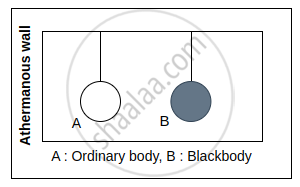
Let R be the emissive power of body A, RB be the emissive power of blackbody B and a be the coefficient of absorption of body A. If Q is the quantity of radiant heat incident on each body in unit time and Qa is the quantity of radiant heat absorbed by the body A, then Qa = a Q. As the temperatures of the body A and blackbody B remain the same, both must emit the same amount as they absorb in unit time. Since emissive power is the quantity of heat radiated from unit area in unit time, we can write
Quantity of radiant heat absorbed by body A = Quantity of heat emitted by body A
or a Q = R ...(1)
For the perfect blackbody B,
Q = RB ...(2)
From Eqs. (1) and (2), we get,
a = `R/Q = R/R_b` ...(3)
From Eq. (3), we get, `R/a = R_b`
By definition of coefficient of emission,
`R/R_b` ...(4)
From Eqs. (3) and (4), we get, a = e.
Hence, the proof of Kirchhoff‘s law of radiation.
At a given temperature, the ratio of emissive power to the coefficient of absorption of a body is equal to the emissive power of a perfect blackbody at the same temperature for all wavelengths:
The wavelength (λm) for which the emissive power of a blackbody is maximum is inversely proportional to the absolute temperature of the blackbody:
With increase in temperature, λm decreases (shifts towards shorter wavelengths). Also, the energy Emax emitted at λm increases with the fifth power of temperature, i.e., Emax ∝ T5.
The rate of emission of radiant energy per unit area (power radiated per unit area) of a perfect blackbody is directly proportional to the fourth power of its absolute temperature:
The area under the spectral curve increases with temperature and is directly proportional to T4.
All bodies at all temperatures above 0 K radiate thermal energy and at the same time, they absorb radiation received from their surroundings.
Key Points
- In gases, the intermolecular forces are very weak, causing the molecules to move apart in all directions.
- Gases have no fixed shape and no fixed size — they can be obtained in a vessel of any shape or size.
- Gases expand indefinitely and uniformly to fill any available space.
- Gases exert pressure on their surroundings.
- Pressure of an ideal gas = ⅔ of mean kinetic energy of translation per unit volume.
- At constant V and T: p ∝ mN — more mass → more molecules → more collisions → higher pressure.
- At constant m and T: p ∝ \[\frac {1}{V}\] — less volume → molecules closer → more collisions → higher pressure.
- At constant m and V: p ∝ T — higher temperature → faster molecules → greater momentum → higher pressure.
- Independence from Pressure: vrms does not depend on the pressure of the gas at constant temperature. If pressure is increased n times, density also increases n times, but vrms remains constant (Boyle's Law: p ∝ ρ).
- Atmosphere of Planets: A planet or satellite will have an atmosphere only if vrms < ve (escape velocity). Moon has no atmosphere because vrms of its gas molecules is greater than escape velocity (ve).
- Heat energy absorbed (Q) depends on mass (m), rise in temperature (Δt), and specific heat capacity (c), i.e., Q ∝ m × Δt × c.
- Heat capacity (C') and specific heat capacity (c) are related by C′ = m × c.
- A perfectly black body absorbs completely the radiations of all wavelengths incident on it — it neither reflects nor transmits any radiation, hence a = 1.
- The colour of an opaque body is the colour (wavelength) of radiation reflected by it. Since a black body reflects no wavelength, it appears black whatever be the colour of radiations incident on it.
- In practice, Ferry's body is considered a perfect black body — the lampblack used in it absorbs 97% of incident energy.
- A perfect black body appears black in light and glows in the dark, because a good absorber is always a good emitter of thermal radiation.
- Every body emits and absorbs heat radiations at all finite temperatures (except 0 K).
- Energy exchange among bodies takes place via radiation.
- If radiation absorbed > emitted → body's temperature increases and it appears hotter.
- At absolute zero (0 K or −273°C), all heat exchange ceases completely.
Concepts [25]
- Gases and Its Characteristics
- Classification of Gases: Real Gases and Ideal Gases
- Mean Free Path
- Pressure of Ideal Gas
- Root Mean Square (RMS) Speed
- Interpretation of Temperature in Kinetic Theory
- Law of Equipartition of Energy
- Degrees of Freedom
- Bonding in Some Homonuclear Diatomic Molecules
- Specific Heat Capacity
- Moyer's Relation
- Monatomic Gases
- Diatomic Gases
- Polyatomic Gases
- Absorption, Reflection, and Transmission of Heat Radiation
- Interaction of Thermal Radiation and Matter
- Perfect Blackbody
- Ferry's Blackbody
- Emission of Heat Radiation
- Coefficient of Emission or Emissivity
- Kirchhoff’s Law of Heat Radiation and Its Theoretical Proof
- Spectral Distribution of Blackbody Radiation
- Wien's Displacement Law
- Stefan-boltzmann Law of Radiation
- Prevost's Theory of Heat Exchange
