Advertisements
Advertisements
Question
You have to perform the experiment, "To identify the different parts of an embryo of a gram seed." Describe the procedure that you would follow.
Advertisements
Solution
The procedure to identify the different parts of an embryo of a gram seed is as follows:
(i) Take some gram seeds and soak them overnight in water.
(ii) Drain the excess water.
(iii) Cover the seeds with a wet cloth and leave them for a day.
(iv) Cut open the seeds carefully and observe the different parts.
We will observe the following parts in the embryo: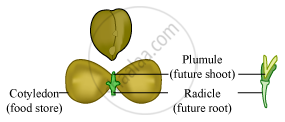
APPEARS IN
RELATED QUESTIONS
Mention the changes a flower undergoes after fertilisation.
Draw a neat sketch of the carpel of a flower. Mark in it stigma, style and ovary.
Which of the following statements are true for sexual reproduction in flowering plants?
(i) it requires two types of gametes
(ii) fertilisation is a compulsory event
(iii) it always results in the formation of zygote
(iv) offsprings formed are clones
(a) (i) and (iv)
(b) (i), (ii) and (iv)
(c) (i), (ii) and (iii)
(d) (ii), (iii) and (iv)
Find the odd-one out, giving reason:
Anther, pollen grain, ovule male gamete
Distinguish between unisexual and bisexual flowers giving one example of each. Draw a diagram showing process of germination of pollen grains on stigma and label the following parts:
(a) Female germ cell
(b) Male germ cell
(c) Ovary
The ovule of an angiosperm is technically equivalent to ______
What would be the number of chromosomes of the aleurone cells of a plant with 42 chromosomes in its roots tip cells?
Draw the diagram of a flower and label the four whorls. Write the names of gamete producing organs in the flower.
The pollen tube usually enters the embryo sac ______.
Given below is a diagram of a germinating seed. Label the parts that:
- gives rise to future shoot.
- gives rise to future root system.
- stores food.