English

Y 2 D X D Y + X − 1 Y = 0 - Mathematics

Advertisements
Advertisements

Question

\[y^2 \frac{dx}{dy} + x - \frac{1}{y} = 0\]


Sum
Advertisements

Solution

We have, 
\[ y^2 \frac{dx}{dy} + x - \frac{1}{y} = 0\]
\[ \Rightarrow y^2 \frac{dx}{dy} + x = \frac{1}{y} \]
\[ \Rightarrow \frac{dx}{dy} + \frac{1}{y^2}x = \frac{1}{y^3} . . . . . . . . \left( 1 \right)\]
Clearly, it is a linear differential equation of the form
\[\frac{dx}{dy} + Px = Q\]
where
\[P = \frac{1}{y^2}\]
\[Q = \frac{1}{y^3}\]
\[ \therefore I . F . = e^{\int P\ dy} \]
\[ = e^{\int\frac{1}{y^2}dy} \]
\[ = e^\frac{- 1}{y} \]
\[\text{ Multiplying both sides of }\left( 1 \right)\text{ by }e^\frac{- 1}{y} ,\text{ we get }\]
\[e^\frac{- 1}{y} \left( \frac{dx}{dy} + x\frac{1}{y^2} \right) = e^\frac{- 1}{y} \frac{1}{y^3}\]
\[ \Rightarrow e^\frac{- 1}{y} \frac{dx}{dy} + x\frac{1}{y^2} e^\frac{- 1}{y} = e^\frac{- 1}{y} \frac{1}{y^3}\]
Integrating both sides with respect to y, we get
\[x\ e^\frac{- 1}{y} = \int e^\frac{- 1}{y} \frac{1}{y^3}dy + C\]
\[ \Rightarrow x\ e^\frac{- 1}{y} = I + C . . . . . . . . \left( 2 \right)\]
where
\[I = \int e^\frac{- 1}{y} \frac{1}{y^3}dy\]
\[\text{Putting }t = \frac{1}{y}, \text{ we get }\]
\[dt = - \frac{1}{y^2}dy\]
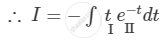
\[ = - t\int e^{- t} dt + \int\left[ \frac{d}{dt}\left( t \right)\int e^{- t} dt \right]dt\]
\[ = t e^{- t} + e^{- t} \]
\[ = \left( t + 1 \right) e^{- t} \]
\[ = \left( \frac{1}{y} + 1 \right) e^{- \frac{1}{y}} \]
\[\text{Putting the value of I in }\left( 2 \right),\text{ we get }\]
\[x\ e^\frac{- 1}{y} = \left( \frac{1}{y} + 1 \right) e^{- \frac{1}{y}} + C \]
\[ \Rightarrow x = \left( \frac{y + 1}{y} \right) + C e^\frac{1}{y} \]
\[\text{Hence, }x = \left( \frac{y + 1}{y} \right) + C e^\frac{1}{y} \text{ is the required solution.} \]

shaalaa.com
  Is there an error in this question or solution?
Chapter 22: Differential Equations - Exercise 22.10 [Page 106]

APPEARS IN

RD Sharma Mathematics [English] Class 12
Chapter 22 Differential Equations
Exercise 22.10 | Q 23 | Page 106

RELATED QUESTIONS

For the differential equation, find the general solution:

`cos^2 x dy/dx + y = tan x(0 <= x < pi/2)`


For the differential equation, find the general solution:

`x log x dy/dx + y=    2/x log x`


For the differential equation, find the general solution:

`x dy/dx + y - x + xy cot x = 0(x != 0)`


For the differential equation, find the general solution:

`(x + y) dy/dx = 1`


For the differential equation, find the general solution:

y dx + (x – y2) dy = 0


For the differential equation, find the general solution:

`(x + 3y^2) dy/dx = y(y > 0)`


For the differential equation given, find a particular solution satisfying the given condition:

`dy/dx - 3ycotx = sin 2x; y = 2`  when `x = pi/2`


Find the equation of the curve passing through the origin given that the slope of the tangent to the curve at any point (x, y) is equal to the sum of the coordinates of the point.


\[\left( 1 + x^2 \right)\frac{dy}{dx} + y = e^{tan^{- 1} x}\]

\[\left( 2x - 10 y^3 \right)\frac{dy}{dx} + y = 0\]

(x + tan y) dy = sin 2y dx


\[\left( x^2 - 1 \right)\frac{dy}{dx} + 2\left( x + 2 \right)y = 2\left( x + 1 \right)\]

\[x\frac{dy}{dx} + 2y = x \cos x\]

\[\frac{dy}{dx} + 2y = x e^{4x}\]

Solve the differential equation \[\left( x + 2 y^2 \right)\frac{dy}{dx} = y\], given that when x = 2, y = 1.


Find the general solution of the differential equation \[x\frac{dy}{dx} + 2y = x^2\]


Find the general solution of the differential equation \[\frac{dy}{dx} - y = \cos x\]


Solve the following differential equation:- \[\left( \cot^{- 1} y + x \right) dy = \left( 1 + y^2 \right) dx\]


Solve the following differential equation: \[\left( \cot^{- 1} y + x \right) dy = \left( 1 + y^2 \right) dx\] .


Find the integerating factor of the differential equation `x(dy)/(dx) - 2y = 2x^2`


Find the integerating factor of the differential equation `xdy/dx - 2y = 2x^2` . 


Solve the following differential equation:

`("x + y") "dy"/"dx" = 1`


Solve the following differential equation:

`(1 - "x"^2) "dy"/"dx" + "2xy" = "x"(1 - "x"^2)^(1/2)`


Find the equation of the curve which passes through the origin and has the slope x + 3y - 1 at any point (x, y) on it.


The integrating factor of `(dy)/(dx) + y` = e–x is ______.


`(x + 2y^3 ) dy/dx = y`


The integrating factor of the differential equation sin y `("dy"/"dx")` = cos y(1 - x cos y) is ______.


The integrating factor of the differential equation (1 + x2)dt = (tan-1 x - t)dx is ______.


Which of the following is a second order differential equation?


Let y = y(x) be the solution curve of the differential equation `(dy)/(dx) + ((2x^2 + 11x + 13)/(x^3 + 6x^2 + 11x + 6)) y = ((x + 3))/(x + 1), x > - 1`, which passes through the point (0, 1). Then y(1) is equal to ______.


If sin x is the integrating factor (IF) of the linear differential equation `dy/dx + Py` = Q then P is ______.


Find the general solution of the differential equation:

`(x^2 + 1) dy/dx + 2xy = sqrt(x^2 + 4)`


If sec x + tan x is the integrating factor of `dy/dx + Py` = Q, then value of P is ______.


The slope of tangent at any point on the curve is 3. lf the curve passes through (1, 1), then the equation of curve is ______.


The slope of the tangent to the curve x = sin θ and y = cos 2θ at θ = `π/6` is ______.


Share
Notifications

Englishहिंदीमराठी


      Forgot password?
Use app×