Advertisements
Advertisements
Question
Answer the following question briefly:
In the context of the Parliamentary form of government, answer the following question:
Why are powers distributed between the central and the state governments?
Advertisements
Solution
As India is a vast country, it is not possible for one central government to take care of the specific needs of people living in different parts of the country. Therefore, the country has been divided into different units, which are called states. Each state has a state government and the processes of the government are shared by the central government and the state governments.
The parliamentary form of government is also present in the states. The pattern is the same-the state executive is formed out of the state legislature, whose members are directly elected by the people.
RELATED QUESTIONS
Choose the correct answer:
The President carries out his/her functions on the advice of the Prime Minister and the__________.
Choose the correct answer:
The President can nominate________members from the Anglo-Indian community to the Lok Sabha.
State whether the following is true or false:
The State List includes subjects of national importance.
State whether the following is true or false:
The money bill has to be introduced in the Rajya Sabha.
Answer the following question briefly:
Give an account of the Lok Sabha with reference to its term.
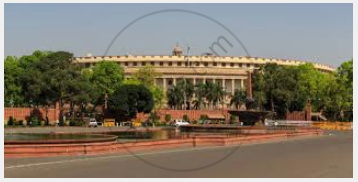
This is the picture of an important government building in India.
What are the basic qualifications of the members of Lok Sabha?
Match the contents of Column A with those of Column B.
| Column A | Column B |
| 1. The speaker | (a) Presides over the Rajya Sabha |
| 2. The Vice President | (b) The legislative organ of the Union Government |
| 3. The Rajya Sabha | (c) The House of People |
| 4. The Parliament | (d) Presiding Officer of the Lok Sabha |
| 5. The Lok Sabha | (e) Permanent House |
Tick mark the correct statement:
The Rajya Sabha is presided over the Vice President of India.
Write short notes on Secret Ballot.
Answer the following question in one or two words/ sentence:
How are the members of the Rajya Sabha elected?
