Advertisements
Advertisements
प्रश्न
Answer the following question briefly:
In the context of the Parliamentary form of government, answer the following question:
Why are powers distributed between the central and the state governments?
Advertisements
उत्तर
As India is a vast country, it is not possible for one central government to take care of the specific needs of people living in different parts of the country. Therefore, the country has been divided into different units, which are called states. Each state has a state government and the processes of the government are shared by the central government and the state governments.
The parliamentary form of government is also present in the states. The pattern is the same-the state executive is formed out of the state legislature, whose members are directly elected by the people.
संबंधित प्रश्न
State whether the following is true or false:
The Vice-President is the presiding officer of the Rajya Sabha.
Answer the following question in one or two words/sentences:
How do we know that the Parliament has supreme authority in the government?
Answer the following question in one or two words/ sentences:
Which branch of government interprets and defines laws?
In the context of the Parliamentary form of government, answer the following question:
Name the three branches of government and state their respective functions.
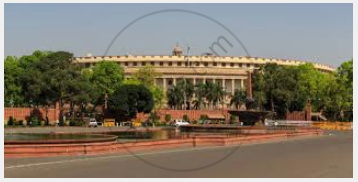
This is the picture of an important government building in India.
What are the basic qualifications of the members of Lok Sabha?
Name the following:
The current Chairperson of the Rajya Sabha.
Name the following:
The current ministers in charge of External Affairs.
Answer the following question:
How are the members to the Lok Sabha elected?
Answer the following question:
What is a bicameral legislature?
Write short notes on Adjournment motion.
