Advertisements
Advertisements
Question
Write the difference between the following -
Non-ethical hacking and Ethical hacking
Advertisements
Solution
Non-ethical hacking:
- A non-ethical hacker is one who tries to gain unauthorized access to computers or networks in order to steal sensitive data with the intent to damage or bring down systems.
- They are called black hat hackers or crackers.
- Their primary focus is on security cracking and data stealing.
- They use their skill for illegal or malicious purposes. Such hackers try to break through system securities for identity theft, monetary gain, to bring a competitor or rival site down, to leak sensitive information, etc.
Ethical hacking:
- Hacking, when done with positive intent, is called ethical hacking.
- Such ethical hackers are known as white hat hackers.
- They are specialists in exploring any vulnerability or loophole during the testing of the software. Thus, they help in improving the security of software.
- An ethical hacker may exploit a website in order to discover its security loopholes or vulnerabilities. He then reports his findings to the website owner.
- Ethical hacking is actually preparing the owner against any cyber attack.
RELATED QUESTIONS
Out of the following, which all comes under cyber crime ?
1) Stealing away a brand new hard disk from a showroom
2) Getting in someone's social networking account without his consent and posting on his behalf
3) Secretly copying data from server of an organization and selling it to the other organization.
4) Looking at online activities of a friends blog.
After a fight with your friend, you did the following activities. Which of these activities is not an example of cyber bullying?
Exploring appropriate and ethical behaviours related to online environments and digital media.
In ethical hacking and cyber security, there are ______ types of scanning.
A research student is expected to write a thesis on a topic. The student browses the Internet for the topic and luckily finds it on the Internet. He copies and submits the entire thesis as his own research work. Which of the following activities appropriately categorizes the act of the writer?
Which of the following crime(s) is/are covered under cybercrime?
- Stealing a brand new hard disk from a shop.
- Get into an unknown person's social networking account and start messaging on his behalf.
- Copying some important data from a computer without taking permission from the owner of the data.
- Working on someone's computer with his/her permission.
Identify the type of cybercrime for the following situations: A person complains that his/her debit/credit card is safe with him still somebody has done a shopping/ATM transaction on this card.
Which of the following is not a type of cybercrime?
The primary law in India dealing with cybercrime and electronic commerce is ______
______ is the crime of obtaining the personal or financial information of another person for the sole purpose of assuming that person's name or identity to make transactions or use it to post inappropriate remarks, comments, etc.
______ is a term used to describe the legal issues related to using of communications technology, particularly "cyberspace", i.e. the Internet.
Which kind of offense out of the following is made by the student who copies someone else's work?
Rishika found a crumpled paper under her desk. She picked it up and opened it. It contained some text which was struck off thrice. But she could still figure out easily that the struck-off text was the email ID and password of Garvit, her classmate. What is ethically correct for Rishika to do?
Match the following:
| Column A | Column B |
| Plagiarism | Fakers, by offering special rewards or money prizes asked for personal information, such as bank account information. |
| Hacking | Copy and paste information from the Internet into your report and then organize it. |
| Credit card fraud | The trail is created when a person uses the Internet. |
| Digital Foot Print | Breaking into computers to read private emails and other files. |
The school offers a wireless facility (wifi) to the Computer Science students of Class XI. For communication, the network security staff of the school has a registered URL schoolwifi.edu. On 17 September 2017, the following email was mass distributed to all the Computer Science students of Class XI. The email claimed that the password of the students was about to expire. Instructions were given to go to the URL to renew their password within 24 hours.
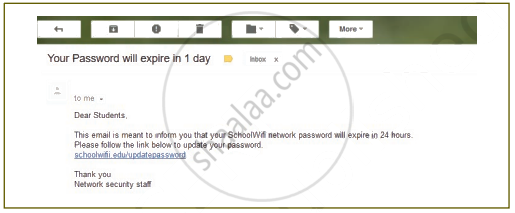
Do you find any discrepancy in this email?
The school offers a wireless facility (wifi) to the Computer Science students of Class XI. For communication, the network security staff of the school has a registered URL schoolwifi.edu. On 17 September 2017, the following email was mass distributed to all the Computer Science students of Class XI. The email claimed that the password of the students was about to expire. Instructions were given to go to the URL to renew their password within 24 hours.
What will happen if the student will click on the given URL?
Describe why it is important to secure your wireless router at home. Search the Internet to find the rules to create a reasonably secure password. Create an imaginary password for your home router. Will you share your password for the home router with the following people? Justify your answer.
- Parents
- Friends
- Neighbours
- Home Tutors
List down the steps you need to take in order to ensure -
your computer is in good working condition for a longer time.
|
Nadar has recently shifted to a new city and school. She does not know many people in her new city and school. But all of a sudden, someone is posting negative, demeaning comments on her social networking profile, etc. She is also getting repeated mails from unknown people. Every time she goes online, she finds someone chasing her online. |
- What is this happening to Nadar?
- What immediate action should she take to handle it?
- Is there any law in India to handle such issues? Discuss briefly.
