Advertisements
Advertisements
Question
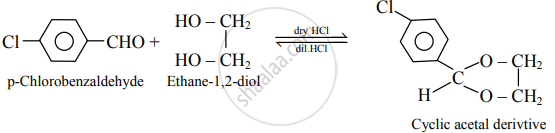
Write reactions for the action of the following reagents on p-chlorobenzaldehyde.
Ethane-1,2-diol in presence of dry HCl.
Advertisements
Solution
RELATED QUESTIONS
Answer in brief.
Formic acid is stronger than acetic acid. Explain.
Write the reducing agent which CANNOT reduce –COOH group.
What is the action of following on proponal?
Hydroxyl amine
What is the action of following on proponal?
Hydrazine
Write reactions for the following conversions.
4-Nitrobenzoic acid to Nitrobenzene
Write chemical reactions to convert –COOH group of acetic acid into the following.
CH4
Write chemical reactions to convert –COOH group of acetic acid into the following.
C2H5OH
Explain the acidic nature of carboxylic acids.
The product of the reaction between dialkyl cadmium and acyl chloride is a/an ____________.
Which of following elements does not form amide when reacted with ammonia?
The elimination of CO2 from a carboxylic acid is known as ____________.
The reducing agent preferred to convert carboxylic acids and esters to primary alcohols is ____________.
The oxidation number of B in NaBH4 is ____________.
Which of the following aromatic acids has less acidic strength than benzoic acid?
Which of the following compounds is obtained when ethanoic anhydride is treated with water?
Which of the following carboxylic acids ha highest acidic strength?
Which oxide of nitrogen is obtained on heating ammonium nitrate at 250°C?
The number of bonding pairs and lone pairs of electrons present in the central atom of ammonia molecular are respectively.
Identify the product ‘B’ in the following sequence of reactions.
\[\ce{\underset{}{Methylpropanoate} ->[Δ][dil. NaOH] \underset{\underset{}{}}{A}->[H+][Conc. HCl] \underset{\underset{}{}}{B}}\]
Which of the following can not be oxidised to give carboxylic acid?
Which among the following is the strongest acid?
