Advertisements
Advertisements
Question
Write down the expression for the elastic potential energy of a stretched wire.
Advertisements
Solution
The work done in stretching the wire by dl,
dW = F.dl
The total work done in stretching the wire from 0 to l is
W = `int_0^"l" "F"."dl"` ..........(1)
From Young’s modulus of elasticity, force becomes,
Y = `"F"/"A" xx "L"/"l" = "YAl"/"L"` ........(2)
Substituting equation (2) in (1) we get,
W = `int_0^"l" "YAl"/"L" "dl"`
Since l is the dummy variable in the integration, we can change l to lʹ(not in limits).
Therefore W = `int_0^"l" "YAlʹ"/"L" "dlʹ" = "YA"/"L"["lʹ"^2/2]_0^"l" = "YA"/"L" "l"^2/2 = 1/2["YAl"/"L"] "l" = 1/2 "Fl"`
W = `1/2` Fl
This work done is known as the elastic potential energy of a stretched wire.
APPEARS IN
RELATED QUESTIONS
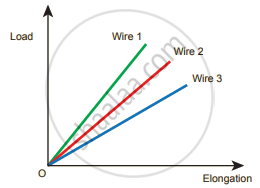
The load-elongation graph of three wires of the same material as shown in the figure. Which of the following wire is the thickest?
The Young’s modulus for a perfect rigid body is __________.
Which of the following is not a scalar?
If the temperature of the wire is increased, then Young’s modulus will __________.
Define stress.
Define strain.
State Hooke’s law of elasticity
Define Poisson’s ratio.
Which one of these is more elastic, steel or rubber? Why?
Why the passengers are advised to remove the ink from their pens while going up in an aeroplane?
