Advertisements
Advertisements
Question
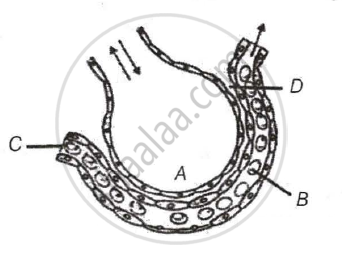
With the help of labelled diagram explain the exchange of gases between alveolus and capillary.
Advertisements
Solution

External respiration is the process of exchange of gases at the alveolar level. Alveoli consist of a layer of simple squamous epithelium resting on a basement membrane. They are intimately associated with a dense network of capillaries. The capillary wall is also made up of simple squamous epithelium resting on a thin basement membrane. Both the layers are thin walled and have similar structure. Together they form the respiratory membrane through which gaseous exchange occurs i.e. between the alveolar air and the blood. Diffusion of gases will take place from an area of higher partial pressure to an area of lower partial pressure until the partial pressure in the two regions reaches equilibrium. The partial pressure of CO2 of blood entering the pulmonary capillaries is 45 mmHg while partial pressure of CO2 in alveolar air is 40 mmHg.
This difference in partial pressure causes diffusion of CO2 from the capillaries into the alveolus. Similarly, partial pressure of O2 of blood in pulmonary capillaries is 40 mmHg while in alveolar air it is 104 mmHg. Due to this difference O2 diffuses from alveoli to the capillaries.
RELATED QUESTIONS
Answer briefly the following:
What is the difference between breathing and respiration?
Short answer question.
Why is it advantageous to breathe through the nose than through the mouth?
Define total lung capacity.
______ is formed when carbon monoxide combines with haemoglobin.
Which of the following is formed in RBCs when CO2 combines with H2O in presence of carbonic anhydrase?
The partial pressures (in mm Hg) of oxygen (O2) and carbon dioxide (CO2) at alveoli (the site of diffusion) are ______
Identify the wrong statement with reference to the transport of oxygen.
Which one has the lowest value?
The figure given below shows a small part of human lung where exchange of gas takes place. In which one of the options given below, the one part A, B, C or D is correctly identified along with its function.
Give function of carbonic anhydrase.
