Advertisements
Advertisements
Question
Why does the poet wish to 'turn' and live with animals?
Advertisements
Solution
The poet Walt Whitman expresses his wish that he can identify himself better with the animals, of their qualities of serenity and calm composure. So he intends to turn towards them, away from his human companions, since they have better values than those of the humans.
APPEARS IN
RELATED QUESTIONS
I think I could turn and live with animals, they are
so placid and self-contain’d
I stand and look at them long and long.
They do not sweat and whine about their condition,
They do not lie awake in the dark and weep for their sins,
They do not make me sick discussing their duty to God,
Not one is dissatisfied, not one is demented with
the mania of owning things.
Not one kneels to another, nor to his kind that
lived thousands of years ago,
Not one is respectable or unhappy over the whole earth.
So they show their relations to me and I accept them,
They bring me tokens of myself, they evince
them plainly in their possession
I wonder where they get those tokens,
Did I pass that way huge times ago and negligently drop them?
(A1) Complete the following sentences with the help of the poem.
(a) The poet wishes he could.............................
(b) Animals do not complain about............................
(c) Animals do not merely discuss.............................
(d) Animals are not crazy about .............................
(A2) The qualities of animals that highlighted by the poet in the poem are
.............................................................................................................
............................................................................................................
..........................................................................................................
(A3) Name and explain the figures of speech.
“I stand and look at them long and long.’’
Notice the use of the word ‘turn’ in the first line, “I think I could turn and live with animals…”. What is the poet turning from?
Do humans kneel to other humans who lived thousands of years ago? Discuss this in groups.
We come across many animals in our vicinity. We have also read about different animals in books. Make a list of all animals that fall under various categories. One is given for you.
| Amphibians | Mammals | Wild Animals | Aquatic Animals | Pet Animals |
| frog | cow | lion | octopus | cat |
Find adjectives from the poem which refer to positive and negative thinking.
| Positive | Negative |
| 1. ................... | 1. ................... |
| 2. ................... | 2. ................... |
| 3. ................... | 3. ................... |
Animals do not complain about ______.
Animals are not crazy about ______.
State whether the following statement is true or false.
Animals quarrel for their possessions.
State whether the following statement is true or false.
Animals do not worship other animals.
State whether the following statement is true or false.
Humans have given up many good qualities.
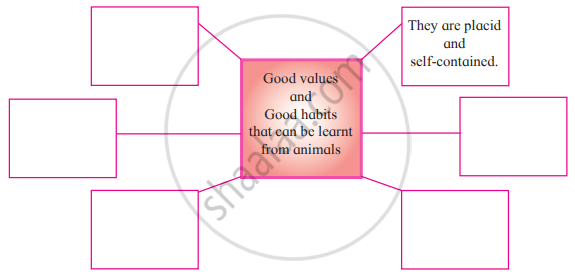
Read the text again, and complete the web, highlighting the good values/habits which we can learn from animals.
Read the following poem and write an appreciation of it with the help of the given points in a paragraph format:
|
Animals I think I could turn and live with animals, they are |
You can use the following points while appreciating the given poem.
- The title and the poet of the poem [1]
- Rhyme scheme [1]
- Figures of speech [1]
- Central Idea/Theme [2]
Justify how ‘Animals’ by Walt Whitman is a criticism of mankind and its ways.
Read the following extract and do the given activities.
A1. State whether the following statements are true or false: (2)
- Animals show their relations to us.
- Humans have given up many good qualities.
- Animals sweat and whine about their condition.
- Animals are placid and self-contained.
| I think I could turn and live with animals, they are so placid and self-contain'd, I stand and look at them long and long. They do not sweat and whine about their condition, They do not lie awake in the dark and weep for their sins, They do not make me sick discussing their duty to God, Not one is dissatisfied, not one is demented with the mania of owning things. Not one kneels to another, nor to his kind that lived thousands of years ago, Not one is respectable or unhappy over the whole earth, So they show their relations to me and I accept them, They bring me tokens of myself, they evince them plainly in their possession. I wonder where they get those tokens, Did I pass that way huge times ago and negligently drop them? |
A2. Answer the following question with the help of the given extract: (2)
(i) What craze do animals never display? Why?
A3. Pick out one example of Rhetorical question from the extract. (1)
Read the following extract and do the given activities.
A1. Match the words from cloud 'A' with cloud 'B': (2)
| Cloud 'A' | Cloud 'B' |
| (a) Stand and look | (i) Not one is demented |
| (b) Not one is dissatisfied | (ii) long and long |
| (c) They do not sweat | (iii) over the whole earth |
| (d) Not one is unhappy | (iv) about their condition |
|
I think I could tum and live with animals, they are -Walt Whitman |
A2. Why does Walt Whitman feel more at home with animals? (2)
A3. Name and explain the figure of speech in the given sentence. (1)
'They bring me tokens of myself'.
Mention any two reasons why Walt Whitman appreciates animals more than humans.
List any two things that animals do and humans don't.
Walt Whitman speaks of the human race with a tinge of sarcasm. Which are the two reasons that you agree with?
'They do not sweat and whine about their condition.' What human traits does the poet condemn in these lines?
