Advertisements
Advertisements
Question
Which of the following rational numbers is the greatest?
Options
`(-17)/24`
`(-13)/16`
`7/(-8)`
`(-31)/32`
Advertisements
Solution
`(-17)/24`
Explanation;
Hint:
L.C.M of 24, 16, 8, 32 = 8 × 2 × 3 × 2 = 96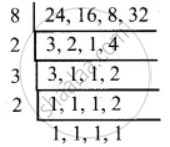
`(-17)/24 = (-17 xx 4)/(24 xx 4) = (-68)/96`
`(-13)/16 = (-13 xx 6)/(16 xx 6) = (-78)/96`
`7/(-8) = (-7 xx 12)/(8 xx 12) = (-84)/96`
`(-31)/32 = (-31 xx 3)/(32 xx 3) = (-93)/96`
`(-93)/96 < (-84)/96 < (-78)/96 < (-68)/96`
`(-31)/32 < 7/(-8) < (-13)/16 < (-17)/24`
∴ `(-17)/24` is the greatest number
APPEARS IN
RELATED QUESTIONS
Compare the following number.
`(-5)/4, 1/4`
Compare the following number.
`-17/20, (-13)/20`
Compare the numbers `5/4 and 2/3`. Write using the proper symbol of <, =, >.
Compare the numbers `(-7)/3 and (-5)/2`.
0 is the smallest rational number
`(-19)/5` is greater than `15/(-4)`
`(-27)/45` and `(-3)/5` represent ______ rational numbers.
Fill in the box with the correct symbol >, < or =.
`3/7 square (-5)/6`
Fill in the box with the correct symbol >, < or =.
`(-9)/7 square 4/(-7)`
Given that `p/q` and `r/s` are two rational numbers with different denominators and both of them are in standard form. To compare these rational numbers we say that:
`p/q = r/s`, if ______ = ______
