Advertisements
Advertisements
Question
What is meant by human circulatory system? Name the organs of the circulatory system in humans.
Advertisements
Solution
The organ system that is responsible for the transport of materials inside the human body is known as the human circulatory system. In human beings, the organs of the circulatory system are the heart, arteries, veins, and capillaries.
APPEARS IN
RELATED QUESTIONS
Explain ABO blood group system in human being with a suitable chart.
Give biological reasons for the following statements:
The left ventricle of the heart has a thicker wall than the right ventricle.
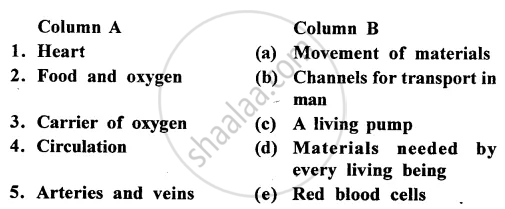
Match the statements in Column A with those in Column B:
What is Diapedesis?
When a doctor is recording your pulse, he is pressing on your wrist exactly on a
Given below is a certain structure, write its chief functional activity.
Lymphocytes - ______.
The table below is designed to indicate the transport of certain substance in our body. Fill in the
blanks with suitable answers.
| Substance | From | To |
| Lungs | Whole body | |
| Carbon dioxide | ||
| Urea | ||
| Digested carbohydrates |
Intestines | |
| Target organs |
pH of oxygenated blood is ______.
Which side of the heart (left or right) contains oxygenated blood?
Multiple choice questions. Tick ( ✓ ) the correct choice:
The blood vessels in which blood goes away from the heart to different body parts are
Describe the functions of the: Blood vessels
How many litres of blood does an adult human body have?
Differentiate between:
Red blood cells and White blood cells
Given below is the simplified pathway of the circulatory system:
(i) Name the blood vessels marked 1 to 8.
(ii) Name the chamber of the heart which:
(a) Receives blood from ‘1’.
(b) Pumps blood into blood vessel ‘8’.
(iii) Mention two structural differences between blood vessels ‘7’ and ‘2’.
_____ gas is transported to all parts of the body.
Match the following.
| Group A | Group B |
| (1) Lungs | (a) Circulation |
| (2) Stomach | (b) Respiration |
| (3) Heart | (c) Co-ordination |
| (4) Brain | (d) Digestion |
What is the location of maturation of T-lymphocytes?
Which of the following is/are required for the production of RBCs?
______ is a granulocyte.
A female has haemophilic brother and parents having nonual blood clotting. She marries a male who has no history of haemophilia in his family. What is the possibility of her children having this disease?
