Advertisements
Advertisements
Question
What do you think the mechanical hand was trying to do?
Advertisements
Solution
The mechanical hand that emerged from the alien spacecraft, was trying to collect samples of soil from the surface of Mars. The purpose was to study if there was life on it.
RELATED QUESTIONS
Find the words in the text which show Ustad Bismillah Khan’s feelings about the items listed below. Then mark a tick (✓ ) in the correct column. Discuss your answers in class.
| Bismillah Khan’s Feelings about | Positive | Negative | Neutral |
| 1. teaching children music | |||
| 2. the film world | |||
| 3. migrating to the U.S.A | |||
| 4. playing at temples | |||
| 5. getting the Bharat Ratna | |||
| 6. the banks of the Ganga | |||
| 7. leaving Benaras and Dumraon |
How does Bill Bryson end up in a “crash position” in the aircraft?
Look at the passage below and study how the personal pronouns refer to different people.
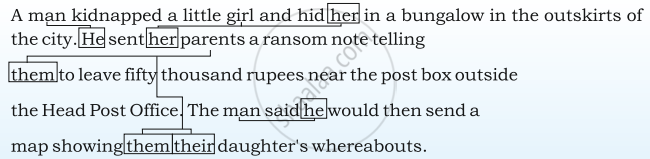
Form pairs - one student will read the text for 'Hockey', and the second student will read the text for 'Football'.
Hockey

The game starts when the umpire blows his whistle for the opening pass-back. The passback is made at the centre of the field to start the game (also after half- time and after each goal is scored). The ball, which may be pushed or hit, must not be directed over the centre line. All players of the opposing team must stand at least 5 yard from the ball and all players of both teams, other than the player making the pass-back must be in their own half of the field.
There are two umpires to control the game and to administer the rules. These umpires are the sole judges of the game. The umpires are responsible for keeping time for the duration of the game.


In front of each goal is an area known as the penalty area. This is a rectangular area, 40.2m wide and extending 16. Sm into the field where the goalkeeper operates.
A standard adult football match consists of two periods of 45 minutes each, known as halves. Each half runs continuously, meaning that the clock is not stopped when the ball is out of play. There is usually a 15-minute half-time break between halves. The end of the match is known as full-time. Anytime during the match, a team can substitute upto three players maximum.
The game is controlled by a referee who is the official timekeeper for the match, and may make an allowance for time lost through substitutions, injured players requiring attention, or other stoppages. There are also two linesmen who keep guard of the touchlines or sidelines, signalling when the ball crosses the boundary lines. The referee alone signals the end of the match.
Handling the ball deliberately, pushing or tripping an opponent, or hitting a player from behind are examples of fouls, punishable by a direct free kick or penalty kick depending on where the offence occurred. Other fouls are punishable by an indirect free kick.
The referee may punish a player's or substitute's misconduct by a caution (yellow card) or sending-off (red card). A player is given a yellow card is said to have been 'booked'.
• Red - Serious misconduct resulting in ejection from the game. If a player has been sent off, no substitute can be brought in his place.
She lighted another match, and then she found herself sitting under a beautiful Christmas-tree. It was larger and more beautifully decorated than the one which she had seen through the glass door at the rich merchant’s. Thousands of tapers were burning upon the green branches, and colored pictures, like those she had seen in the show- windows, looked down upon it all. The little one stretched out her hand towards them, and the match went out.
The Christmas lights rose higher and higher, till they looked to her like the stars in the sky. Then she saw a star fall, leaving behind it a bright streak of fire. “Someone is dying,” thought the little girl, for her old grandmother, the only one who had ever loved her, and who was now dead, had told her that when a star falls, a soul was going up to God.
Read the extract given below and answer the question that follow.
Describe the Christmas tree.
Then, trying to hide my nervousness, I added, “How are you?”
“I’m fine. The question is: How are you?“
“What do you mean?” 1 asked “Something must be eating you,” he said—proud the way foreigners are when they’ve mastered a bit of American slang. “You should be able to qualify with your eyes closed.”
“Believe me, I know it,” I told him—and it felt good to say that to someone.
For the next few minutes we talked together. I didn’t tell Long what was “eating” me, but he seemed to understand my anger, and he took pains to reassure me. Although he’d been schooled in the Nazi youth movement, he didn’t believe in the Aryan-supremacy business any more than I did. We laughed over the fact that he really looked the part, though. An inch taller than I, he had a lean, muscular frame, clear blue eyes, blond hair and a strikingly handsome, chiseled face. Finally, seeing that I had calmed down somewhat, he pointed to the take-off board.
“Look,” he said. “Why don’t you draw a line a few inches in back of the board and aim at making your take-off from there? You’ll be sure not to foul, and you certainly ought to jump far enough to qualify. What does it matter if you’re not first in the trials? Tomorrow is what counts.”
Read the extract given below and answer the question that follow.
Did Owens tell Long what was eating him? If not, why?
Read the extract given below and answer the questions that follow:
"He was not accustomed to facing the entire class and speaking out aloud. He knew that he did not have a flair for making speeches. However, he had worked hard on his assignment and had written it from the depth of his heart." (India's Heroes-Anonymous!
(i) Who was 'he'? What evidence is there that he was not used to facing the entire class?
(ii) What was the assignment? How was our assignment different from the others?
(iii) Who was the first person to feature in 'his' assignment? What did 'he' say about him?
(iv) Who was the General Manager of the Taj Hotel ' What role did he play?
(v) What, according to this speaker, is the only true religion in the world? What human qualities have I been highlighted through 'his' speech?
Complete the following sentences.
i. An ant is the smallest,————————————————————————————————
ii. We know a number of facts about an ant’s life because————————————————————————————————
Complete the following sentence by adding the appropriate part of the sentence given below.
Someone else suggested that the king should have a timetable ____________________.
Complete the sentence below by appropriately using anyone of the following
if you want to/if you don’t want to/if you want him to
Please use my pen_____________________.
What were the notable qualities of the shepherd?
What led the king of Iran to the cave of the shepherd?
What do you think the man said to his friend who waited at the door?
Who was Vijay Singh? What did he look like?
Make a sentence of your own using the word ‘drag.’
Say what you feel about homework. (The words and phrases in the boxes may help you.) Do you think it is useful, even though you may not like it? Form pairs, and speak to each other.
For example:
You may say, “I am not fond of homework.”
Your partner may reply, “But my sister helps me with my lessons at home, and that gives a boost to my marks.”
(not) be fond of
(not) take to
(not) develop a liking for
(not) appeal to
(not) be keen on
(not) have a taste for
- support
- assist
- with the aid of
- help
- be a boon
- give a boost to
What did the author point out about the children in the playground?
With your partner, complete the following sentence in your own word using the ideas in the poem.
English is a __________________ with words that everyone can play.
Which of the given options contains the figure of speech that appears in the following line from Leigh Hunt's poem “The Glove and the Lions’: ‘Ramped and roared the lions’:
Complete the following sentence by providing a reason.
In the short story, Atithi, Motilal Babu and Annapurna choose Tarapada as a prospective groom for their daughter because ______.
