Advertisements
Advertisements
Questions
What are the average fixed cost, average variable cost and average cost of a firm? How are they related?
What is the relationship between average cost, average fixed cost and average variable cost?
Advertisements
Solution
Average Fixed Cost:
It is defined as the fixed cost per unit of output.
`"AFC"="TFC"/Q`
Where,
TFC = Total fixed cost
Q = Quantity of output produced
Average Variable Cost:
It is defined as the variable cost per unit of output.
`"AVC"="TVC"/Q`
Where,
TVC = Total variable cost
Q = Quantity of output produced
Average cost:
It is defined as the total cost per unit of output. Average cost is derived by dividing total cost by quantity of output.
`"AC"="TC"/Q`
AC is also defined as the sum total of average fixed cost and average variable cost.
AC = AFC + AVC
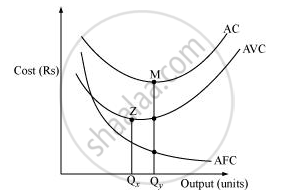
Relationship between AC, AFC, AVC:
- AVC and AFC are derived from AC, as AC = AFC + AVC.
- The plot for AFC is a rectangular hyperbola and falls continuously as the quantity of output increases.
- The minimum point of AVC will always exist to the left of the minimum point of AC; i.e., point ‘Z’ will always lie left to point ‘M’.
- AFC being a rectangular hyperbola falls throughout; this causes the difference between AC and AVC to keep decreasing at higher output levels. However, it should be noted that AVC and AC can never intersect each other. If they intersect at any point, it would imply that AC and AVC are equal at that point. However, this is not possible, as AFC will never be zero because it is a rectangular hyperbola that never touches x-axis. AC inherits its shape from AVC’s shape, and it is because of law of variable proportions that both the curves are U-shaped.
