Advertisements
Advertisements
Question
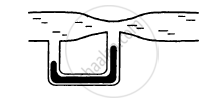
Water flows through the tube shown in figure. The areas of cross section of the wide and the narrow portions of the tube are 5 cm2 and 2 cm2 respectively. The rate of flow of water through the tube is 500 cm3 s−1. Find the difference of mercury levels in the U-tube.
Advertisements
Solution
Given:
Area of cross section of the wide portions of the tube, aa = 5 cm2
Area of cross section of the narrow portions of the tube, ab= 2 cm2
Now, let va and vb be the speeds of water at A and B, respectively.
Rate of flow of water through the tube = 500 cm3/s
\[\Rightarrow v_A = \left( \frac{500}{5} \right) = 100 cm/s\]
From the equation of continuity, we have:
\[ v_A a_A = v_B a_B \]
\[ \Rightarrow \frac{v_A}{v_B} = \frac{a_B}{a_A} = \frac{2}{5}\]
\[ \Rightarrow 5 v_A = 2 v_B \]
\[ \Rightarrow v_B = \left( \frac{5}{2} \right) v_A . . . (i)\]
From the Bernoulli's equation, we have:
\[\frac{1}{2}\rho v_A^2 +ρg h_A + p_A = \frac{1}{2}\rho v_B^2 + ρg h_B + p_B \]
\[ \Rightarrow p_A - p_B = \frac{1}{2}\left[ p\left( v_B^2 - v_A^2 \right) \right]\]
Here,
ρ is the density of the fluid.
pA and pB are the pressures at A and B.
h is the difference of the mercury levels in the U-tube.
Now,
\[h \times 13 . 6 \times 980 = \frac{1}{2} \times 1 \times \frac{21}{4}(100 )^2 [\text{Using }(i)]\]
\[ \Rightarrow h = \frac{21 \times (100 )^2}{2 \times 13 . 6 \times 980 \times 4} [ \because p_A - p_B ]\]
\[ = 1 . 969 cm\]
Therefore, the required difference is 1.969 cm.
