Advertisements
Advertisements
Question
Verify Euler's formula for the following polyhedron:

Advertisements
Solution
In the given polyhedron:
Edges E=16
Faces F=9
Vertices V=9
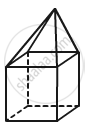
Now, putting these values in Euler's formula:
RHS: F+V
= 9+9
= 18
LHS: E + 2
= 16 + 2
= 18
LHS = RHS
Hence, Euler's formula is satisfied.
RELATED QUESTIONS
Can a polyhedron have for its faces 3 triangles?
The given Figure are prisms or not?
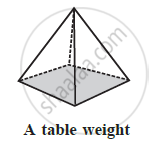
The given Figure are prisms or not?
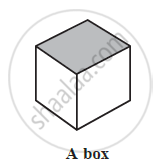
Verify Euler's formula for the following polyhedron:
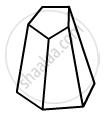
Verify Euler's formula for the following polyhedron:
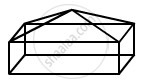
Draw net for the following polyhedron :
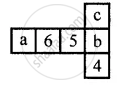
Dice are cubes where the sum of the numbers on the opposite faces is 7. Find the missing numbers a, b and c.
The figure, given below, shows shadows of some 3D object when seen under the lamp of an overhead projector:
A square
In this case, name the object.
The figure, given below, shows shadows of some 3D object when seen under the lamp of an overhead projector:
A rectangle
In this case, name the object.
How many faces does the following solid have?
Hexahedron
