English

Using the method of integration, find the area of the region bounded by the lines 3x − 2y + 1 = 0, 2x + 3y − 21 = 0 and x − 5y + 9 = 0 - Mathematics

Advertisements
Advertisements

Question

Using the method of integration, find the area of the region bounded by the lines 3x − 2y + 1 = 0, 2x + 3y − 21 = 0 and x − 5y + 9 = 0

Sum
Advertisements

Solution

`3"x" - 2"y" + 1 = 0 ⇒ "y"_1 =((3"x"+1))/2` ...........(i)

`2"x" - 3"y" - 21 = 0 ⇒ "y"_2 =((21-2"x"))/3` .....(ii)

`"x" - 5"y" + 9 = 0 ⇒ "y"_3 = (("x"+9))/5` ......(iii)

Point of intersection of (i) and (ii) is A(3, 5)

Point of intersection of (ii) and (iii) is B(6, 3) and

Point of intersection of (iii) and (i) is C(1, 2).
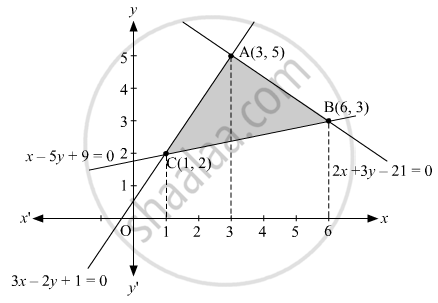
Therefore, the area of the region bounded=`int_1^3"y"_1."dx"+int_3^6"y"_2."dx"-int_1^6"y"_3". dx"`

`=int_3^1((3"x"+1))/2."dx"+int_3^6((21-2"x"))/3."dx"-int_1^6(("x"+9))/5."dx"`

`=1/2((3"x"^2)/2+"x")_1^3+1/3(21"x"-"x"^2)_3^6-1/5("x"^2/2+9"x")_1^6`

`1/2[14]+1/3[36]-1/5[125/2]`

`= 7+12-12.5`

`= 6.5  "sq.units"`

shaalaa.com
  Is there an error in this question or solution?
2018-2019 (March) 65/4/3

Video TutorialsVIEW ALL [1]

RELATED QUESTIONS

Find the area of the region bounded by the parabola y2 = 16x and the line x = 3.


Find the equation of a curve passing through the point (0, 2), given that the sum of the coordinates of any point on the curve exceeds the slope of the tangent to the curve at that point by 5.


Make a rough sketch of the graph of the function y = 4 − x2, 0 ≤ x ≤ 2 and determine the area enclosed by the curve, the x-axis and the lines x = 0 and x = 2.


Sketch the region {(x, y) : 9x2 + 4y2 = 36} and find the area of the region enclosed by it, using integration.


Using integration, find the area of the region bounded by the following curves, after making a rough sketch: y = 1 + | x + 1 |, x = −2, x = 3, y = 0.


Find the area of the region bounded by y =\[\sqrt{x}\] and y = x.


Find the area bounded by the curve y = 4 − x2 and the lines y = 0, y = 3.


Using integration, find the area of the region bounded by the triangle whose vertices are (2, 1), (3, 4) and (5, 2).


Find the area of the region bounded by \[y = \sqrt{x}\] and y = x.


Find the area of the region enclosed by the parabola x2 = y and the line y = x + 2.


Find the area of the region bounded by the parabola y2 = 2x and the straight line x − y = 4.


The area of the region formed by x2 + y2 − 6x − 4y + 12 ≤ 0, y ≤ x and x ≤ 5/2 is ______ .


The area of the region bounded by the parabola (y − 2)2 = x − 1, the tangent to it at the point with the ordinate 3 and the x-axis is _________ .


The area bounded by the parabola y2 = 8x, the x-axis and the latusrectum is ___________ .


The area bounded by the y-axis, y = cos x and y = sin x when 0 ≤ x ≤ \[\frac{\pi}{2}\] is _________ .


The area of the circle x2 + y2 = 16 enterior to the parabola y2 = 6x is


Find the area of the curve y = sin x between 0 and π.


Find the area of the region above the x-axis, included between the parabola y2 = ax and the circle x2 + y2 = 2ax.


The area of the region bounded by the curve y = x2 and the line y = 16 ______.


Using integration, find the area of the region bounded by the line 2y = 5x + 7, x- axis and the lines x = 2 and x = 8.


Draw a rough sketch of the region {(x, y) : y2 ≤ 6ax and x 2 + y2 ≤ 16a2}. Also find the area of the region sketched using method of integration.


Area of the region bounded by the curve y = cosx between x = 0 and x = π is ______.


The area of the region bounded by the line y = 4 and the curve y = x2 is ______. 


Let f(x) be a continuous function such that the area bounded by the curve y = f(x), x-axis and the lines x = 0 and x = a is `a^2/2 + a/2 sin a + pi/2 cos a`, then `f(pi/2)` =


Area lying in the first quadrant and bounded by the circle `x^2 + y^2 = 4` and the lines `x + 0` and `x = 2`.


Find the area of the region bounded by the curve `y^2 - x` and the line `x` = 1, `x` = 4 and the `x`-axis.


Find the area of the region bounded by `y^2 = 9x, x = 2, x = 4` and the `x`-axis in the first quadrant.


Let P(x) be a real polynomial of degree 3 which vanishes at x = –3. Let P(x) have local minima at x = 1, local maxima at x = –1 and `int_-1^1 P(x)dx` = 18, then the sum of all the coefficients of the polynomial P(x) is equal to ______.


Find the area of the smaller region bounded by the curves `x^2/25 + y^2/16` = 1 and `x/5 + y/4` = 1, using integration.


Share
Notifications

Englishहिंदीमराठी


      Forgot password?
Use app×