Advertisements
Advertisements
Question
Using integration, find the area of the region bounded by the line x – y + 2 = 0, the curve x = \[\sqrt{y}\] and y-axis.
Advertisements
Solution
The equations of the given curves are
x2 = y .....(1)
x – y + 2 = 0 .....(2)
The equation (1) represents a parabola that has its vertex at the origin, axis along the positive direction of y-axis and opens upward.
The equation (2) represents a straight line that intersects the x-axis at (–2, 0) and the y-axis at (0, 2).
Solving (1) and (2), we have
\[x^2 = x + 2\]
\[ \Rightarrow x^2 - x - 2 = 0\]
\[ \Rightarrow \left( x - 2 \right)\left( x + 1 \right) = 0\]
\[ \Rightarrow x - 2 = 0 \text { or} x + 1 = 0\]
\[ \Rightarrow x = 2 \text { or} x = - 1\]
When x = 2, y = 2 + 2 = 4
When x = –1, y = –1 + 2 = 1
Thus, the points of intersection of the given curves (1) and (2) are (–1, 1) and (2, 4).
The graph of the given curves is shown below and the shaded region OBDO represents the area bounded by the line and the parabola.
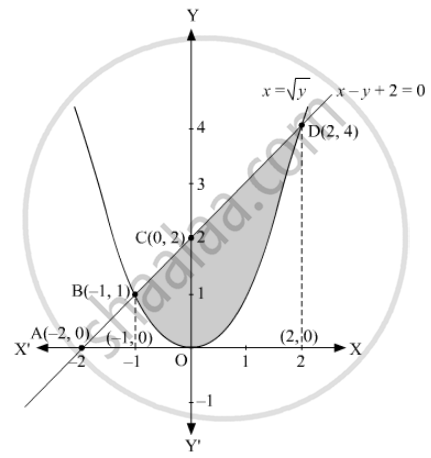
∴ Area of the required region OBDO
\[= \int_{- 1}^2 y_{\text{ line }} dx - \int_{- 1}^2 y_{\text { parabola }} dx\]
\[= \int_{- 1}^2 \left( x + 2 \right)dx - \int_{- 1}^2 x^2 dx\]
\[= \left( \frac{x^2}{2} + 2x \right)_{- 1}^2 - \left( \frac{x^3}{3} \right)_{- 1}^2 \]
\[ = \left[ \left( \frac{4}{2} + 2 \times 2 \right) - \left( \frac{1}{2} + 2 \times \left( - 1 \right) \right) \right] - \left[ \frac{8}{3} - \frac{\left( - 1 \right)}{3} \right]\]
\[ = 6 + \frac{3}{2} - \frac{8}{3} - \frac{1}{3}\]
\[ = \frac{9}{2} \text { square units }\]
Thus, the area of the region bounded by the line and given curve is \[\frac{9}{2}\] square units.
