English

Using Differentials, Find the Approximate Value of the Following up to 3 Places of Decimal (0.999)^(1/10) - Mathematics

Advertisements
Advertisements

Question

Using differentials, find the approximate value of the following up to 3 places of decimal

`(0.999)^(1/10)`

Advertisements

Solution

`(0.999)^(1/10)`
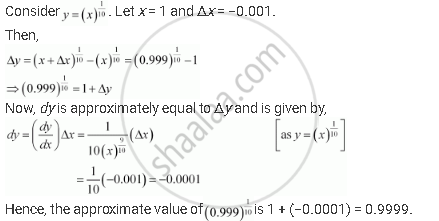
shaalaa.com
  Is there an error in this question or solution?
Chapter 6: Application of Derivatives - Exercise 6.4 [Page 216]

APPEARS IN

NCERT Mathematics Part 1 and 2 [English] Class 12
Chapter 6 Application of Derivatives
Exercise 6.4 | Q 1.5 | Page 216

Video TutorialsVIEW ALL [2]

RELATED QUESTIONS

Using differentials, find the approximate value of the following up to 3 places of decimal

`sqrt(49.5)`


Using differentials, find the approximate value of the following up to 3 places of decimal

`(0.009)^(1/3)`


Using differentials, find the approximate value of the following up to 3 places of decimal

`(255)^(1/4)`


Using differentials, find the approximate value of the following up to 3 places of decimal

`(401)^(1/2)`


Using differentials, find the approximate value of the following up to 3 places of decimal

`(26.57)^(1/3)`


Using differentials, find the approximate value of the following up to 3 places of decimal

`(3.968)^(3/2)`


Find the approximate change in the volume V of a cube of side x metres caused by increasing side by 1%.


If f (x) = 3x2 + 15x + 5, then the approximate value of (3.02) is

A. 47.66

B. 57.66

C. 67.66

D. 77.66


The approximate change in the volume of a cube of side x metres caused by increasing the side by 3% is

A. 0.06 x3 m3 

B. 0.6 x3 m3

C. 0.09 x3 m3

D. 0.9 x3 m3


The normal at the point (1, 1) on the curve 2y + x2 = 3 is

(A) x + y = 0

(B) x − = 0

(C) x + y + 1 = 0

(D) − y = 1


The normal to the curve x2 = 4y passing (1, 2) is

(A) x + y = 3

(B) x − y = 3

(C) x + = 1

(D) x − = 1


The points on the curve 9y2 = x3, where the normal to the curve makes equal intercepts with the axes are

(A)`(4, +- 8/3)`

(B) `(4,(-8)/3)`

(C)`(4, +- 3/8)`

(D) `(+-4, 3/8)`


Find the approximate value of log10 (1016), given that log10e = 0⋅4343.


Show that the relative error in computing the volume of a sphere, due to an error in measuring the radius, is approximately equal to three times the relative error in the radius ?


Using differential, find the approximate value of the following: \[\left( 0 . 007 \right)^\frac{1}{3}\]


Using differential, find the approximate value of the \[\sqrt{401}\] ?


Using differential, find the approximate value of the \[\frac{1}{(2 . 002 )^2}\] ?


Using differential, find the approximate value of the \[\frac{1}{\sqrt{25 . 1}}\] ?


Using differential, find the approximate value of the \[\cos\left( \frac{11\pi}{36} \right)\] ?


Using differential, find the approximate value of the \[\sqrt{26}\] ?


Using differential, find the approximate value of the \[\left( \frac{17}{81} \right)^\frac{1}{4}\] ?


A piece of ice is in the form of a cube melts so that the percentage error in the edge of cube is a, then find the percentage error in its volume ?


If there is an error of a% in measuring the edge of a cube, then percentage error in its surface is


The height of a cylinder is equal to the radius. If an error of α % is made in the height, then percentage error in its volume is


If loge 4 = 1.3868, then loge 4.01 =


A sphere of radius 100 mm shrinks to radius 98 mm, then the approximate decrease in its volume is


If y = xn  then the ratio of relative errors in y and x is


The approximate value of (33)1/5 is


The circumference of a circle is measured as 28 cm with an error of 0.01 cm. The percentage error in the area is


Find the approximate values of: `root(3)(28)`


Find the approximate values of : cot–1 (0.999)


Find the approximate values of : tan–1 (1.001)


Find the approximate values of : 32.01, given that log 3 = 1.0986


Find the approximate value of (1.999)5.


Share
Notifications

Englishहिंदीमराठी


      Forgot password?
Use app×